

How to Secure Customer Data in Salesforce with a Biometric Login System?
Millions of enterprise accounts get hacked every year not due to penetration by bypassing the firewall but simply by logging in. Hackers have always found password thefts, credential reuse, and phishing as the most consistent means of gaining access to CRM applications. And for enterprises who hold sensitive data within Salesforce, it is becoming a major risk that conventional security measures find hard to contain.
The shift toward Salesforce biometric login and authentication is not just a technology trend. It reflects a hard-won recognition that identity itself is the new perimeter. And when that identity layer is built directly into your CRM, the implications for customer data security, regulatory compliance, and fraud prevention are significant.
The Hidden Connection Between Identity Verification and CRM Security
Accessing Salesforce is one thing; ensuring that the customer whose information is residing in your CRM system is indeed the one he or she claims to be is another.
This is precisely where Know Your Customer (KYC) comes into play when it comes to CRM security strategy. Since the identification of the customer using his or her biometric-linked identity data will ensure higher trust throughout the interactions, fraudulent users can be caught much earlier in the cycle.
The Aadhaar-based verification, which links the customer’s biometric identity to the verified government records, is one such verification method. By integrating the verification process natively into Salesforce at the time of onboarding, the audit trail becomes tamper-proof and compliant.
Manras Technologies addresses exactly this layer through IdentryX, a Salesforce-native KYC and identity verification solution. IdentyX allows for artificial intelligence–powered fraud detection, OCR-based document verification, and facial recognition in the Salesforce context. Instead of adding an external identity verification solution, they have a cohesive verification process that is automatically integrated with their CRM records.
This is especially relevant in the context of Salesforce Aadhaar verification use cases. Industries working in regulated markets like banking, insurance, and telecommunications require KYC procedures that are compliant and yet do not create friction for customer onboarding. Since the identification is done upfront via biometrics, the subsequent records in Salesforce become a lot more reliable.
Authentication Methods Compared: Where Biometrics Stand Out
| Authentication Method | Security Level | User Experience | Fraud Risk | Enterprise Readiness |
| Passwords | Low | Moderate | High | Limited |
| OTP / SMS MFA | Moderate | Low (friction) | Moderate | Partial |
| App-Based MFA | Moderate | Moderate | Moderate | Good |
| Face Recognition | High | High | Low | Strong |
| Fingerprint Authentication | High | High | Low | Strong |
| Biometric + Identity Verification | Very High | High | Very Low | Excellent |
The table above illustrates a clear pattern. Each step away from passwords and toward biometric authentication improves both the security outcome and the user experience. Biometric authentication combined with identity verification delivers the strongest posture across all four dimensions.
For enterprise Salesforce environments, this matters beyond internal access control. It affects how customers experience secure onboarding, how compliance teams demonstrate regulatory readiness, and how fraud prevention teams can act on verified identity signals within the CRM.
The Approach Being Adopted for Biometric-Integrated CRM Platforms by Modern Businesses
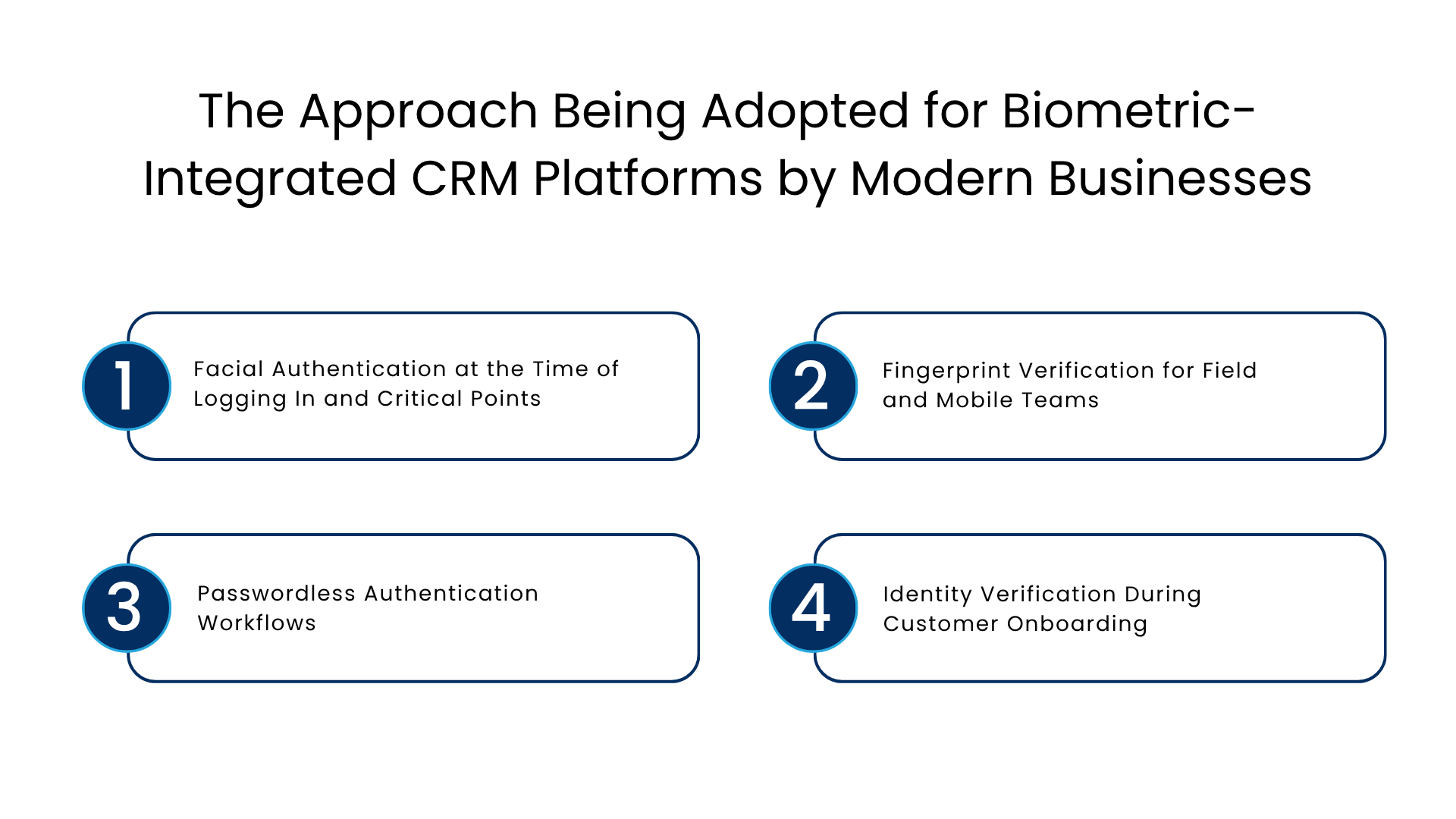
Businesses which are incorporating the biometric verification system into Salesforce are doing so without changing their entire technology ecosystem.
Facial Authentication at the Time of Logging in and Critical Points
In facial authentication, there is an inclusion of a liveness check that ensures the presence of the person logging in, and his identity is confirmed through this verification procedure. This may be initiated at the time of first log-in, or in some critical activities such as bulk export of data or access to sensitive customer information in Salesforce.
As opposed to a password or token, a face cannot be phished. A face cannot be sent through SMS. The combination of session monitoring and face authentication makes security teams more secure.
Fingerprint Verification for Field and Mobile Teams
The use of the sales representative or field service employee using the Salesforce application on his/her smartphone often occurs in an environment where it is not practical to enter a password or launch an authentication app. This makes fingerprint authentication more convenient for them and enhances their security.
Passwordless Authentication Workflows
Passwordless authentication removes the credential entirely. Instead of a username and password pair, access is granted through a verified biometric signal, a cryptographic device key, or a combination of both. For Salesforce administrators managing large org deployments, moving toward passwordless ecosystems reduces helpdesk overhead, eliminates password reset vulnerabilities, and simplifies the authentication audit trail.
Identity Verification During Customer Onboarding
The most impactful integration point is not internal login at all. It is the moment a new customer enters the CRM. When biometric identity verification is embedded in the onboarding flow, organizations can confirm identity before a record is ever created in Salesforce. This prevents fraudulent accounts from entering the system in the first place.
Industry Snapshot: Where Biometric-Enabled CRM Systems Are Making a Difference
- Banking and Financial Services: When banks onboard customers, they authenticate users through facial recognition and use document optical character recognition to validate identity in real time. Records captured through Salesforce have a verified biometric stamp and minimize fraud in future and help with AML compliance.
- Insurance: Insurance policies have large volumes of personal information. Insurance companies with native identity verification solutions in Salesforce can verify the identity of the applicant prior to underwriting and minimize risks of fraud.
- Real Estate: Real estate developers and brokers dealing with high value transactions have to verify the identity of buyers before entering into any agreement. With biometrically validated CRM solutions, you can make sure that the customer record has a verified identity before any transaction takes place.
- Telecoms: High fraud rate in telecoms comes from SIM swap fraud and identity theft. With biometrically validated CRM, telecoms can ensure that callers can verify identity in real time before any action is taken without moving agents out of the Salesforce flow.
- B2B Enterprises: Enterprises operating partner portals and customer communities through Salesforce Experience Cloud can ensure that users undergo identity verification in high-risk scenarios like contract review or accessing financial information.
The Future of Customer Trust Will Depend on Identity
The trajectory is becoming clear. Passwords are being phased out. Static MFA is being challenged. And the organizations that build robust, biometric-linked identity frameworks into their core systems now will be significantly better positioned for the regulatory and security environment that is already emerging.
Several developments will shape this shift over the next few years.
- AI-driven identity verification is already improving liveness detection accuracy, reducing false positives, and making continuous authentication more practical. Rather than authenticating once at login, systems can monitor behavioral biometrics such as typing cadence and session patterns to flag anomalies in real time.
- Continuous authentication moves security from a one-time gate to an ongoing assurance model. In a Salesforce context, this means that access permissions can dynamically adjust based on user behavior, session context, and risk signals, without interrupting the workflow.
- Passwordless ecosystems supported by frameworks like FIDO2 and WebAuthn are gaining adoption across enterprise platforms. As Salesforce extends its identity infrastructure, organizations that have already invested in biometric identity verification will be better placed to adopt these standards without rebuilding their access control model from scratch.
- Digital trust is not just a security concept. It is becoming a competitive differentiator. Customers who know their identity is protected through verified biometric authentication interact with more confidence. And regulators are increasingly treating identity verification not as a best practice but as a baseline requirement.
Securing Salesforce Starts with Getting Identity Right
The discussion of secure customer data in Salesforce must not revolve around just the network and permission settings. It must begin with identifying users – who are those logging in and how sure are we about their identity? Whose data is being uploaded, and how sure are we of the user’s identity before creating such a record?
Salesforce biometric login solves the former challenge. Salesforce KYC/identity verification solves the latter one. In combination, this changes the security strategy from reactive to proactive and from being based on credentials to being identity centric.
For organizations willing to create a safer Salesforce environment, solutions that move identity verification into the CRM environment rather than having it as an additional step should be evaluated. IdentryX offers such a Salesforce native solution combining face recognition, Aadhaar verification, OCR document processing, and AI fraud detection into one package.
Getting identity right is not a one-time project. It is the foundation every other layer of CRM security is built on.
FAQs
What is Salesforce biometric login?
Salesforce biometric login is when one uses a biometric factor as part of the process to gain access to a Salesforce environment. The system verifies the identity of the user based on something like a fingerprint or facial recognition in real time, instead of asking for a password.
In what ways does biometric authentication in Salesforce make security better than standard MFA?
The standard multi-factor authentication involves something that the user has, like a phone or a token that might be easily stolen, shared or intercepted. Biometric authentication is tied to something that is specific about the user themselves, thus providing better protection against session hijacking and credential theft. Also, biometric authentication makes it harder to trick a user into confirming fraudulent push notifications.
Is there any way to integrate Salesforce natively for identity verification and KYC in the CRM?
There is no way to do KYC natively within Salesforce. However, a Salesforce native solution like IdentryX by Manras would provide all the needed functionality including Aadhaar verification, document OCR, face authentication and fraud detection in the Salesforce environment.
Which industry sectors can take maximum advantage of biometric CRM systems?
These sectors have to follow KYC and AML laws, have higher cases of identity theft, and need verification of customer identity at several points during the customer life cycle. Using biometrics in Salesforce can save time and improve compliance.
What is Passwordless Authentication, and how can it be used in Salesforce implementations?
Passwordless authentication involves using no password at all, using biometric authentication instead, hardware security keys, and cryptographic device credentials. Passwordless authentication is becoming more viable with respect to enterprise Salesforce implementations as FIDO2 and WebAuthn become more widely supported. Organizations that use biometric identity verification at this point will be in a good position to move towards a full passwordless ecosystem.
For more insights, updates, and expert tips, follow us on LinkedIn.


Comment (01)