

Salesforce Staff Augmentation Vs Hiring Full-time Employees: Which is Better For Startups?
Every founder hits this wall eventually. Your Salesforce org needs work, but you cannot decide whether to hire someone full time or bring in outside help. Get it wrong, and you either overpay for a role you do not need yet, or you understaff a system that runs your entire revenue pipeline.
This decision matters more for startups than for larger companies. You have less room for a bad hire, less time to wait through a long recruitment cycle, and less budget to carry someone through a slow ramp-up. Choosing between Salesforce staffing solutions and a permanent hire is really a question of timing, workload, and how much control you need over the work.
Why This Decision Feels Harder Than It Should Be
Salesforce is not a simple tool you can hand to whoever is free. It touches sales, marketing, service, and finance data all at once. A messy implementation early on creates cleanup work for years.
At the same time, startups rarely have steady, predictable Salesforce workloads. Some months you need heavy configuration work. Other months you barely touch the system. That unevenness is exactly what makes the hiring decision tricky.
The Salesforce talent pool adds yet another complication. An economic impact study conducted by IDC and commissioned by Salesforce estimated that there would be a net creation of 11.6 million jobs and 2 trillion dollars worth of business revenue created in the Salesforce ecosystem from 2022 to 2028. Such kind of high demand makes talent gravitate to whoever offers the best pay, and startups seldom emerge victorious in such situations.
What Full-Time Hiring Actually Costs
Founders often underestimate what a full-time Salesforce hire costs beyond salary. Recruiting, onboarding, benefits, and ramp-up time all add up quickly.
According to SHRM benchmarking figures, the cost per hire for non-executive positions ranges high enough that even after including recruitment, screening, and interview time, it is far above the stated pay scale, while more than two out of three organizations found themselves unable to hire for the open positions in 2026. For a start-up on a budget, the difference between “We need to hire someone” and “This person is being productive” can take many months.
Here is a rough breakdown of what goes into a full-time hire beyond the paycheck:
- Recruiter or agency fees, often 15 to 25 percent of first-year salary
- Interview time from founders or team leads, which is time not spent on the product
- Onboarding and training before the person is fully independent
- Benefits, payroll taxes, and equipment
- Severance risk if the role does not work out
None of this means full-time hiring is a mistake. It means the decision needs real math behind it, not a gut call made during a busy sprint.
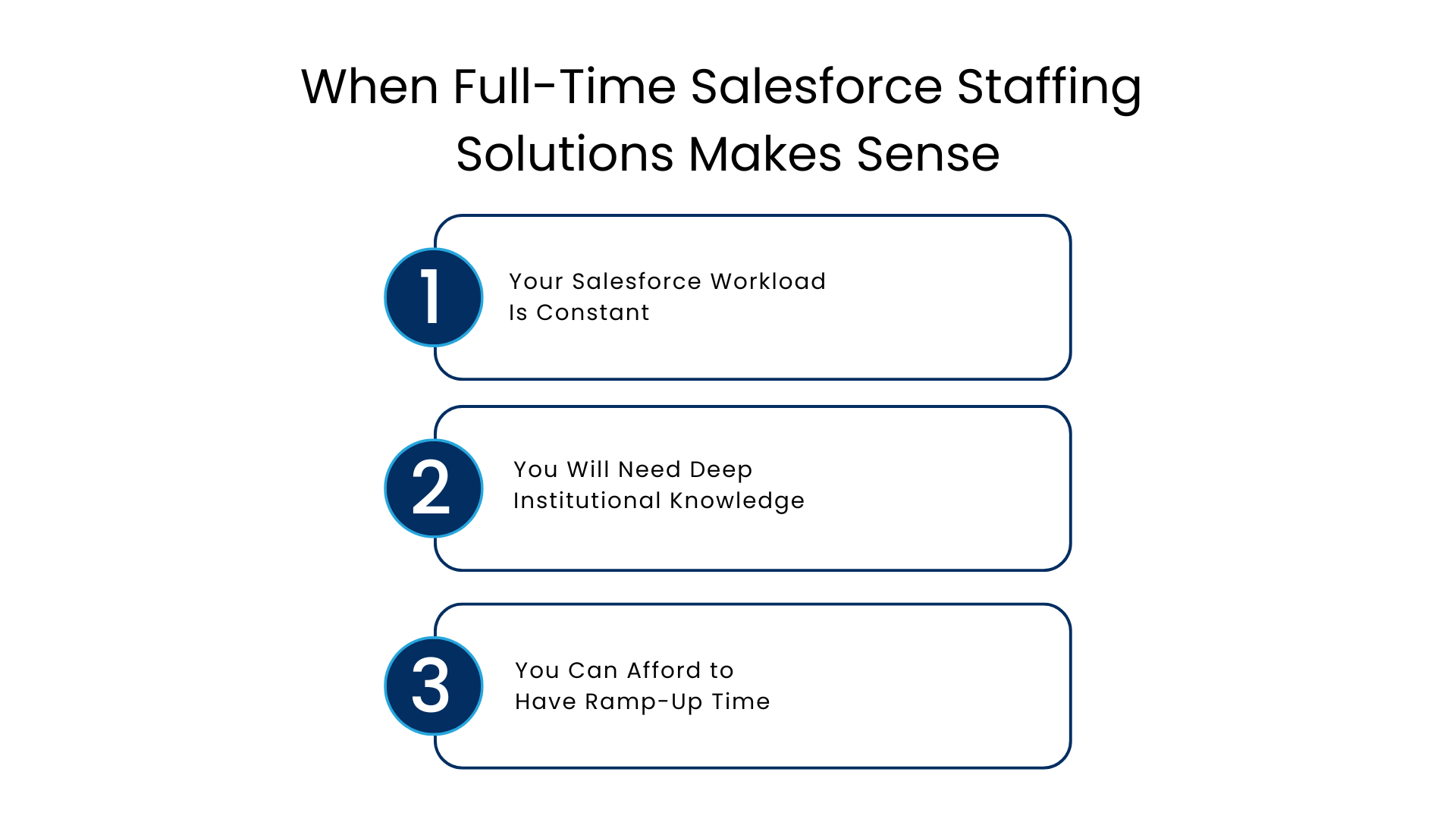
When Full-Time Salesforce Staffing Solutions Makes Sense
Certain situations genuinely call for a permanent employee rather than outside help.
Your Salesforce Workload Is Constant
If your team touches Salesforce every single day, building new automations, fixing user issues, training new sales reps, a dedicated person embedded in your company makes sense. Constant, varied work is where full-time Salesforce developers shine.
You Will Need Deep Institutional Knowledge
Certain startups develop Salesforce setups that are very unique and closely coupled with their business model. Someone who exists in this system on a day-to-day basis creates context that cannot be easily recreated by outsiders.
You Can Afford to Have Ramp-Up Time
The first month on the job is typically when someone is not very productive. If your startup runway can support three to six months of ramp-up time, then a full-time hire makes sense.
When Salesforce Staff Augmentation Services Make More Sense
Now flip the scenario. Many startups do not have year-round, predictable Salesforce work. They need a big push during implementation, then lighter maintenance after.
This is where the strength of utilizing the Salesforce staffing solutions lies. You get to hire professionals certified in specific skill sets for the time that you require, without necessarily putting them on your payroll.
Scenario One: Post-Funding Implementation Sprint
A seed-stage SaaS startup just closed its Series A and needs Salesforce set up properly before the sales team doubles. This is a defined, time-bound project. Staff augmentation lets the founder bring in a certified consultant for eight weeks instead of committing to a twelve-month salary for work that will taper off after launch.
Scenario Two: Specialized Skill Gap
The current admin of the startup is very good at handling daily tasks, but does not have any experience in developing an integration between Salesforce and the external billing software. The alternative to hiring a specialist on a permanent basis would be staff augmentation with the required skills.
Scenario Three: Coverage During Growth Spurts
A startup scaling its sales team from ten reps to forty needs extra hands fast. Recruiting a full-time admin takes weeks the business does not have. Augmented staff can start almost immediately and scale down once the growth spurt levels off.
A Side-by-Side Comparison
| Factor | Full-Time Employee | Salesforce Staffing Solutions |
| Time to start | Weeks to months | Days to a couple of weeks |
| Cost structure | Salary, benefits, taxes, overhead | Project or hourly rate, no benefits overhead |
| Best for | Ongoing, daily Salesforce work | Defined projects, spikes, or skill gaps |
| Flexibility | Fixed commitment | Scale up or down as needed |
| Institutional knowledge | Builds over time | Limited unless engagement is extended |
| Access to specialists | Limited to what you can recruit | Broad access to niche certified skills |
Building a Simple Decision Framework
Instead of guessing, run your situation through three questions.
How consistent is the workload? If there is Salesforce work every single week on an individual’s calendar, go ahead and choose full-time. However, if the Salesforce workload occurs in spurts, then the answer would be staff augmentation.
How unique is the requirement? It is easier to permanently hire for general administrative activities. Unique requirements like custom integrations, data migration, or even niche configurations are usually less expensive and quicker to acquire from external vendors.
What can your runway support? Start-ups in their early stages of development usually do not have the budget capacity for permanent hiring.
A hybrid model also works well for many startups. Keep a full-time admin for daily operations and bring in Salesforce staff augmentation services for bigger projects like implementations, custom development, or Salesforce consulting services around a major system overhaul. For ongoing maintenance and health checks between projects, Salesforce Managed Services can fill the gap without adding headcount.
What to Look for When You Choose Augmented Talent
Not all staffing options are created equally. Before hiring Salesforce developers or hiring a Salesforce consultant via the augmentation model, you need to make sure that the option you chose is:
- Salesforce-certified in accordance with your project and not only certified as Salesforce Admins
- Has experience working with startups, and not only enterprise clients
- Is clear on the project scope and timeline, and the handoff process
- Is flexible enough to adjust to changing requirements
When it comes to hiring Salesforce professionals via the Salesforce implementation partner, and not a freelance developer, it’s also important to understand the handoff process in case of termination of the cooperation.
In the best case scenario, there should be documentation and some training left after the work is done. The providers offering both Salesforce Implementation Services and other services are more likely to do so, as they will have knowledge continuity during all stages of work.
Conclusion
There is no universal right answer here. A ten-person startup mid-implementation needs something different from a fifty-person company with daily Salesforce operations. The honest starting point is looking at your actual workload pattern over the last six months, not what you assume it will be.
If the work is steady and deep, invest in a full-time hire. If it is project-based, specialized, or urgent, Salesforce staffing solutions gets you moving faster without a long-term commitment. Many startups end up blending both as they grow.
Whether it is the path for you depends on where you are at right now. An internal review of where you are with your Salesforce system right now, combined with a conversation with an implementation partner, will make the choice clear.
FAQs
Is Salesforce staff augmentation more costly than employing full-time employees?
No, usually not. Augmentation will save you on recruitment cost, benefits, and training time, making it typically less expensive for specific projects.
Will I be able to make the Salesforce consultant working as an augmentation candidate my full-time employee?
Yes. Many startups initially engage in augmentation to assess the candidate’s ability, with the intention to offer him or her a full-time position later.
How quickly can the augmented Salesforce staff be integrated?
Much quicker than in case of regular recruitment. Many augmentations start immediately because there is no need to go through a long interview and negotiation process.
Will I lose the control over the project with staff augmentation?
Absolutely not. While the project direction remains under your control, the staffing partner will take care of finding and managing the workforce for your project.
At what stage of growth is a startup more suited to receive staff augmentation services?
The startups that stand to gain the most are those which are young and in the process of growing and have changing workloads when using Salesforce. Most startups tend to combine their usage of augmentation services with some light Salesforce Support Services after completing their projects.
Do I need to hire my Salesforce admin support if I use augmentation in large projects?
Not necessarily. Some startups survive on pure augmentation services alone while others only hire their admin support part-time for routine tasks and use augmentation for large projects.
For more insights, updates, and expert tips, follow us on LinkedIn.