

How AI and Automation Are Reshaping CPQ to Revenue Cloud Migration Strategies
For years, Salesforce CPQ was the standard for enterprise configure-price-quote processes. It solved the right problem at the right time: getting complex product configurations and pricing logic out of spreadsheets and into a governed, repeatable system.
But the way enterprises generate, manage, and grow revenue has shifted considerably. Subscription models, usage-based pricing, complex renewal cycles, and real-time revenue intelligence are now table stakes for competitive B2B organizations.
That is precisely why CPQ to Revenue Cloud migration has moved from a roadmap consideration to an active strategic priority for enterprise RevOps leaders. And what is accelerating both the urgency and the feasibility of this shift is AI and automation.
The combination is not just speeding up migration timelines. It is changing how organizations approach the entire transformation, from pre-migration discovery through post-go-live revenue lifecycle management.
This article breaks down where AI and automation are making the most practical difference, what migration risks remain underestimated, and how to structure a CPQ to Revenue Cloud transition that delivers measurable RevOps outcomes.
Why Are Enterprises Moving Beyond Salesforce CPQ?
Salesforce CPQ is a capable tool within a defined scope. It handles product catalog logic, pricing rules, discount approvals, and quote generation well. Where it begins to strain is at the edges of the modern revenue lifecycle.
CPQ was built around a transactional revenue model – a rep creates a quote, it gets signed by the customer, and the deal is closed. This simple motion does not match the reality of enterprise revenue today. Companies are dealing with subscription amendment management, mid-term upsells, co-termination among different products, and renewal automation across thousands of customers all at once. Building such capabilities on top of existing CPQ deployments leads to overly fragile customization, slow quotation, and revenue recognition problems causing potential risks for audits.
Revenue Cloud, particularly Revenue Cloud Advanced, solves this issue by changing the architecture of the solution entirely. This reimagines the revenue system not as a quote builder linked with CRM but as a full-fledged revenue lifecycle platform where pricing, billing, contracts, and forecasting all run under one data model.
The Operational Gap That Drives Migration
The core operational gap is this: CPQ operates upstream of revenue. Everything that happens after the quote closes (billing, subscription management, renewals, amendments, revenue recognition) typically lives in disconnected systems. Finance runs on ERP. Billing runs on a third-party platform. Subscription data sits in spreadsheets or a homegrown tool.
Revenue Cloud closes that gap. When billing automation, subscription management, and revenue intelligence all operate within the same Salesforce environment, the quote-to-cash workflow becomes a single governed process rather than a handoff between systems.
AI in Data Mapping and Transformation
The data mapping phase during the migration of a Salesforce CPQ to the Revenue Cloud has historically been high-risk because product catalog information, pricing information, and contractual details must be mapped appropriately to fit the data model in Revenue Cloud. Mismapping in the initial phase creates a domino effect leading to billing issues, revenue recognition problems, and renewal process failures.
An AI-assisted tool for mapping makes this process safer since it performs pattern matching between the source object and target schema, highlights ambiguous mappings to be manually checked, and generates a transformation formula that can then be verified without affecting live data.
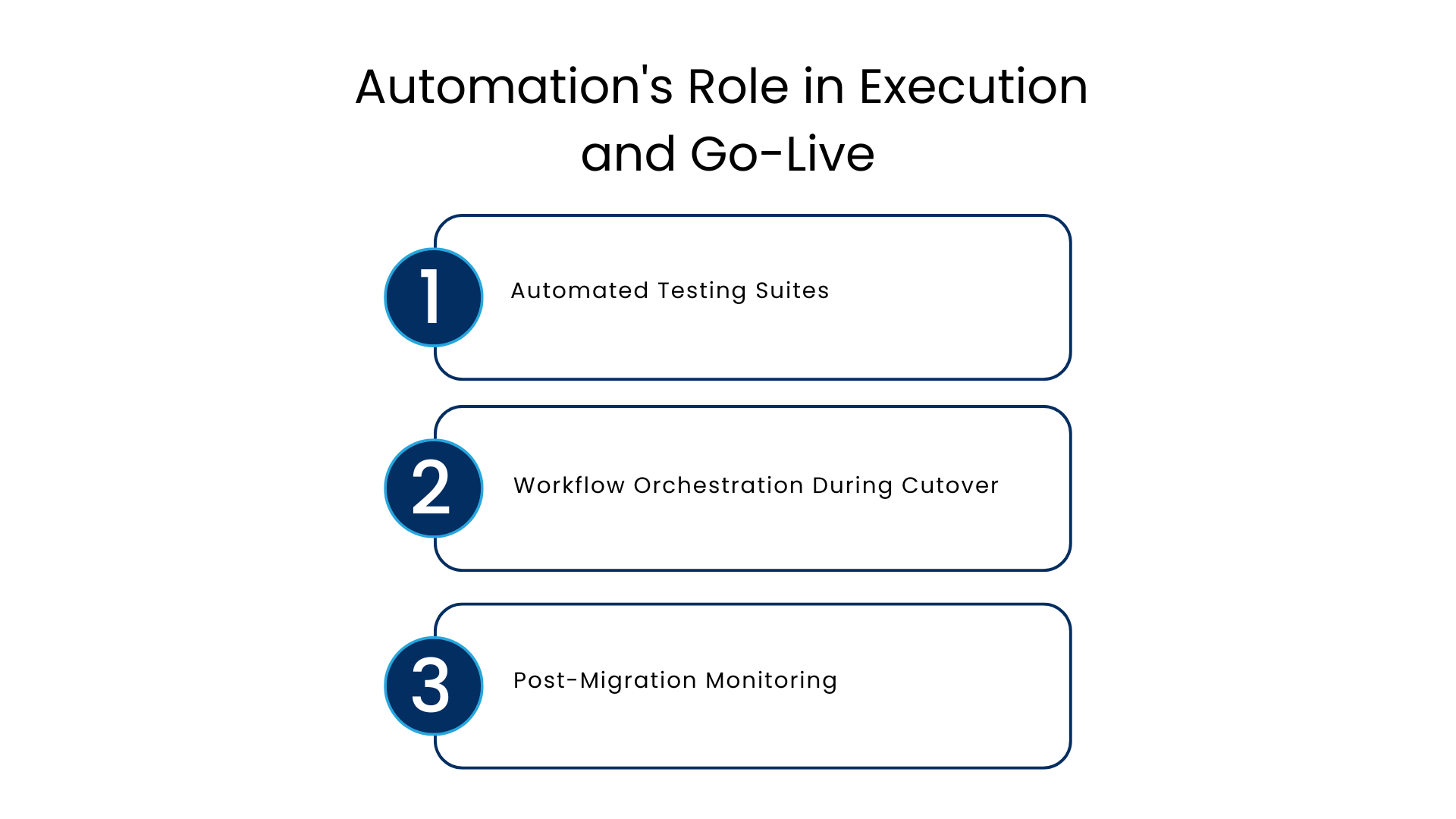
Automation’s Role in Execution and Go-Live
Even with excellent pre-migration planning, execution introduces risk. Parallel testing, data validation, cutover sequencing, and user acceptance testing across multiple business units require orchestration that manual project management struggles to maintain at enterprise scale.
Automation brings structure to execution in several ways.
Automated Testing Suites
Revenue Cloud migrations benefit from automated regression testing that validates quote output, billing triggers, and approval flows after each configuration change. Rather than relying on manual QA cycles that slow-release velocity, automated test suites run continuously and flag deviations immediately.
Workflow Orchestration During Cutover
Cutover from CPQ to Revenue Cloud is not a single switch event in most enterprise environments. It involves sequencing the migration of active contracts, open quotes, renewal pipelines, and billing schedules without disrupting live customer accounts. Automated workflow orchestration tools help manage this sequence, reducing the window of dual-system operation and the associated data integrity risk.
Post-Migration Monitoring
Automation also supports hypercare in the weeks following go-live. Automated monitoring of key metrics including billing run accuracy, quote generation time, renewal trigger rates, and revenue recognition schedules provides early warning when something behaves unexpectedly. This matters because the cost of a billing error caught in week two is far lower than one discovered at quarter close.
Migration Risks That Are Consistently Underestimated
Enterprise organizations that have gone through this migration process repeatedly flag several risks that are easy to underestimate in planning.
Over-Customized CPQ Configurations
Organizations that built extensive Apex customizations in CPQ to handle edge cases often discover that those customizations are not directly portable to Revenue Cloud. The right response is not to re-create them. It is to evaluate whether Revenue Cloud’s native capabilities handle the underlying business requirement differently, and often better. Migrating the customization rather than migrating the outcome is a common source of rework.
Integration Dependencies with ERP and Finance Systems
CPQ-to-Revenue Cloud migration does not happen in isolation. Finance systems, ERP platforms, and third-party billing tools have integrations with CPQ that need to be mapped to Revenue Cloud’s API surface. Identifying and documenting these dependencies early is critical. Integration failures discovered in UAT or after go-live are the single most frequent cause of migration delays.
Change Management for Revenue Operations Teams
The technology change is often executed better than the human change. Revenue Cloud requires finance, sales operations, and billing teams to work in new ways. Approval workflows change. Revenue recognition processes change. The data model for reporting changes. Organizations that invest in change management and training ahead of go-live consistently report better adoption and fewer post-launch support tickets.
CPQ vs. Revenue Cloud: Key Capability Comparison
| Capability | Salesforce CPQ | Revenue Cloud Advanced |
| Quote generation | Yes | Yes |
| Subscription management | Limited | Native |
| Automated billing | No (requires add-on) | Native |
| Usage-based pricing | Not natively | Native |
| Revenue recognition | Requires integration | Built-in |
| AI-assisted pricing | Limited | Einstein-powered |
| Renewal automation | Manual / semi-automated | Automated workflows |
| Contract lifecycle management | Basic | Full lifecycle |
| Revenue forecasting | Requires separate tool | Native revenue intelligence |
What Enterprise Architecture Planning Must Address?
A Salesforce CPQ to Revenue Management modernization effort is, above all, an architectural effort. The technology choice is obvious. It is the design of the data architecture, the integration architecture, and the governance architecture that will support the revenue lifecycle for the organization. These are the parts that make the difference.
The Salesforce Revenue Lifecycle Management services address this as a multi-tier challenge: the revenue data architecture, the process automation tier, and the system integration tier. All three tiers require architectural design that is appropriate not just for the current state of the business but also for the future direction of the business for the next three years. There are many factors involved: subscriptions, geographical reach, new products, and revenue recognition rules, to name a few.
For enterprise organizations already running complex Salesforce environments, Manras’s Salesforce consulting services provide the architectural review and migration planning capability needed to reduce risk before the project starts.
The AI Layer That Changes Revenue Operations Permanently
Once migration is complete, AI becomes the ongoing capability that separates Revenue Cloud from any previous revenue tooling.
Einstein-powered pricing recommendations analyze deal history, competitive positioning, and customer segment data to surface optimal price points in real time. Reps are not guessing at discounts. They are working with AI recommendations grounded in actual win/loss patterns.
Moving away from pipeline-based forecasts, revenue forecasts are based on models. With machine learning ingesting contract information, renewal indicators, churn warnings, and usage trends, revenue forecasts are produced, which will be more accurate than the usual roll-ups of the CRM-based pipeline process. Alignment between finance and revenue operations will also be achieved since both parties will be using the same smart forecast instead of the same pipeline viewed differently.
Intelligence about revenue reveals issues that would have been overlooked if done manually, such as expiring contracts without renewal activities, billing issues before being flagged by customers, and growth in usage greater than contracted levels.
This is what RevOps transformation actually looks like in practice. Not just faster quoting. Smarter, more proactive revenue management across the full customer lifecycle.
Conclusion
CPQ to Revenue Cloud migration is a significant undertaking, and organizations that treat it as a one-time lift-and-shift project consistently underperform against those that treat it as a platform transformation. The difference is architectural thinking, AI enablement, and a clear picture of what the revenue operations model should look like after migration.
Migration has become more precise, thanks to AI and automation technologies that have rendered migration more efficient and safer than it used to be two years ago. The discovery process is much quicker, data mapping more accurate, testing more thorough, and post migration monitoring capable of preemptively identifying issues.
The more significant issue, however, is what follows migration. Once implemented correctly, Revenue Cloud Advanced transforms the tempo at which the revenue team within an organization operates. Renewal becomes automated, billing done without any manual interference, and forecasting based on intelligence and not guesswork.
If your organization is evaluating a CPQ to Revenue Cloud transition or is mid-project and navigating architectural complexity, Manras Technologies brings the implementation depth and Salesforce platform expertise to help you get there cleanly. Explore how Manras approaches Revenue Cloud migration and implementation or speak with a consultant to assess your current CPQ environment against your revenue operations objectives.
FAQs
How do CPQ and Revenue Cloud differ?
Salesforce CPQ specializes in configure-price-quote functions – generating accurate quotes with sophisticated product and price logic. In contrast, Revenue Cloud – and in particular, Revenue Cloud Advanced – encompasses not only quotation but also such aspects as billing, subscription, contract management, revenue recognition, and AI-driven revenue intelligence capabilities. It is geared towards the entire revenue lifecycle, not just one part of it.
What are the typical timeframes involved in migrating from CPQ to Revenue Cloud for an enterprise?
Migration timelines depend greatly on the intricacy of existing CPQ setups, extent of integration with ERP and financial systems, and the sophistication of the revenue model that needs to be migrated. For a midsized or large enterprise with a decent level of CPQ customization, a well-designed project will likely last about four to nine months, from kickoff to go-live; however, with AI-driven discovery and testing involved, the early stages can be sped up considerably.
What are the biggest risks in a Salesforce CPQ to Revenue Cloud migration?
The three most frequently underestimated risks are heavily customized CPQ configurations that are not portable to Revenue Cloud’s native architecture, undocumented integration dependencies with ERP and billing systems, and insufficient change management for the finance and revenue operations teams who will work in the new system. All three are addressable with early planning and the right consulting expertise.
Is a complete move to Revenue Cloud required to switch out all existing billing tools?
Absolutely not. Revenue Cloud’s automated billing feature set will work alongside or in replacement of your current billing tools, depending on your organization’s needs and architecture. In cases where there are separate billing tools with deep financial system integrations, there may be a two-part strategy involving leveraging Revenue Cloud for the quoting and contracts portion and using Salesforce’s own API integration to cover the billing side.
What does AI add to revenue forecasting following Revenue Cloud?
With the use of Salesforce Einstein technology, Revenue Cloud makes use of history, renewals, contracts, and usage data to deliver revenue forecasts beyond simple pipeline predictions. The finance and rev ops departments get access to model-driven forecasting, which will be able to spot renewal risks, expansion chances, and churn earlier and more precisely than through manual review of the pipeline.
For more insights, updates, and expert tips, follow us on LinkedIn.