


Salesforce Revenue Cloud Advanced: A Complete Guide for Quote to Cash Architecture
If you have configured a quote in Salesforce over the past decade, you know where the seams are. Configuration and pricing lived in one managed package, billing in another, and custom integration code held the two together. Pricing could not run until a quote already existed. Revenue Cloud Advanced is Salesforce’s answer to that arrangement: a quote-to-cash platform rebuilt on native objects on the Salesforce core, exposed through APIs, rather than bolted on as packages.
This article is written for developers, architects, and teams sizing up the platform. It covers what Revenue Cloud Advanced actually is, how its modules connect into a single quote-to-cash flow, why the underlying architecture is a clean break from legacy CPQ, and what early adopters are reporting. Wherever a claim rests on a vendor or partner figure, the source is named so you can weigh it for yourself.
| A QUICK NOTE ON NAMES
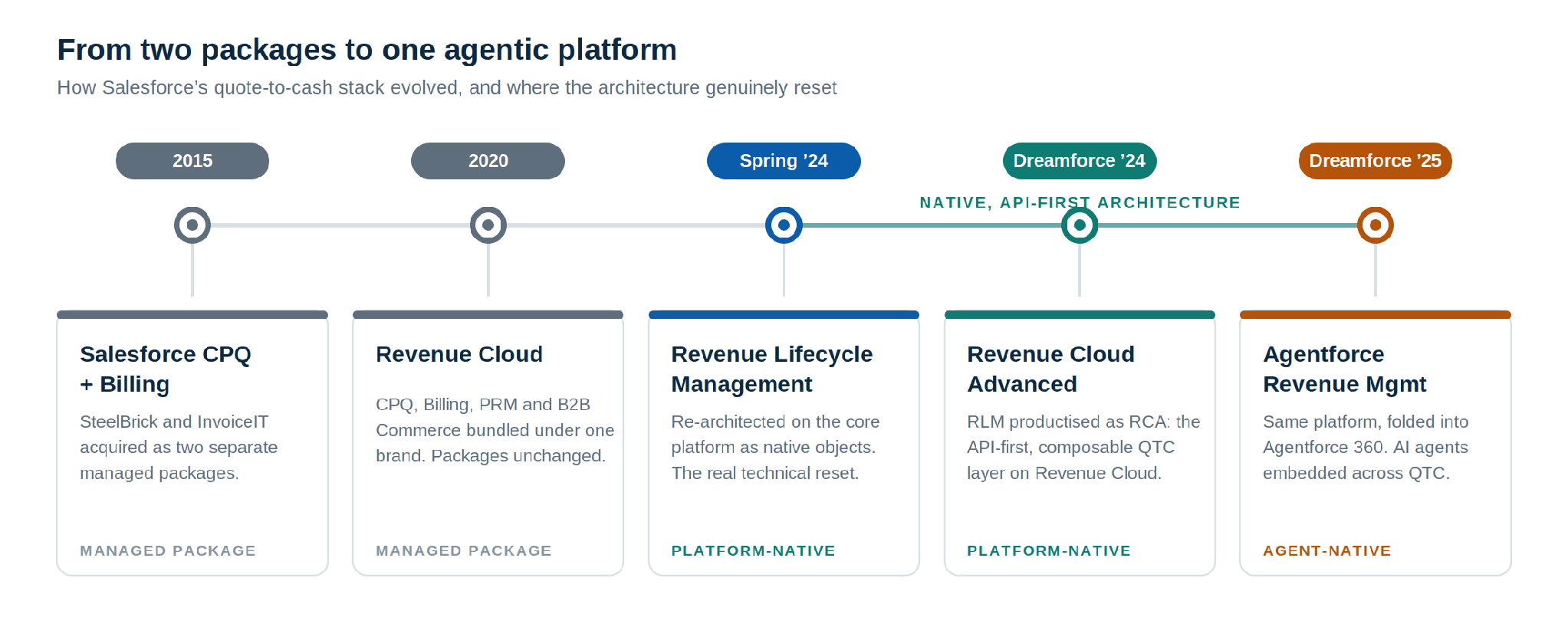
The same platform has carried several labels: Salesforce CPQ and Billing (managed packages), then Revenue Cloud (the 2020 brand), then Revenue Lifecycle Management (Spring ’24, the native rebuild), then Salesforce Revenue Cloud Advanced (Dreamforce 2024), and now Agentforce Revenue Management (Dreamforce 2025), part of Salesforce’s wider move from “Cloud” names to the Agentforce brand. Salesforce’s own site now reads “Agentforce Revenue Management (formerly Revenue Cloud).” The capabilities here apply regardless of the label on the tin. This article uses RCA and ARM interchangeably. |
Background: from two packages to one platform
To see what changed, recall how the legacy stack was assembled. Salesforce CPQ came from the 2015 SteelBrick acquisition. Salesforce Billing came from InvoiceIT. They shipped as distinct managed packages with their own data models and release cycles, which meant teams wrote custom integration code simply to move data between them. In 2020, Salesforce bundled CPQ, Billing, PRM, and B2B Commerce under the Revenue Cloud brand, but the packages underneath did not change.
The real reset came with Revenue Lifecycle Management in Spring ’24, when Salesforce re-engineered the capabilities as native objects on the core platform. Dreamforce 2024 productised that work as Revenue Cloud Advanced, and Dreamforce 2025 folded it into the Salesforce Agentforce family as Agentforce Revenue Management. The names are marketing. The architecture change in Spring ’24 is the part that matters to anyone who builds on the platform.
The building blocks
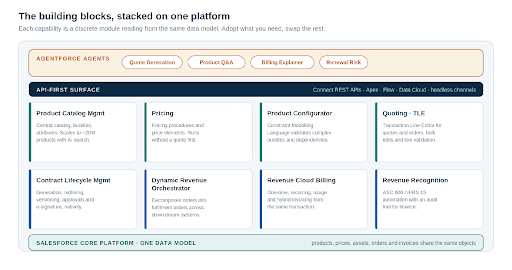
At its core, RCA is a set of discrete modules, each owning one revenue competency, that all read from a single data model on the Salesforce core. You adopt the modules you need and leave the rest. The main blocks are these:
- Product Catalog Management (PCM): A central catalog of products, bundles, and attributes, with AI-assisted search. Salesforce states catalogs can scale to roughly 20 million products. Every downstream module reads from this single source.
- Pricing: A standalone pricing engine built around pricing procedures and price elements. It can run without a quote, a clean break from legacy CPQ where pricing was tied to the quote object.
- Product Configurator: Constraint-based configuration, expressed in Constraint Modelling Language, that validates complex bundles and dependencies.
- Quoting and the Transaction Line Editor (TLE): The grid where reps build and edit quotes and orders, with bulk edits, live validation, and control over which child products in a bundle appear on the document.
- Contract Lifecycle Management (CLM): Native contract generation, redlining, versioning, approval routing, and e-signature, without a separate tool.
- Dynamic Revenue Orchestrator (DRO): Order decomposition and fulfilment coordination across downstream systems, covered in the next section.
- Billing and Revenue Recognition: Invoicing for one-time, recurring, usage-based, and hybrid models, with ASC 606 and IFRS 15 automation and an audit trail for finance.
Where reps spend their time
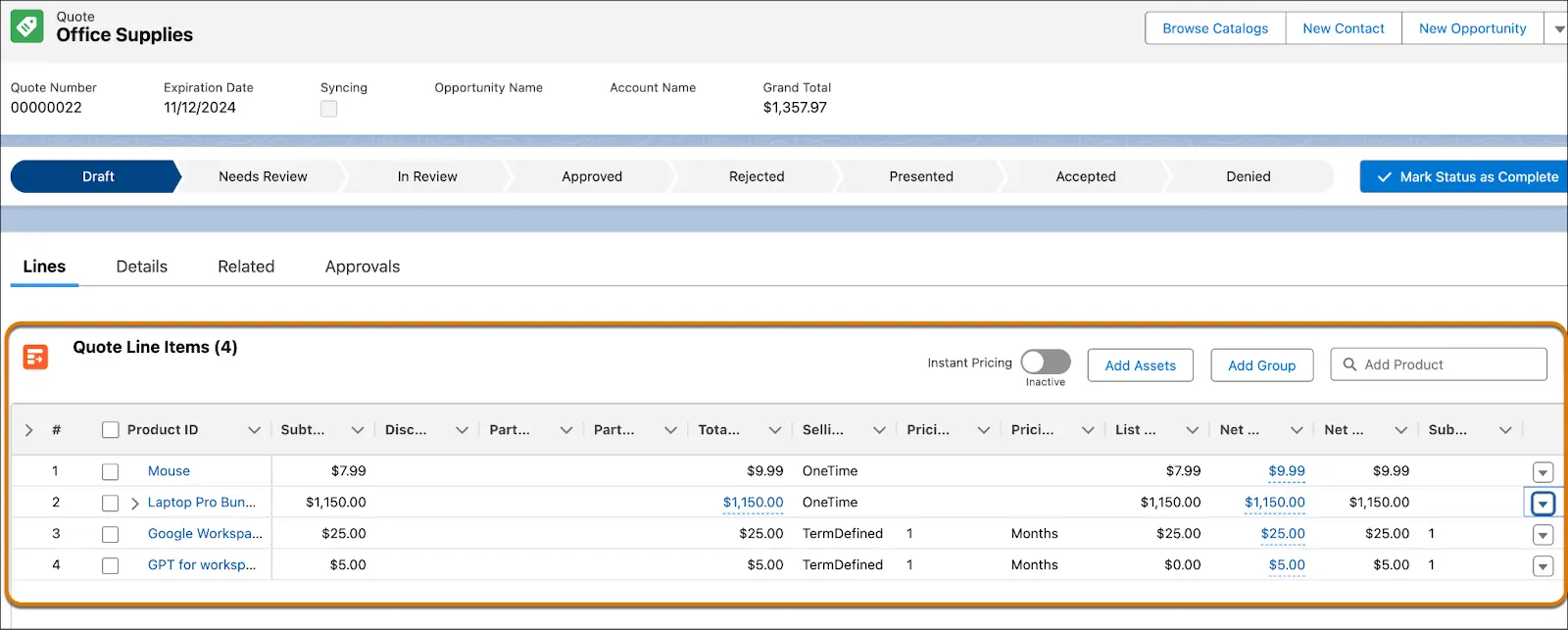
The Transaction Line Editor handles bundle hierarchies, per-line discounting, usage lines, and live repricing in one grid. Quote totals roll up as lines change, and bundle components can be shown or hidden per the quote document.
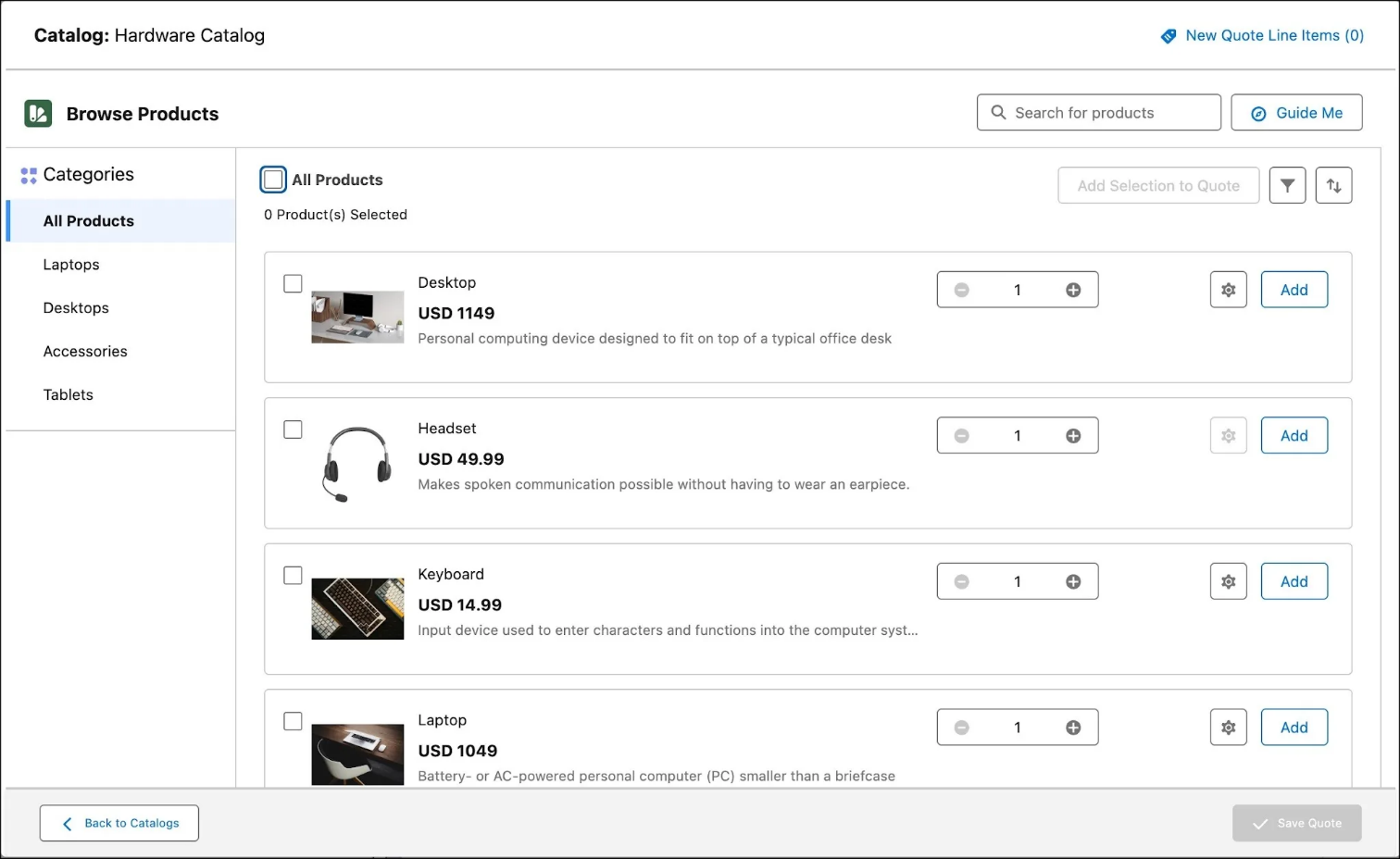
Everything starts from the catalog. Because product, attribute, and pricing data live in shared objects, a change in PCM is reflected everywhere a quote, order, or contract reads from it.
The quote-to-cash flow, end to end
Bret Schmidt, the EVP and GM who described the new architecture, framed the modules as building blocks: loosely coupled and interchangeable. A typical flow runs catalog to renewal. A rep, or an agent, searches the catalog, configures a bundle against constraint rules, prices it through the pricing engine, assembles it in the Transaction Line Editor, routes it through CLM for contracting, and submits an order.
Order fulfilment is where the Dynamic Revenue Orchestrator earns its place. DRO works in two phases. First, decomposition: a submitted order is broken into smaller technical orders called fulfilment orders, typically one per downstream system such as provisioning, billing, field service, or ERP. Second, orchestration: DRO coordinates dependencies across those fulfilment orders, retries failures, and rolls status back up to the order. Because the relationship between an ordered product and its fulfillment is often one to many, this decomposition is what keeps complex products from falling through the cracks.

From there, billing reflects the order precisely, revenue recognition runs against ASC 606 and IFRS 15, and renewals and amendments work from an asset-based model that preserves history. The same data carries through every step, so finance and sales read from one record rather than reconciling two.
Why the architecture shift matters
For developers and architects, the move from managed package to platform-native is the consequential part. It changes how you integrate, extend, and automate.
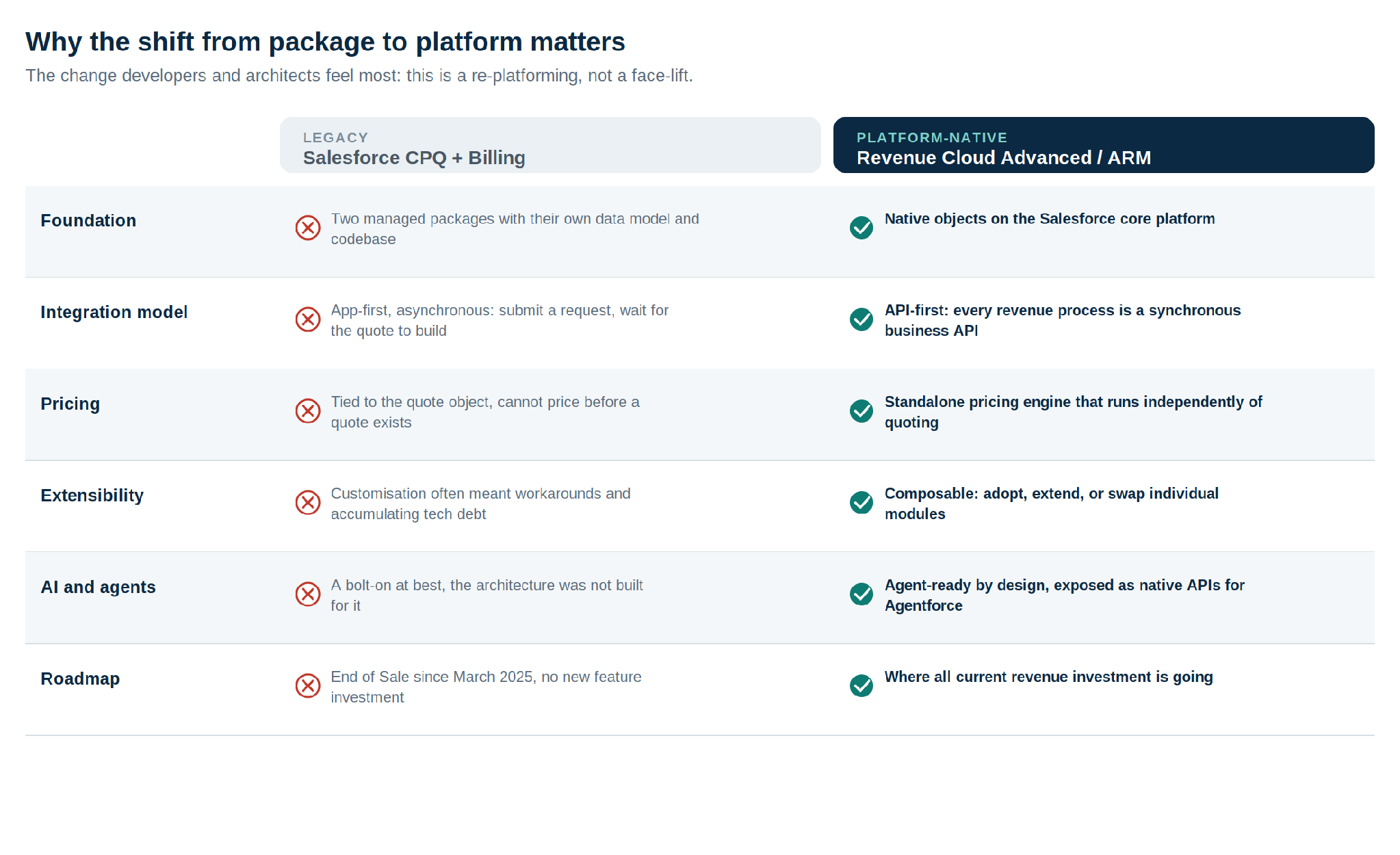
Legacy Salesforce CPQ was app-first. Functionality was confined to its UI, and its APIs were asynchronous: you submitted a request and waited minutes for the quote to build. RCA is API-first but not API-only. Every revenue process is exposed as a native, synchronous business API, with a UX layer on top that you can use or bypass. That SF headless capability is what lets channels (commerce, portals, partner systems) and Agentforce agents act directly: pulling products, applying pricing rules, and generating quotes through the same APIs and approvals a person would use.
The agent case is worth seeing. A rep describes the deal in natural language, the agent assumes the rep’s profile and pricebook, runs catalog search, pricing, and validation, and returns a draft quote for review.
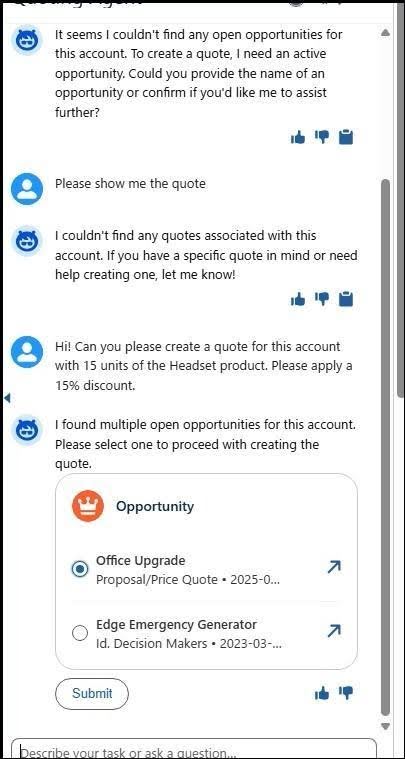
The practical payoff of native objects: cleaner integration with Data Cloud and ERP, better API access, and less of the workaround-driven technical debt that accumulated under the managed-package model. The cost: more of the design responsibility now sits with your team, which the migration section returns to.
Who it is for, and what early adopters report
RCA is aimed at organisations with genuine quote-to-cash complexity: multiple revenue models (subscription, one-time, usage-based, hybrid), omni-channel selling, and a need for automation across sales, finance, and legal. The reported outcomes cluster around speed, accuracy, and reduced leakage.
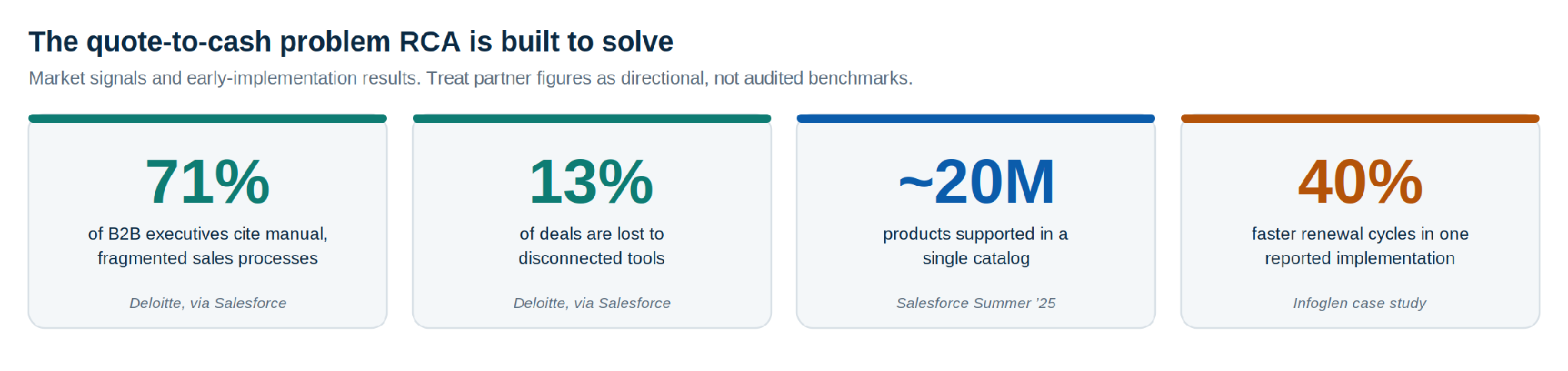
Salesforce, citing Deloitte, reports that 71% of B2B executives struggle with manual, fragmented sales processes, and that 13% of deals are lost to disconnected tools. On the delivery side, partner case studies describe meaningful gains. One implementation reported 40% faster renewal cycles and a 25% improvement in quote-to-cash speed after moving to RCA.
| A MEASURED NOTE ON THE NUMBERS
Treat these figures as directional. The market statistics come from Salesforce and Deloitte, and the delivery results come from consulting-partner case studies rather than audited benchmarks. Validate them against your own baseline before forecasting ROI. |
If you are on legacy CPQ
Migration is not optional in the long run, and the timeline is now public. Salesforce placed legacy CPQ at End of Sale on 27 March 2025: no new licenses for net-new customers, and no further feature investment. Existing customers can keep using and renewing CPQ, and Salesforce has not announced a formal End of Life date, though industry estimates put it several years out.
Two things matter for planning. First, this is a reimplementation, not an upgrade. Custom Apex triggers, configuration rules, and bespoke UI built on the legacy package generally need to be rebuilt against the new data model, not ported. Treating RCA as a lift-and-shift of legacy CPQ tends to carry existing quote-to-cash problems forward rather than fix them. Second, budget realistically. RCA carries a higher list price than legacy CPQ (commonly cited around $200 per user per month, billed annually), and licensing is separate from implementation and partner cost. The clean approach is a structured migration: data mapping, module sequencing, and process redesign, planned ahead of any End-of-Life pressure rather than under it.
What to watch
- Composability shifts design onto your team. The architecture rewards deliberate modelling and punishes shortcuts. There are fewer guardrails than the old managed package imposed.
- Documentation lags the rename. Through the RCA to ARM transition, some guides and screenshots trail the product. Verify against current Salesforce documentation rather than any single secondary source.
- Not everything announced is generally available. Confirm feature status for your edition before you design around an Agentforce capability.
- Pricing can exclude smaller orgs. The list price puts RCA out of reach for some mid-market and SMB teams, a real consideration when you size the move.
The bottom line
Revenue Cloud Advanced reframes quote-to-cash from a chain of integrated packages into a single, composable, API-first platform where product, pricing, quoting, contracts, ordering, billing, and revenue share one source of truth, and where agents can act through native APIs. For organisations with real revenue complexity, that architecture is the difference between revenue that works and revenue that flows.
| YOUR NEXT STEP, BY WHERE YOU SIT
Evaluating RCA or ARM? Spin up a trial or scratch org and model one real quote-to-cash flow end to end, catalog to renewal. On legacy CPQ? Run a migration-readiness assessment and read Salesforce’s official transition guidance before sequencing modules. Studying the platform? Start with the Revenue Cloud Trailhead trailmix and the Salesforce Ben guide, then map the building blocks above to your own process. |
FAQs
Is Revenue Cloud replacing CPQ?
CPQ is typically used by organizations with sophisticated and complex quoting processes. Revenue Cloud, however, is used by organizations like RevOps and Finance that value accuracy and scalability when dealing with revenue processes. This means that Revenue Cloud will not always replace CPQ.
Can Revenue Cloud Advanced generate AI-driven quotes?
Certainly. The Revenue Cloud Advanced tool is built based on the features of Agentforce. The tool allows the user to describe the deal in his or her own words, after which the tool finds products, prices the products according to specific criteria, and makes up a quote.
Is the process of transitioning from Salesforce CPQ to Revenue Cloud Advanced just an upgrade?
Not at all. The transition from CPQ to Revenue Cloud Advanced cannot just be an upgrade since the product is an entirely different system that has its own unique architecture.
What is the significance of an API-first approach in Revenue Cloud Advanced?
An API-first strategy helps organizations gain access to the various processes of pricing, configuration, quoting, and revenue through native business APIs, which in turn facilitates integration of third-party apps, digital capabilities, Agentforce capabilities, and customized user interface without being limited to a particular application layer.
Which type of organization would find the Revenue Cloud Advanced product suitable for its business model?
The Revenue Cloud Advanced would be a perfect match for businesses having complex requirements related to their quote-to-cash processes, particularly organizations implementing subscription pricing, usage pricing, and hybrid pricing models.
Sources and further reading
- Salesforce Newsroom, Under the Hood of Revenue Cloud’s New Architecture
- Salesforce, What Is Revenue Cloud (Agentforce Revenue Management)
- Salesforce Ben, Your Guide to Salesforce Revenue Cloud
- Gearset, Revenue Cloud Advanced deployment (module reference)
- AllCloud, Why move from CPQ to RCA now (End of Sale)
- Continuous, Revenue Cloud Advanced (RCA / ARM) guide
- Infoglen, Revenue Cloud implementation (case-study figures)
For more insights, updates, and expert tips, follow us on LinkedIn.