

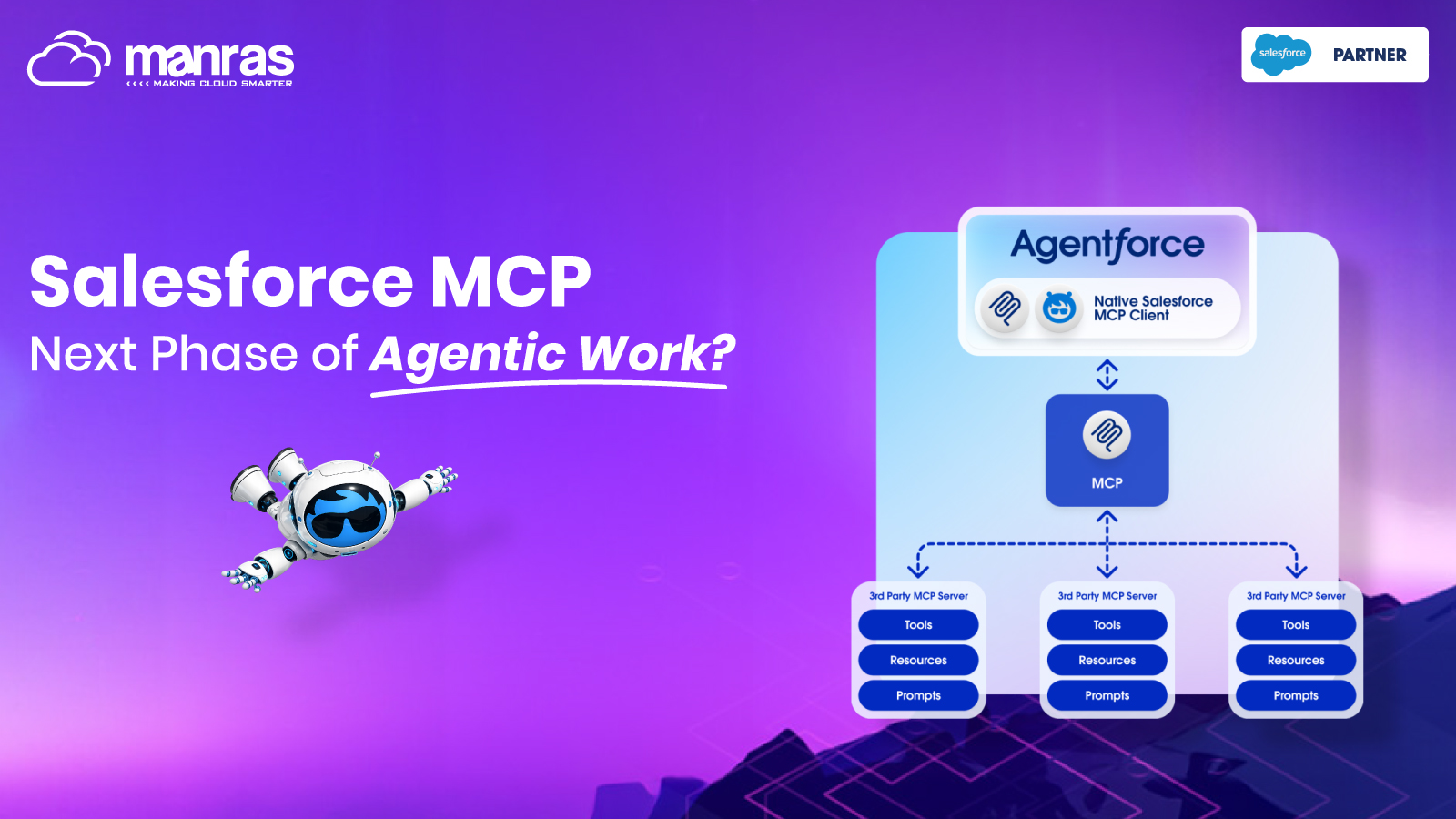
MCPs in Salesforce – The Next Phase of Agentic Work
Artificial intelligence is turning out to be the operating system of enterprises. However, at the heart of this paradigm lies one transformational protocol – the Model Context Protocol, or MCP.
As a Salesforce professional or as an enterprise leader, knowing about Salesforce MCP will not just be an academic endeavor; rather, it will be the gateway to a whole new realm of intelligent automation beyond any CRM workflows.
This article will delve into the implications of Salesforce MCP, why it powers AI agents with Agentforce and what you can do now as a business leader to keep pace with the times.
What Is the Model Context Protocol and Why Does It Matter for Salesforce?
In laymen language, Salesforce Model Context Protocol is an open standard defining how the AI agents work and interact with external tools, data sources, and business systems. In essence, it is a shared language that allows the AI agents to access live data, execute tasks based on that data, and maintain the context throughout the process.
Without a protocol like MCP, AI models are essentially isolated. They can generate text, summarize documents, or answer questions, but they can’t reliably act on behalf of a user inside a live enterprise system. MCP changes that equation entirely. MCP defines a structured way for:
- AI agents to discover available tools and data sources
- Models to request and receive contextual information
- Systems to execute agent-initiated actions securely and predictably
Why Salesforce Is the Ideal MCP Environment
Salesforce sits at the intersection of customer data, business processes, and enterprise workflows. It keeps the details of the information AI agents need like accounts, leads, opportunities, service cases, and more. When you layer MCP for AI agents on top of this foundation, the result is a system where agents do not just retrieve data but understand it and act on it wisely.
According to Salesforce’s official Agentforce documentation, the platform is actively evolving to support agentic AI experiences that can handle multi-step tasks autonomously, with human oversight built in.
Salesforce Agentforce and the Rise of AI-Powered Workflows
Salesforce Agentforce is Salesforce’s platform for building, deploying, and managing AI agents within the Salesforce ecosystem. It provides the infrastructure for creating autonomous agents that can reason, plan, and take action, all within the guardrails of your business logic.
Agentforce agents can be deployed across Sales Cloud, Service Cloud, Marketing Cloud, and beyond. They handle everything from drafting personalized outreach emails to resolving customer service tickets without human intervention.
How MCP Enhances the Abilities of Agentforce
This is how Salesforce Agentforce MCP integration can become revolutionary. Using MCP, Agentforce agents will be able to do the following things in a uniform manner:
Get live data from Salesforce by obtaining information about the account, open opportunities, or cases without coding any API
Use external applications through integration with ERP systems, document management systems, and other SaaS applications using a common protocol
Maintain the context of the task by considering the whole process in which several steps may be involved
Perform cross-application tasks by making changes in the record in CRM, initiating workflows, and notifying the recipient in an agentic way
In the absence of MCP, developing all these abilities would require significant efforts. The use of MCP tools for Salesforce reduces this burden.
Core Benefits of MCP in Enterprise Salesforce Workflows
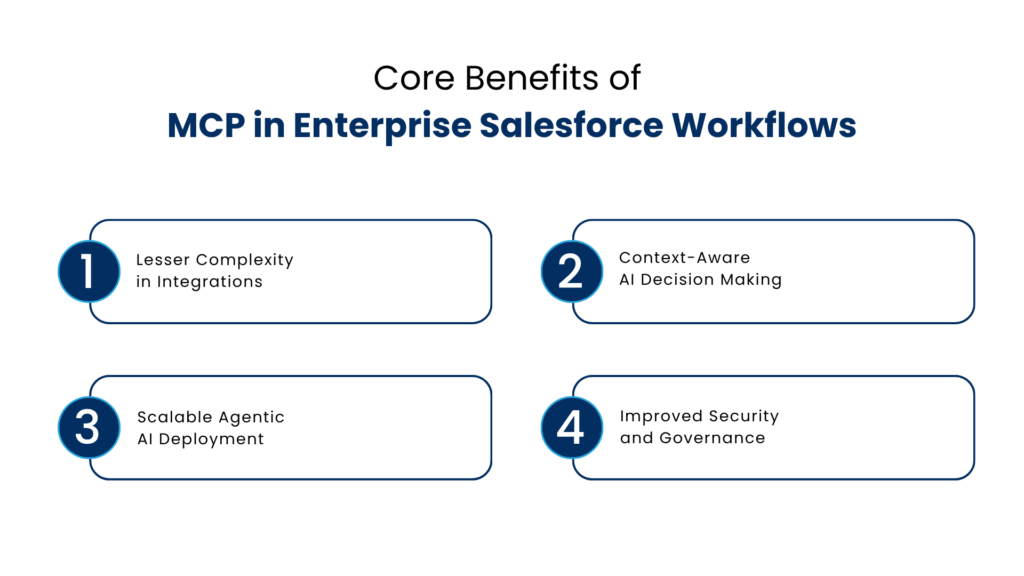
There are significant benefits for businesses using AI-powered Salesforce workflows that leverage the MCP architecture:
Lesser Complexity in Integrations
The standard process involves point-to-point integration using APIs and custom-built middleware. With MCP, the AI agent is capable of communicating with all tools/data sources using a single protocol.
Context-Aware AI Decision Making
MCP allows agents to carry context across the entire duration of a task. Instead of treating each tool call as isolated, agents can build a coherent picture of a business situation and make smarter decisions. In a Salesforce environment, this means an agent helping with a deal renewal can simultaneously understand the account’s history, outstanding support tickets, and recent email sentiment, without being explicitly told to look at each one.
Scalable Agentic AI Deployment
Enterprises can deploy Salesforce AI agents across dozens of use cases including sales development, customer success, field service, and compliance monitoring, using the same underlying MCP-compliant infrastructure. This creates a scalable foundation rather than a collection of one-off automations.
Improved Security and Governance
Because MCP standardizes how agents request and receive data, it becomes easier to audit, monitor, and govern AI behavior. Enterprises can enforce role-based access controls, log every agent action, and apply data residency rules consistently.
As McKinsey’s research Con AI workflow orchestration highlights, enterprises that build AI on top of structured integration standards outperform those relying on ad hoc connections, both in speed of deployment and quality of outcomes.
How MCP is Used in Real World
Use Case 1: Autonomous Sales Development Representatives
An Agentforce Sales Agent running on MCP technology is employed by a B2B technology company in Salesforce. It receives incoming leads, conducts company research through an MCP-integrated web portal, references CRM records, scores the lead, and generates a customized email message all on its own without the need for any human SDRs.
The human sales representatives spend time only making calls while reviewing and approving the outreach messages in the queue.
Use Case 2: Intelligent Customer Service Resolution
A financial services company uses the Agentforce Service Agent integrated with MCP technology to the policy database, billing system, and case history database. In case of any contact from the customer, the agent gets all the information about their account, finds out the root cause of the problem, resolves the issue provided that it falls within policy, and escalates it with a comprehensive brief when human involvement is necessary.
The time taken to resolve cases reduces significantly. The service reps get to deal with the complicated cases alone.
Use Case 3: Forecasting of Revenue Operations
A Software as a Service (SaaS) organization’s Revenue Operations team uses an MCP-powered Agentforce Analytics Agent. This agent collects information from Salesforce Opportunities, combines it with external market signals through a linked MCP application, and produces a weekly pipeline health report indicating problematic deals and necessary interventions.
Use Case 4: Monitoring of Compliance within CRM Information
A regulated organization leverages MCP applications for Salesforce to develop a compliance agent that analyzes CRM entries for any problems with data quality, absence of consent indicators, or other compliance concerns. Such an agent replaces quarterly audits by performing continuous monitoring.
What is the Future of Salesforce MCP
The trajectory is clear. As MIT research on autonomous AI systems continues to advance the theory behind multi-agent coordination, platforms like Salesforce are translating those principles into enterprise-ready tools. Expect to see:
- Native MCP support deeply embedded within the Salesforce Platform
- An expanding library of MCP-compliant tools and connectors in AppExchange
- Multi-agent orchestration where specialized Agentforce agents collaborate on complex workflows
- AI workflow orchestration capabilities that span CRM, ERP, ITSM, and data warehouses in a unified agentic layer
The organizations that invest in MCP-ready infrastructure today will be positioned to deploy next-generation agents tomorrow, with far less technical friction.
What Your Organization Needs to Do
Whatever your role whether you are a Salesforce administrator, enterprise architect, or digital transformation professional, here are the action steps that should get your attention:
- Conduct an assessment of your existing integration architecture: Find out what Salesforce integrations you currently have can be improved using the MCP model. Start with identifying high volume and repetitive tasks.
- Data Quality Improvement: Since agentic AI depends significantly on the ability to harness data capabilities offered by the CRM system, having high-quality data becomes essential.
- Train your team about agentic AI basics: Future Salesforce Administrators should understand how to build agents, design prompts, and orchestrate tools rather than just workflows and validations.
- Begin small, grow large: Begin by implementing a pilot in a specific application such as sales agents, service bots, or reporting agents using MCP.
- Collaborate with experts in Salesforce technology: Considering the complexity of MCP implementation, it would be necessary to work alongside Salesforce professionals experienced in enterprise AI architecture.
If you’re looking for guidance on where to begin, the Salesforce Consulting Services team at Manras Technologies helps enterprises design and deploy AI-ready Salesforce architectures tailored to their industry and scale.
For organizations ready to move from strategy to execution, Salesforce Implementation Services from Manras provide the end-to-end technical expertise needed to bring MCP-enabled agentic workflows to life, on time and on budget.
Conclusion: The Agentic Era Starts with Salesforce MCP
The shift from rule-based automation to context-aware agentic AI is not on the horizon. It’s already underway. Salesforce MCP is the infrastructure layer that makes this shift coherent, scalable, and enterprise-safe.
Organizations that treat MCP as a strategic priority, not a technical curiosity, will outpace competitors in every dimension that matters: sales velocity, customer satisfaction, operational efficiency, and AI-driven innovation capacity.
The next phase of agentic work isn’t about replacing people. It’s about giving your best people, and their AI counterparts, the context, tools, and autonomy to do their best work.
FAQs
What is Salesforce MCP?
Salesforce MCP (Model Context Protocol) is a standard that allows AI agents to interact with Salesforce applications and data as well as other systems in the context of a protocol. The protocol allows AI models to execute actions in Salesforce workflows instead of generating texts in response to prompts.
How is MCP different from current Salesforce integration solutions?
Unlike the current Salesforce integration solutions that are based on point-to-point APIs and require custom coding and continuous maintenance, MCP is a universal protocol that can be used by AI agents to find, use, and execute actions on any compliant tool and data source.
What is Agentforce and how does it relate to MCP?
Agentforce is the name of the Salesforce platform for creating autonomous AI agents in the Salesforce ecosystem. MCP is complementing Agentforce as it gives agents an opportunity to interact with external tools and keep the context across several actions.
Is Salesforce MCP ready for enterprise adoption now?
Yes, there are companies that already use MCP-powered Agentforce agents for sales, services, and operations. However, the protocol is still in the development phase, which means that enterprises should implement MCP in a structured governance process.
What are the main risks involved in using MCP in Salesforce?
The main risks include low data quality affecting agent performance, lack of governance regarding AI behavior, and difficulty in managing changes as part of implementing agentic workflows. Utilizing an expert Salesforce implementation partner greatly mitigates these risks.
How can I begin using MCP in Salesforce?
First, evaluate the state of your Salesforce data quality and integration. Select a valuable use case for piloting, involve a Salesforce consulting partner knowledgeable in AI architecture, and establish governance prior to scaling.
For more insights, updates, and expert tips, follow us on LinkedIn.