

The ROI of PAN Verification CRM in High-Volume Customer Onboarding
High-volume customer onboarding is a pressure test. For fintech companies, NBFCs, banks, insurance providers, and lending platforms, the difference between a 3-minute onboarding and a 3-day one is not just a process problem. It directly affects revenue, compliance standing, and whether a customer stays or leaves.
PAN verification is the step where most of that pressure lands. It is mandatory for nearly all financial transactions in India, and doing it manually at scale creates a cascade of delays, errors, and costs that are entirely avoidable.
A CRM with PAN verification closes that gap. It moves the identity check inside the workflow, automates the result, and removes the bottleneck without adding complexity.
This article breaks down exactly where the ROI comes from and why more financial institutions are treating PAN verification CRM as a compliance and growth tool, not just an IT integration.
What Is a PAN Verification CRM?
In essence, a Salesforce CRM with PAN verification is an identity verification solution that ensures validation of a person’s Permanent Account Number instantly right from the onboarding record itself, without any need for tabs or portal access and duplication of data.
The process works in the following way:
- The PAN details are provided by the agent (or customer) in the CRM record
- This information is immediately sent by the CRM to an approved API that pulls details from reliable sources
- The response containing PAN status, along with the name and linked details is returned almost instantly
- The response is immediately saved to the customer record
For users of Salesforce CRM, a Salesforce CRM with PAN verification integrates the verification step right into workflows, approvals, and record pages.
Some of the practical applications include:
- Instant verification done by agents without having to leave the CRM
- Automatically populated verified fields
- Prevent processing of unverified customer records
- Every check is recorded with a timestamp
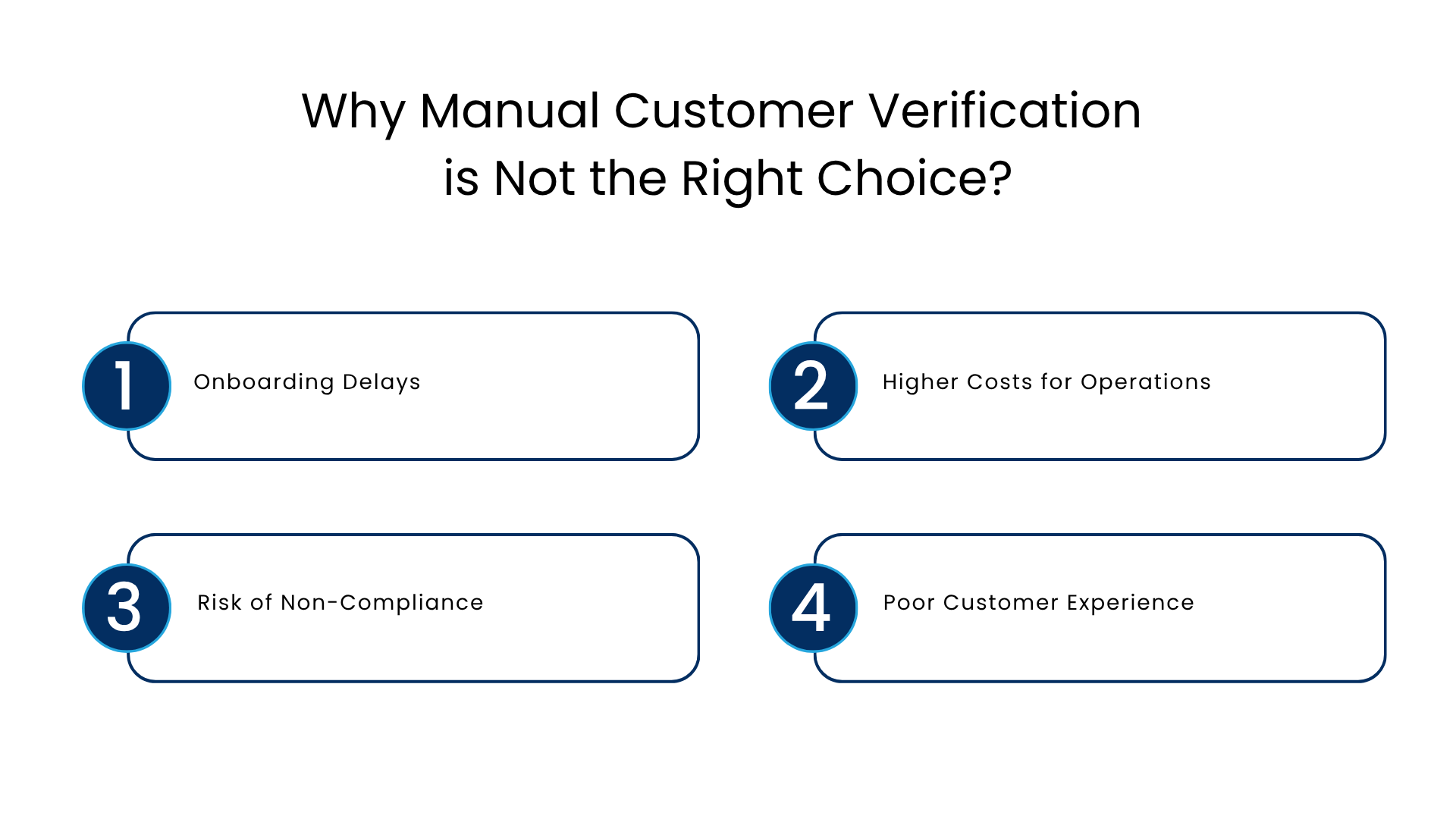
Why Manual Customer Verification is Not the Right Choice?
Companies that still use manual PAN verification don’t quite understand how much this process costs them. The obvious one is the amount of agent time. But there are others.
Onboarding Delays
Here’s the process of manual verification of a single customer:
- Opening the government website in another tab
- Entering the customer’s PAN information
- Receiving the response from the website
- Marking the status of the response
- Manually updating the information in the CRM
- Moving the application to the next stage
Each of these is a very small delay. But multiplying this over hundreds of applications a day and five working days, we’re talking about hundreds of hours lost every month. Which means that onboarding goes from same-day verification to 2-3 day turnaround for many companies.
The business impact: A 5% customer drop-off due to slow onboarding at a mid-sized NBFC processing 3,000 applications per month means 150 lost leads, every month.
Higher Costs for Operations
The manual process cannot be scaled smoothly; there will be the need for the company to choose one of three approaches:
- Deliberately slow down verification and thereby lose customers
- Increase staffing requirements and incur higher costs of employment
- Force staff to verify faster at increased costs and risks of errors
All three options are unsustainable. All three are unnecessary with an automated PAN verification CRM solution implemented.
Risk of Non-Compliance
Human intervention comes with the risks of human errors. These may include:
- Skipping verification due to high workloads
- Mistakes when entering information into the system
- Completion of verification without proper documentation
- Inconsistent procedures followed by different people
A single incomplete file on KYC found during audit checks will lead to regulatory scrutiny and potentially severe penalties. This is especially true for NBFCs and banking institutions that adhere to the RBI guidelines.
Poor Customer Experience
Verification delays create visible friction for customers. The signs show up in:
- Application abandonment mid-flow
- Support calls asking for status updates
- Negative reviews citing slow or confusing onboarding
- Drop-offs between application submission and account activation
Customers who abandon onboarding rarely return. And in a market where competitors can complete the same process faster, the cost of a poor experience is compounded.
How does Salesforce PAN verification integration Improves ROI?
Quickly Verify Identities
Thanks to instant PAN verification in the CRM, the whole verification process takes just seconds. Agents don’t have to wait, don’t have to change programs, and nothing needs to be manually entered. For an average team working through 500 applications a day, savings of just 10 minutes per application mean an extra 80 hours a day for your staff.
- Approvals become possible on the same day
- Decisions can be made faster using the information that has been verified
- Quick onboarding ensures quicker revenue recognition
Less Manual Work
By automating tasks, agents will be able to:
- Spend no more time switching between portals and manually logging information
- Information will automatically populate CRM fields
- Managers won’t have to spend time reviewing errors
- Higher numbers of applicants can be processed by existing staff
Thus you’ll have an optimized process which doesn’t require increased staffing to increase throughput.
Better Compliance and Audit Readiness
Every PAN verification in an automated system creates a time-stamped, searchable record inside the CRM. When an auditor requests KYC evidence for a specific customer, the proof is already there.
Key compliance advantages:
- No chasing paper trails or external spreadsheets
- Verification records are tied to the customer record, not a separate log
- Consistent process across all agents, every time
- Automated workflows block non-compliant records from progressing
Improved Data Accuracy
Automated PAN card verification in the CRM pulls confirmed data directly from the source. What enters the customer record is verified, not self-reported. This matters downstream:
- Credit assessments use accurate name and identity data
- Reporting is cleaner, with fewer reconciliation errors
- Customer service teams work from correct records from day one
Fraud Prevention Benefits
A strong identity verification CRM does not just confirm a PAN exists. It detects patterns that indicate fraud:
- One PAN linked to multiple different names
- Multiple PANs registered against a single individual
- PAN status flagged as inactive, cancelled, or fake
Catching these patterns at the point of onboarding, before an account is opened or a loan is disbursed, prevents losses that would otherwise be discovered much later, at much greater cost.
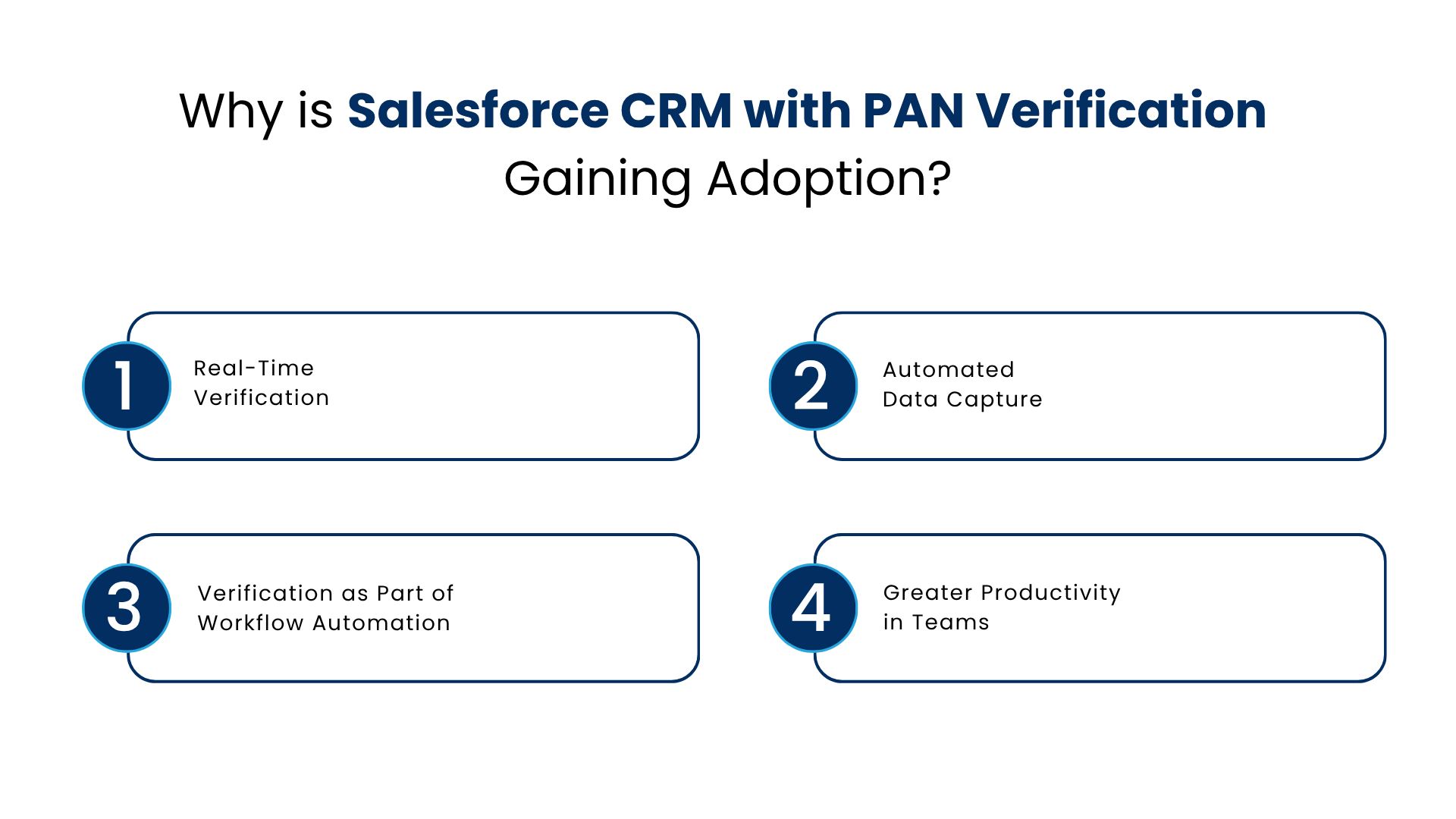
Why is Salesforce CRM with PAN Verification Gaining Adoption?
Salesforce CRM already forms the core infrastructure for many financial institutions in India. By integrating PAN number validation directly in Salesforce CRM, there will be no other software required and there will be only one place where customer information exists.
Here’s how this will work in different departments:
Real-Time Verification
A Salesforce KYC verification CRM triggers PAN validation the moment an agent creates or updates a customer record. No manual initiation needed. Results arrive within seconds.
- Agents stay in Salesforce throughout the process
- No verification bottleneck at high-volume peaks
- Results are available before the agent moves to the next field
Automated Data Capture
Verification results do not just return a pass/fail. In a Salesforce PAN verification integration:
- Customer name and date of birth linked to the PAN are auto-captured
- PAN status (active, inactive, cancelled) is stored in the record
- Number of owners linked to the PAN is flagged if anomalous
Verification as Part of Workflow Automation
Salesforce Flow can implement a verification check as part of a gate process within onboarding:
- Applicants with non-verified PAN cannot proceed to credit verification process
- Agents receive notifications from the platform about verification concerns
- Status tagging is implemented based on verification status
Greater Productivity in Teams
Automated PAN verification makes it easier for downstream processes to be productive:
- The operational department becomes more efficient through automation
- The compliance department receives flawless verification data without contacting agents
- Status dashboards display current information about onboarding process
Measuring the ROI of CRM with KYC Automation
ROI associated with a CRM having PAN verification capabilities is calculable in terms of three broad metrics: cost savings, risk reduction, and revenue generation.
Example of cost savings
A non-banking financial company handling 3,000 applications monthly, whereby manual PAN verification takes an average of 15 minutes per application, uses 750 agent hours per month for an activity that can easily be automated. At a rate of Rs. 300 per agent hour, this equates to Rs. 2.25 lakh in recoverable costs per month.
Risk reduction example
- Average cost of a single finding relating to KYC compliance issues: Several lakhs in cost of correction
- Average time taken to do a compliance review manually: 20-40 hours
- Time taken to perform the same review with automated records: Hours, not days
Revenue gains
- Quick onboarding leads to reduced drop off. A 3% increase in the number of applications processed for a company dealing with 3,000 monthly applications means that 90 more applications will get processed every month.
- Prevention of two cases of fraud in one month, each involving defaulting on a loan worth Rs. 5 lakh results in saving of Rs. 10 lakh monthly.
- Overall, the ROI for CRM with automation of KYC process is recoverable in the first quarter of operation.
Conclusion
At high volumes, manual PAN verification is more than just slow. It poses risks of non-compliance, operational expenses, and customer churn, month after month.
With a PAN verification CRM, the risk is neutralized right out of the gate. The process itself is embedded within the workflow, rather than an additional step. Data starts off clean. Fraud gets detected sooner. Audits are quicker. And agents get to focus on tasks requiring actual human intervention.
For banks that want to expand onboarding volume while minimizing compliance risk, a CRM solution for PAN verification may be the easiest choice for ROI there is.
FAQs
What is PAN verification CRM?
Salesforce KYC verification CRM refers to a system where customers’ PANs are verified at the time of the onboarding process. There is no need to visit any external portal for verification purposes. Everything happens in the record of the customer in the CRM itself, and results are automatically saved along with timestamps.
Is PAN verification necessary for Indian financial organizations?
Yes, it is required. SEBI requires that every investor holding any depository account gets his/her PAN verified; otherwise, the account cannot be used. RBI guidelines stipulate that a customer should complete his/her KYC before getting a loan. All PAN verifications are done against the official list maintained by India’s Income Tax Department.
What is Salesforce PAN verification integration?
A representative inputs all PAN-specific information into a Salesforce entry. This data is sent by IdentryX to a verification API that matches the data against reliable sources and returns the findings within minutes. The verification status, corresponding name, and flag for anomalies are automatically entered into the Salesforce record.
What ROI can companies earn on CRM with KYC automation?
ROI can be expected from the following three sources: savings in agent hours spent on verification (750 hours/month for an NBFC handling 3,000 applications), decreased spending on compliance fixes, and protection against fraud. In most cases, the company earns back its investment within one quarter of operation.
Does PAN verification CRM help identify fraud?
Yes. For example, IdentryX uses advanced techniques like artificial intelligence for checking the legitimacy of a PAN that may be involved in any fraudulent transaction. This could include a PAN associated with various names or even more than one PAN associated with a single person.
For more insights, updates, and expert tips, follow us on LinkedIn.