
AI Governance in Salesforce: How to Implement Responsible AI with Einstein Trust Layer
Every Salesforce org that turns on Einstein or Agentforce is making a decision that goes beyond productivity. It is deciding how much trust to place in a system that can read, summarise, and act on customer data at machine speed. That is exactly why AI Governance in Salesforce has moved from a nice-to-have policy document to a daily operating requirement for IT leaders.
The good news is that Salesforce did not leave this problem to chance. The Einstein Trust Layer gives teams a practical, built-in way to apply governance controls without slowing down AI adoption. This article walks through what that looks like in practice, from the first governance checkpoint to a working implementation roadmap.
Why Governance Has Become a Board-Level Conversation
AI used to sit quietly inside a data science team. Now it drafts service replies, summarises cases, and increasingly takes actions through Agentforce agents. That shift changes who needs to care about oversight.
Salesforce’s own trust research shows that its Trust Layer was built specifically to keep generative AI interactions secure, private, accurate, and aligned with clear ethical standards, following a multi-year effort that pulled in engineering, legal, and product teams across the company.
Here is how it applies to business leaders in practice:
Each prompt, each response from an AI agent, and each action by an AI agent should have an audit log, a proper permission check, and an owner defined. Otherwise, implementing AI poses more risks than opportunities.
Just a reality check for you. What if you had to provide proof within minutes of the exact data used by an AI agent in the previous week? Could you? If not, governance is just a theory at this stage.
How Einstein Trust Layer Supports Salesforce AI Governance
The Einstein Trust Layer acts as the layer that sits between your CRM data and the reasoning done by the large language model. Salesforce defines the Einstein Trust Layer as an architecture that is designed for the purpose of securing generative AI without sharing any company or customer data.
In plain terms, it handles four jobs continuously:
- Data masking: Sensitive fields are hidden before a prompt ever reaches the model.
- Zero data retention: Prompts and responses are not stored by the underlying LLM after the interaction ends.
- Audit trail logging: Every interaction records what was asked, what data was touched, and what was returned.
- Toxicity and prompt injection detection: Responses are screened before they reach a user or customer.
This is a strong technical foundation, but it is not the entire governance story. A permission check inside the Trust Layer does not replace a documented policy on who approves new AI use cases, or how often those use cases get reviewed.
Building Trusted AI Governance in Salesforce: The Practical Layers
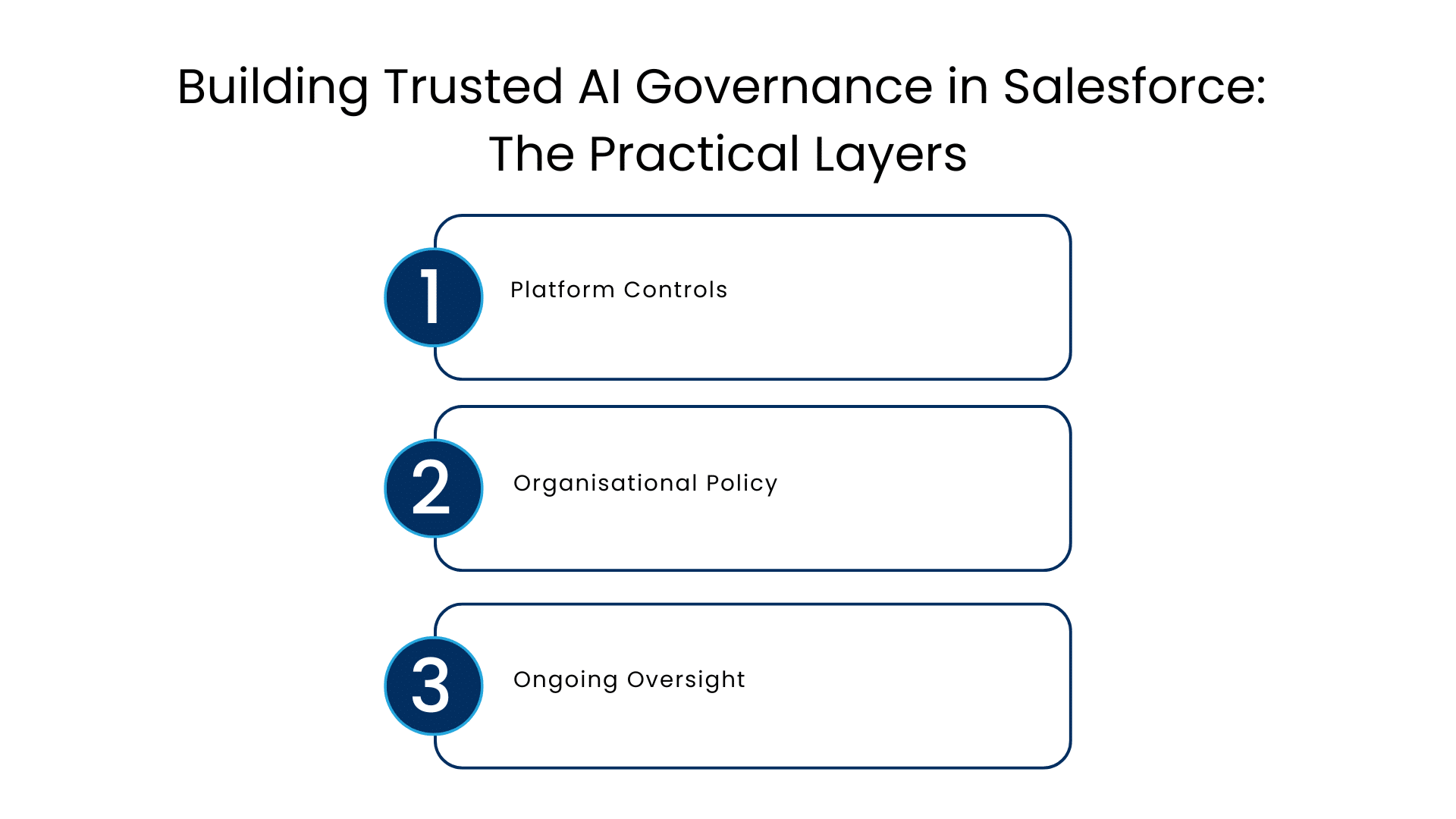
Think of trusted AI as three layers stacked on top of each other, not one feature you switch on.
Layer 1: Platform Controls
This is where Einstein Trust Layer lives. Data masking, encryption in transit, and zero retention settings belong here. IT and platform admins own this layer, and most of it is configuration rather than custom development.
Layer 2: Organisational Policy
This layer covers who can request a new AI use case, who signs off on it, and what documentation is required before it goes live. Many teams skip this layer entirely, which is usually where governance programs quietly fail.
Layer 3: Ongoing Oversight
Governance is not a one-time approval. Usage needs regular review, model outputs need periodic sampling, and access permissions need to be reassessed as teams and use cases change.
A Governance Checklist Before You Scale AI Use Cases
Use this as a working checklist rather than a formality to file away.
- Align all existing and proposed AI use cases to their respective data points.
- Validate field-level security and sharing policies before Einstein functionality, and not afterwards.
- Enable data masking and zero retention within Trust Layer setup.
- Provide a named owner to each AI use case, but not the department.
- Establishing a cadence for reviewing quarterly should work well for many mid-sized organizations.
- Identify the escalation process when the agent’s outcome seems inappropriate.
- Educate the end-user about the reach of the AI tool, so the trust is deserved.
Decision Table: Which Governance Level Fits Your Use Case
| Use Case Type | Data Sensitivity | Minimum Governance Needed |
| Internal email drafting | Low | Standard Trust Layer defaults |
| Customer service replies | Medium | Data masking plus quarterly output review |
| Agentforce record updates | High | Full audit logging, named approver, monthly review |
| Financial or health-adjacent data | Very high | Legal sign-off, restricted permission sets, continuous monitoring |
Common Mistakes That Undermine Salesforce AI Compliance
Most governance failures are not dramatic. They are small gaps that compound over time.
- Consideration of the Trust Layer as a full governance program rather than the technical bedrock of such a program.
- Approval of AI use cases without verification of field-level security taking place before hand.
- Neglecting to analyze audit logs on a regular basis.
- Taking the approach that since there is already data governance in place, there is no need for AI governance.
Field note: Teams with mature data governance, meaning clear permission sets and retention policies already in place, typically reach reliable AI compliance outcomes in a fraction of the time it takes teams starting from scratch.
Best-Practice Table for Ongoing Oversight
| Practice | Frequency | Owner |
| Review Trust Layer audit logs | Monthly | Platform admin |
| Reassess AI-related permission sets | Quarterly | Security lead |
| Sample AI-generated outputs for accuracy | Monthly | Business owner |
| Refresh governance documentation | Bi-annually | IT governance lead |
According to NIST’s AI Risk Management Framework, organisations that build risk management into the AI lifecycle from the start, rather than retrofitting it later, are better positioned to manage trustworthiness as systems scale. That principle applies directly inside Salesforce, where governance decisions made during initial setup are far cheaper than corrections made after a data exposure.
Organisational Readiness: Are You Actually Prepared?
Before scaling any Salesforce AI Implementation, ask three honest questions.
- Do we know exactly what data each AI feature can access today?
- Is there a named person accountable for every live use case?
- Can we produce an audit trail on demand, not just in theory?
If any answer is no, pause new rollouts and fix the gap first. Scaling on top of an unclear foundation only multiplies the eventual cleanup work.
Conclusion
Configuring Trust Layer settings is straightforward on paper. Mapping every use case to the correct permission structure, writing policy that legal and business teams both accept, and setting a review cadence that survives contact with a busy quarter is where most internal teams lose momentum.
On the other hand, the expertise of an experienced Salesforce consultancy partner consists of recognizing patterns in dozens of governance implementations, not in one-off documentation created by any particular vendor.
Such expertise is most often manifested through quicker implementation of Einstein Analytics, more refined permission structure, and the construction of AI governance in Salesforce that would endure audits, not just checklists. In the case of organizations undergoing Agentforce, the structured approach to AI security and governance can bring about compliance faster.
If your organisation is ready to move from ad-hoc AI experimentation to a governed, auditable program, working with a partner who has done this before is usually the fastest and safest path forward.
FAQs
Is the Trust Layer in Einstein’s the same as AI Governance?
No. Trust Layer is the technical layer with masking, retention, and logging features, while AI Governance in Salesforce involves the aspects of policy, named ownership, and review schedule – something that can be managed via Trust Layer.
How frequent is AI permissions review supposed to be?
A quarterly review is the standard schedule for almost any company, except for those using sensitive information like finances or health-related.
Does Salesforce AI Governance affect Agentforce agents differently from the rest of generative AI features?
Yes, since the agents are able to do things and not just generate text – therefore, audit logging and permission review become more important.
Can smaller and mid-size companies afford AI governance without a huge number of people in the company?
Yes, even more so because the technical part of AI Governance will be covered by the defaults of Trust Layer. The rest is mainly documentation and regular review that a good partner can easily introduce into the routine.
What is the first step towards improved Salesforce AI Compliance?
It begins with an inventory of use cases. You cannot manage what you do not map, and most compliance issues stem from the fact that AI capabilities were turned on without mapping the data they impact.
For more insights, updates, and expert tips, follow us on LinkedIn.