

Salesforce Agentforce AI Strategies That Turn Enterprise Data to Actionable Insights
Most enterprises have more data than they know what to do with. Customer records, transaction histories, support tickets, marketing interactions, and sales activity all pile up in systems that rarely connect. The data is there. The problem is that it rarely turns into a decision fast enough to matter.
Salesforce Agentforce AI is built to solve that problem. Rather than leaving data in dashboards for someone to interpret later, Agentforce puts AI agents to work inside your CRM in real time. They surface recommendations, automate routine tasks, and give your teams the context they need before the moment passes.
This article covers the strategies that generate the most impact, from unifying fragmented data to accelerating revenue, and what smart implementation looks like at the enterprise level.
Why Enterprise Data Often Fails to Drive Business Value?
Data Silos within Business Units
Sales, service, marketing, and financial departments all gather significant volumes of customer data; however, it is isolated within department-specific systems. A service representative dealing with an escalated complaint will have no insight into the latest purchase activity of this customer or the conversation during the sales call that took place six months ago. Decisions are based on partial data sets, making clients think that businesses do not understand their needs.
Insufficient Customer Insights
Even advanced CRM systems struggle to predict which customers are likely to churn, which are about to boost their spending, or explain why once engaged segments have suddenly gone quiet. The lack of predictive analytics capabilities makes identifying such patterns impossible without conducting a painstaking analysis, which most businesses lack time to perform.
Faster Decision-Making Process
According to studies conducted by McKinsey, firms that speed up their decision-making processes through the help of AI achieve much better results than companies following a conventional reporting routine. Long sales cycles typical of corporate settings suggest that taking timely actions based on accurate data is often crucial for sealing deals and retaining customers.
How Salesforce Agentforce AI Turns Enterprise Data into Actionable Insights?
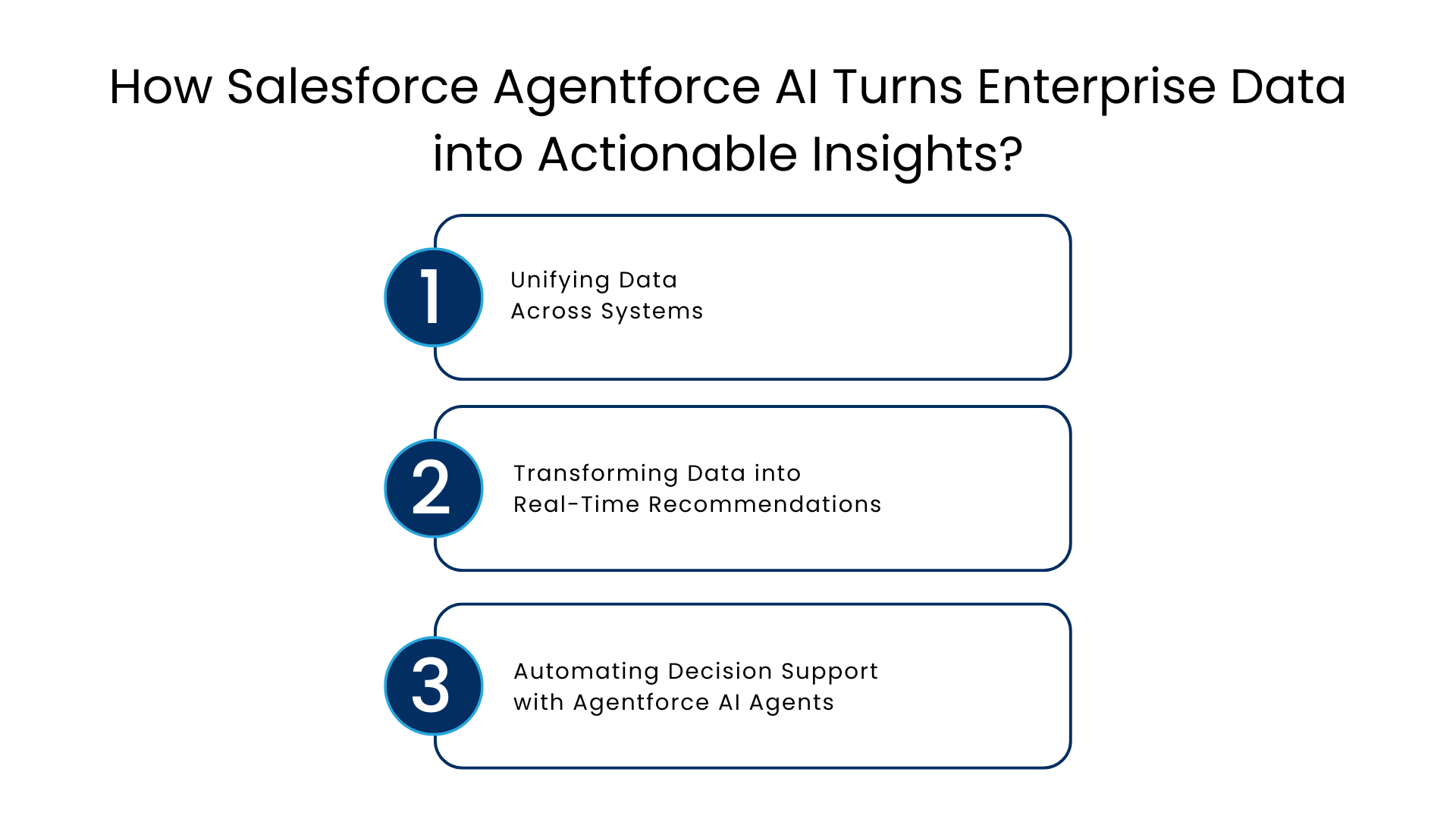
Unifying Data Across Systems
Agentforce Salesforce works alongside Salesforce Data Cloud to pull customer data from across your organization into a single connected profile. CRM records, support interactions, marketing engagement, and purchase data all feed into one view. Every rep or agent working in Salesforce sees the same complete picture of each customer, which is what makes AI recommendations trustworthy.
Transforming Data into Real-Time Recommendations
Once the data is unified, Salesforce Agentforce AI moves beyond storage to generating recommendations. A sales rep opens a record and sees a prioritized list of next actions: which deal to focus on today, which customer is showing churn signals, which upsell has the best odds of closing. These recommendations draw from real-time CRM activity, not a report someone ran last week.
Automating Decision Support with Agentforce AI Agents
Agentforce AI agents handle the repetitive decision points that slow teams down: routing service cases, sending meeting follow-ups, flagging quiet deals, updating records after interactions. These are tasks that consume time without adding strategic value. Agentforce handles them automatically so people can focus on work that requires real judgment.
The Role of Salesforce Data 360 and Salesforce Headless 360
Customer View Integration
Data 360 from Salesforce acts as the platform for providing all of Agentforce’s analytics. The platform integrates customer information into a customer 360 profile by pulling data from all customer interactions throughout the business operations. All customer information can be accessed via one customer profile when all teams are using the same profile to engage with their customers.
Customer Intelligence Delivery Platform
Salesforce Headless 360 is the extension of this data layer to every customer channel used. Customer intelligence should not be confined within a desktop CRM application but accessible to any touchpoint application within your Salesforce ecosystem to deliver consistent customer experience.
Improving Cross-Department Collaboration
When sales, service, and marketing all draw from the same data source, cross-department handoffs improve dramatically. A service team resolving an issue can flag an expansion opportunity for sales. A marketing team running a campaign can suppress customers currently in a support escalation. The data no longer lives in isolated pockets, so decisions made in one department stop accidentally undermining the work of another.
Key Agentforce for Salesforce AI Strategies for Enterprise Success
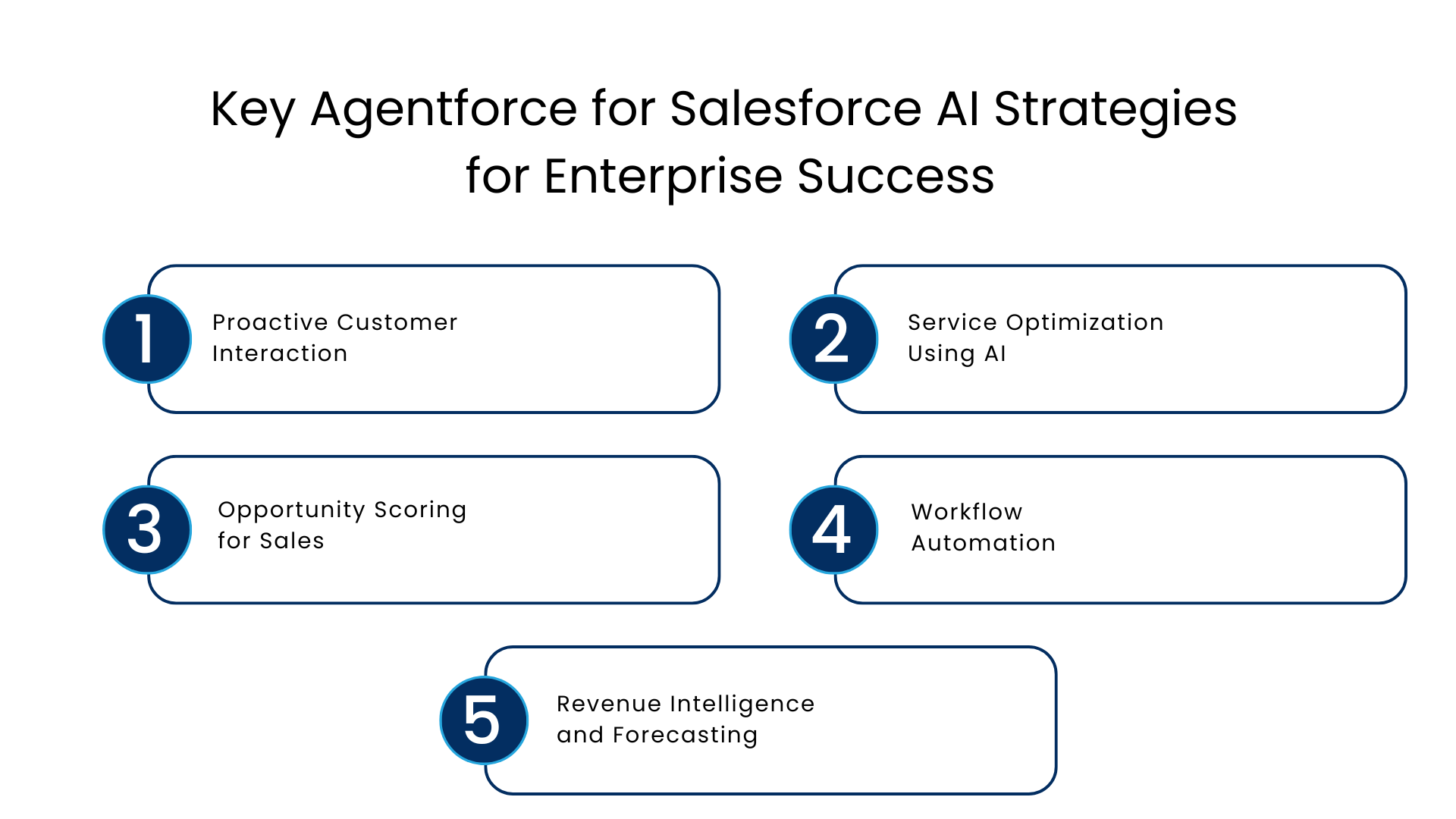
Proactive Customer Interaction
Utilize Agentforce to target customers who are about to renew their subscriptions, customers exhibiting early signs of churn behavior, and customers displaying signs that they are ready to talk to you. Taking action when triggered by these types of behaviors means moving from being reactive to proactive.
Service Optimization Using AI
Agentforce can be used by organizations whose support teams struggle to maintain high-quality performance while handling more cases. The AI-driven agents deal with mundane requests, automatically route complicated cases, and ensure human agents have complete customer information before responding to them.
Opportunity Scoring for Sales
Every lead in the pipeline may not be equally important. Through Agentforce, sales reps can focus on the leads that are most likely to convert based on prior engagement and behavior data.
Workflow Automation
Enterprise organizations’ workflows tend to consist of many stages and may require approvals from different departments and people. These workflows can be automatically orchestrated using Agentforce.
Revenue Intelligence and Forecasting
With unified data feeding into Agentforce, sales leaders get forecasts they can actually trust. Rather than relying on what reps self-report, forecasting draws from actual CRM activity and customer behavior patterns. Leadership makes resource and investment decisions based on real signals rather than best guesses.
How Agentforce Salesforce CRM Integration Improves Decision-Making?
The Link Between Customer Engagement and CRM Information
When an agent uses Salesforce CRM through Agentforce, all interactions get recorded into the customer’s file in the system and automatically create a trigger for the correct workflow with appropriate AI. No information can get lost because of forgetting to enter anything into the CRM.
Context-Based Suggestions and Recommendations
Context is crucial to making an AI-based suggestion relevant to a particular situation. Agentforce takes into account everything about each customer from the start of their relationship to provide recommendations specifically for where the customer stands at the moment. The suggestions will be different depending on whether an agent works on renewals or onboarding.
Greater Workflow Efficiency
As stated by the MIT Sloan Management Review, the problem with enterprise organizations using AI is not low-quality information but ineffective workflows that do not allow making decisions in time. Agentforce provides insights where they matter during the workflow.
Best Practices for Implementing Agentforce AI
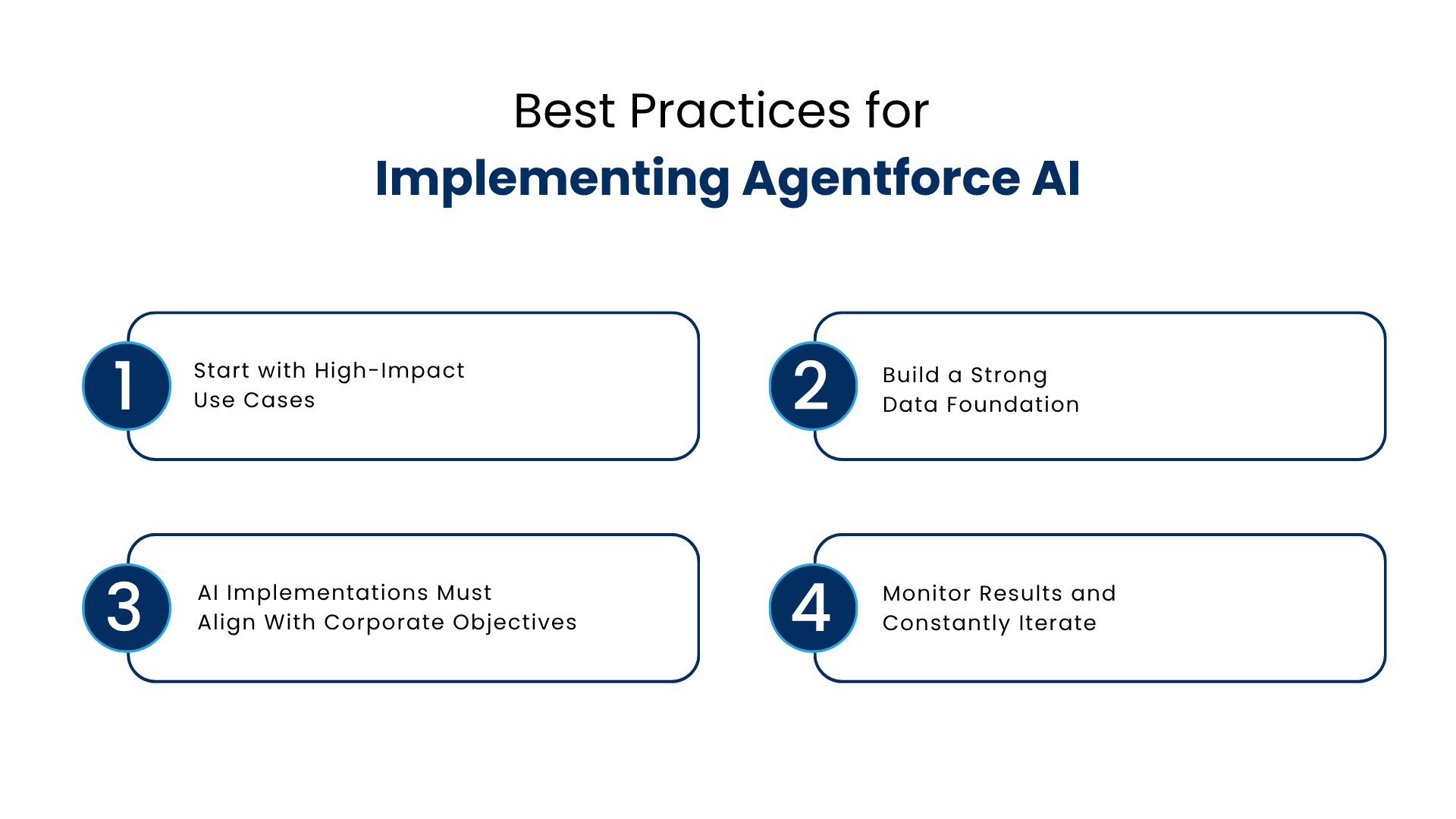
Start with High-Impact Use Cases
Do not try to automate everything at once. Identify the two or three workflows where slow decisions or manual work are costing the most, whether that is lead follow-up, service case routing, or renewal management, and start there. Early wins build confidence and reveal data quality gaps before you scale.
Build a Strong Data Foundation
Agentforce is only as good as the data it works with. Before deploying AI agents, audit your CRM for completeness and consistency. Duplicate records, missing fields, and disconnected systems produce unreliable recommendations. A clean data foundation is a prerequisite, not an optional step.
AI Implementations Must Align with Corporate Objectives
Each workflow implemented through Agentforce must have an identifiable goal in mind; whether quicker resolutions, improved win rates, reduced customer churn, more accurate forecasting, and so forth. It is important to determine exactly how the workflow will provide value prior to implementing it.
Monitor Results and Constantly Iterate
It is recommended to have regular review meetings each month in order to analyze agent performance, the implementation of workflow recommendations, and any shortcomings within the current workflow process. Agentforce grows with use, yet only when your company is continually optimizing their own workflow processes.
The Future of Salesforce Agentic AI and Enterprise Intelligence
Salesforce Agentic AI is moving toward fully autonomous operation. Today, Agentforce agents handle defined tasks within supervised workflows. The direction is toward agents that manage end-to-end processes independently, escalating to humans only when real judgment is needed.
Customer journey orchestration is also advancing. Rather than triggering one action at a time, future implementations will manage entire journeys across sales, service, and marketing simultaneously. The organizations building their data foundations now will have a clear advantage over those starting from scratch two years from now.
Conclusion
Data has never been the bottleneck. The bottleneck has always been turning data into decisions fast enough to matter. Salesforce Agentforce AI directly addresses that gap by putting AI agents inside the workflows where your teams already work, surfacing the right insights at the right moment and automating the tasks that slow everyone down.
The enterprises seeing the most impact are not the ones with the most data. They are the ones with the clearest data strategy, the strongest CRM foundation, and the right implementation partner to build AI workflows that connect to real business outcomes.
FAQs
What is Salesforce Agentforce AI?
The Salesforce Agentforce is a platform within Salesforce that leverages the capabilities of AI agents to automate tasks, provide recommendations, and help with decision-making right within the process flow of your CRM. Unlike most other tools for generating reports that are reviewed by people later on, Agentforce is an always-on platform that helps make sense of your customer data during live interactions.
How does Salesforce Agentforce AI assist with decision-making?
The Agentforce platform enables you to leverage data collected across all parts of your Salesforce system to gain contextual insights and recommendations. A salesperson will be able to decide which deals are more urgent to close, a service agent will see the full picture when handling a customer ticket, and a sales manager will have their forecasts automatically generated out of actual customer data in CRM.
What is Salesforce Agentforce AI and how does it work?
Agentforce is a feature in Salesforce that provides AI-enabled agents to handle all sorts of operations like case handling, deal risk analysis, email follow-ups, customer data management, and even workflows. Everything else is taken care of by AI agents while there is time left for humans to engage in meaningful discussions and decision-making.
How does Salesforce Data 360 contribute to Agentforce operations?
Salesforce Data 360 serves as the foundational data layer for Agentforce intelligence. It brings together customer information from various sources within your organization into one single profile, which comprises data from CRM systems, marketing campaigns, purchases made, and customer support details. Agentforce relies on the consolidated customer profile to provide context-aware recommendations that enhance business operations. If the data is not reliable, there will be no reliability when using AI-powered recommendations.
How do companies measure ROI from Agentforce AI?
ROI can be measured through metrics associated with business processes and workflows such as time spent resolving customer issues, increasing win rate for sales leads, increasing forecast accuracy, reducing task times, and minimizing the customer churn rate. Ensure that you define the specific metrics to measure after launching Agentforce AI so you can measure and improve business processes.
For more insights, updates, and expert tips, follow us on LinkedIn.