

How to Move From AI Code to Production Ready Salesforce Apps with Agentforce for Developers
Writing Salesforce code with AI is no longer the hard part. A developer can describe a requirement in plain language and get working Apex, Lightning components, or flow logic back in seconds. The harder question is what happens next: how that generated code becomes something a business can actually run, safely and reliably, in production.
This is the real challenge behind Agentforce for developers. Teams are not struggling to generate code anymore. They are struggling to validate it, secure it, test it against real business processes, and turn it into an application their organization can trust. Getting that transition right is what separates a fast demo from a dependable Salesforce app.
Agentforce for Developers is Now Agentforce Vibes
If you have researched this topic before, you may know the developer tooling by an earlier name. What Salesforce previously called Agentforce for Developers has evolved into a broader AI-assisted development environment built into the Salesforce platform.
This context includes the VS Code extension as well as the browser-based integrated development environment (IDE) developers employ in planning, creating, debugging, and deploying Salesforce metadata, agents, and applications via natural language prompts. It analyzes the organization’s schema and code first before generating any code, which is why its outputs are more relevant than the outputs generated by a general-purpose AI programming assistant. The core objective remains the same, but the jargon has evolved.
For this article, the practices matter more than the product name. Whether your team calls it Agentforce for developers or simply AI-assisted Salesforce development, the path from generated code to production is the same.
Start With the Business Outcome, Not the Prompt
Prior to the use of an AI programming platform, there must be consensus among the group as to how the application will benefit the firm. Failure to do so results in the most common reasons why AI-generated code goes unused.
A well-defined starting point usually includes:
- The specific business process being supported (a service case, a lending workflow, a lead qualification step)
- Who will use the resulting app or agent, and what decisions they need to make
- Which Salesforce objects, records, and permissions are already involved
- Any compliance, approval, or audit requirement tied to the process
- What “done” looks like in terms of business results, not just working code
When this groundwork exists, prompts to an AI tool become sharper and the resulting code needs far less rework. Without it, developers end up prompting in circles, generating logic that technically runs but does not match how the business actually operates.
A Practical Workflow From Prompt to Production
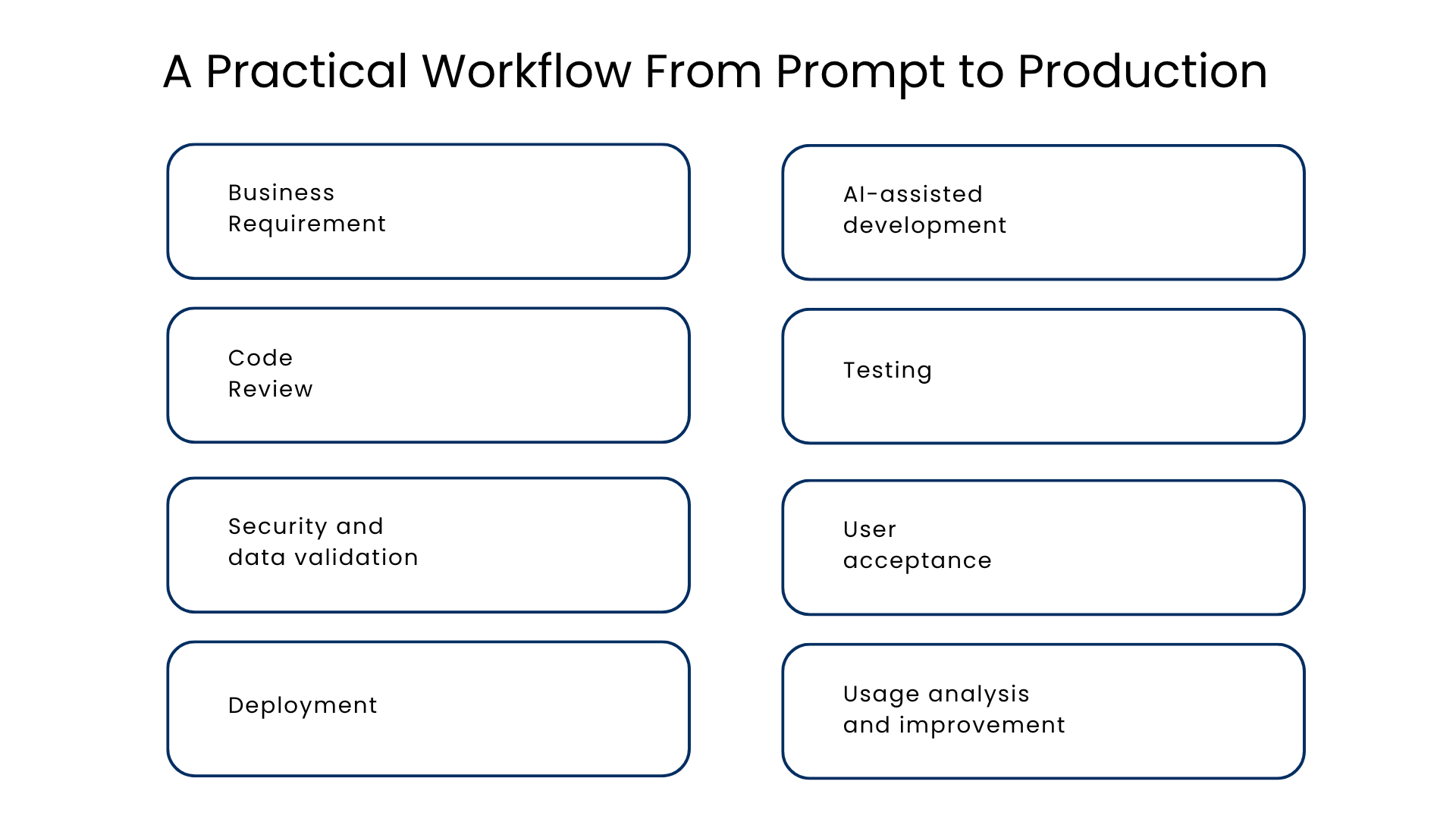
Moving from an AI-generated first draft to a production-ready Salesforce app follows a fairly consistent sequence, regardless of the specific use case.
- Business Requirement: The team defines the process, users, and intended result.
- AI-assisted development: A developer leverages Agentforce development tooling to create a first draft of the code, component, or agent configuration.
- Code Review: A human developer reviews the code line-by-line, verifying logic, nomenclature, and alignment with existing architecture.
- Testing: Code testing includes unit testing, integration testing, and testing for corner cases – not only the happy path scenario.
- Security and data validation: Security at the field level, sharing, and data access are validated against actual user profiles.
- User acceptance: End users test the application in a sandbox environment and verify that it solves the problem it was developed to solve.
- Deployment: The validated code goes live using regular release management processes, not shortcuts.
- Usage analysis and improvement: Application usage and errors are logged after launch, and the application is improved based on actual use.
None of these steps are unique to AI-assisted development. What changes is the volume of code arriving for review, which makes a consistent process more important, not less.
What a Production-Ready Salesforce App Should Pass
Before any AI-assisted build goes live, it helps to check it against a short list of practical questions rather than assuming that working code equals finished code.
| Development Stage | AI Can Help With | Human Validation Needed |
| Planning | Drafting user stories, suggesting object structures | Confirming the plan matches actual business process |
| Development | Writing Apex, triggers, flows, and components | Reviewing logic, naming, and architectural fit |
| Testing | Generating test class scaffolding | Covering edge cases, negative scenarios, and data variety |
| Security | Flagging obvious permission gaps | Verifying field-level security and sharing rules against real profiles |
| Deployment | Preparing deployment packages | Following change management and rollback planning |
A genuinely production-ready application should be able to answer yes to each of these:
- Does it solve the business task it was built for?
- Does the code behave correctly under normal and unusual conditions?
- Has it been tested with more than one type of user and data scenario?
- Does it respect existing security and access rules?
- Does it fit cleanly into current Salesforce processes rather than working around them?
- Can the people using it understand and operate it without special training?
- Can the team maintain and extend it after the original developer moves on?
Where Industry Context Changes the Implementation
Development of such an application may also vary dramatically from one industry to another. In the Financial Services industry, for instance, an AI-powered workflow involving customer onboarding should be approached more carefully due to the involvement of certain KYC procedures, private information, and other aspects, all of which should be considered to declare this solution completed. Agentforce for Financial Services is designed with consideration of this specific approach.
A support-routing agent for a retail business and a policy-question agent for an insurer might start from a similar AI-generated foundation, but the second one carries far more weight around audit trails, disclosures, and approval steps. Recognizing where industry context adds requirements, rather than assuming every use case needs the same level of scrutiny, keeps validation effort proportional to actual risk.
Similarly, Agentforce for Service applies this same idea to customer support, where an AI-assisted agent needs to reflect existing case management rules, escalation paths, and service level commitments before it can be trusted with real customer interactions.
From Developer Tool to Business Solution
Code generation is truly helpful. However, this is not a deployment approach per se. What is required to make use of AI-generated code in an enterprise setting? Here are several prerequisites that are not inherent to any code generation tool:
- Understand the business process for which the application is generated
- Knowledge about the particular Salesforce environment where the application will be running and its customization specifics
- Deployment governance – what will be deployed, by whom, and through what review process
- Testing approach that does not diminish because code generation was quick
- Application maintenance plan post-deployment
Teams that treat the Agentforce platform as one part of a broader implementation process, rather than a shortcut past it, tend to end up with applications that actually get used. Teams that skip straight from prompt to production usually end up rebuilding.
This is also where working with people who understand both the technical platform and the business side of Salesforce implementation makes a measurable difference. AI can draft the code. Getting that code into a Financial Services onboarding flow, a service queue, or a lead qualification process that a team relies on daily still takes judgment, testing, and Salesforce experience.
FAQs
What is Agentforce for developers?
The term “Agentforce for developers” means the AI-powered features integrated into Salesforce to assist developers with creation, verification, and enhancement of Apex, components, and agents using natural language. This is a part of the bigger set of development tools which will be described in the following question.
What is Agentforce Vibes?
This is Salesforce’s AI-assisted development environment consisting of the VS Code extension and browser-based IDE for planning, developing, debugging, and deploying Salesforce applications, agents, and metadata using natural language prompts.
Can AI-generated Salesforce code be deployed to production without changes?
Generally, no. The AI-generated code must go through the developer’s verification, testing, and validation processes in terms of its security since the logic behind it may fail to take into account all possible use cases or business rules of the organization.
How to validate AI-assisted Salesforce applications before going live?
One needs to make sure that the application meets the business goal, perform functional testing and edge cases testing, validate security and sharing rules for actual user profiles, and test the application with business users in the sandbox.
For more insights, updates, and expert tips, follow us on LinkedIn.


Comments (02)