

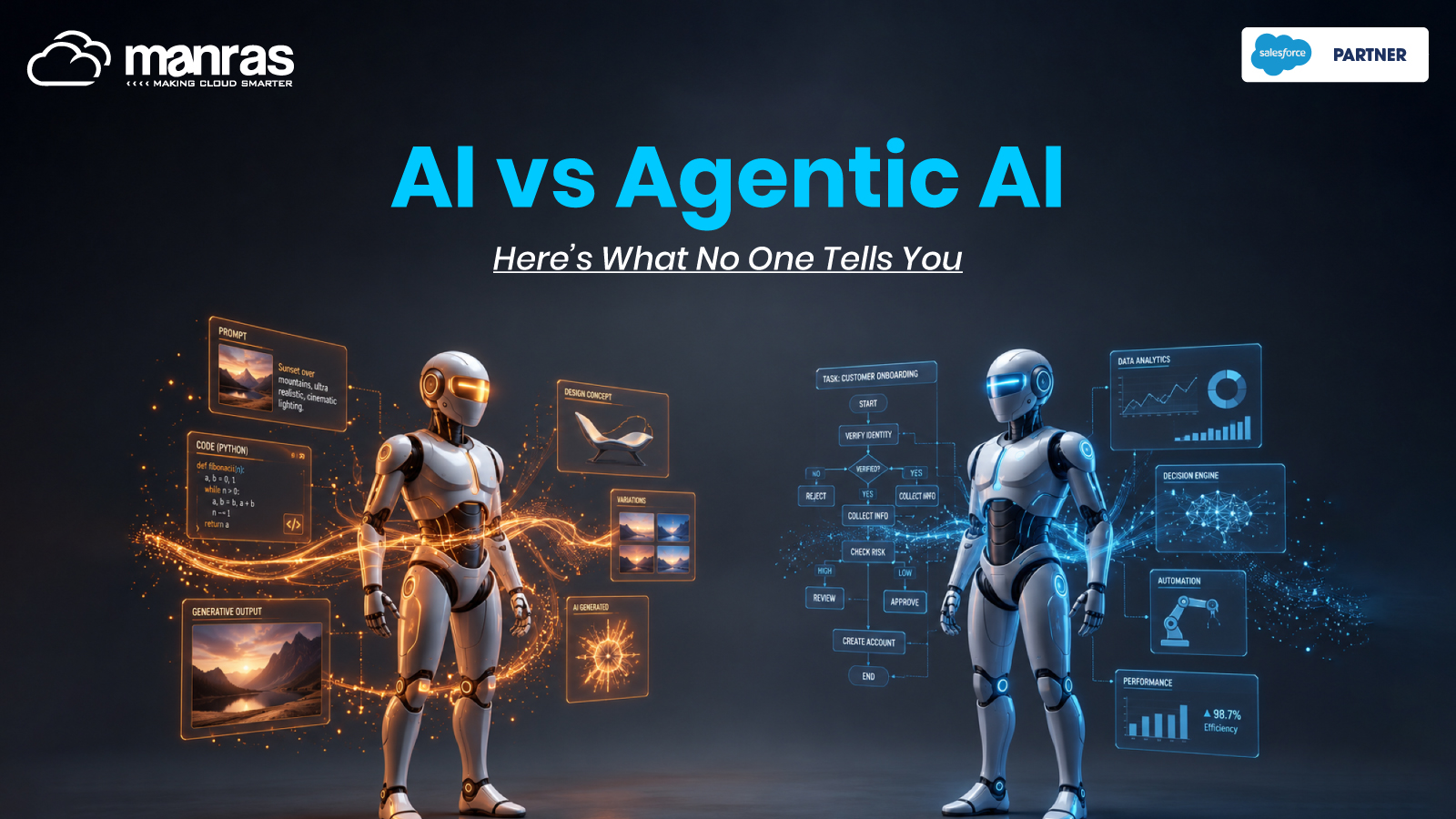
AI Vs Agentic AI: Are They Same or There Is A Different Story?
Ever imagined what will happen if there is one digital agent that does not need a set of predefined rules, take decisions on its own, and perform the tasks seamlessly. This is what Agentic AI is built for and has a different significance than traditional AI models which work on already decided rules.
Salesforce Agentic AI does everything without the need of continuous prompts unlike traditional AI models that cannot work independently in the absence of prompting.
For businesses who think AI and Agentic AI are the same term, this blog is worth reading as it explains what they are, how they are different from each other, what value each of them can add, and what is the future ahead.
What Most People Think “AI” is in Business Context?
For most of the last decade, AI in a business context meant one of a few things.
- A chatbot that handled FAQs
- A recommendation engine that suggested the next product
- A forecasting tool that gives you a probability score on a deal
- A lead scoring model that ranks prospects based on their likelihood to convert
- A marketing platform that recommends the best time to send campaigns
- An analytics dashboard that surfaces patterns hidden in large amounts of data
All these are useful things, genuinely, but all of them shared one important characteristic: they responded. They waited for an input, produced an output, and stopped.
This is what’s sometimes called narrow AI or reactive AI.
It’s pattern recognition at scale. It’s fast, it can be accurate most of the time, and it handles volume that no human team could manage manually.
But the downside is, it does not plan things on its own. It doesn’t sequence its own actions. It doesn’t look at a situation, decide what needs to happen next, go do that thing, check whether it worked, and then adjust.
Is Traditional AI Becoming Outdated?
Not exactly, but the way most businesses think about it probably is.
Traditional AI isn’t going anywhere. Lead scoring models still rank prospects. Recommendation engines still drive product suggestions. Analytics dashboards still surface patterns that would take a human analyst days to find. None of those stops being useful just because something more capable has entered the conversation.
What’s actually becoming outdated is the assumption that this is the ceiling. That responding to prompts, producing outputs, and handing control back to a human is the most AI can do for a business. For years, that assumption went unchallenged because the tools were genuinely good at what they did and good felt like complete.
The Agentic AI has entered the workflows of modern businesses. The shift happening now isn’t about replacing reactive or traditional AI.
It’s about understanding where it ends and where something fundamentally different begins.
Businesses that treat traditional AI as the destination will keep getting the same results they’ve always gotten.
The ones that recognize it as the foundation and build from there, are operating with a different set of possibilities entirely.
The question was never AI versus Agentic AI. It’s knowing which one you’re actually dealing with, and what each one is genuinely built to do.
Agentic AI: What It Actually Does That Regular AI Doesn’t
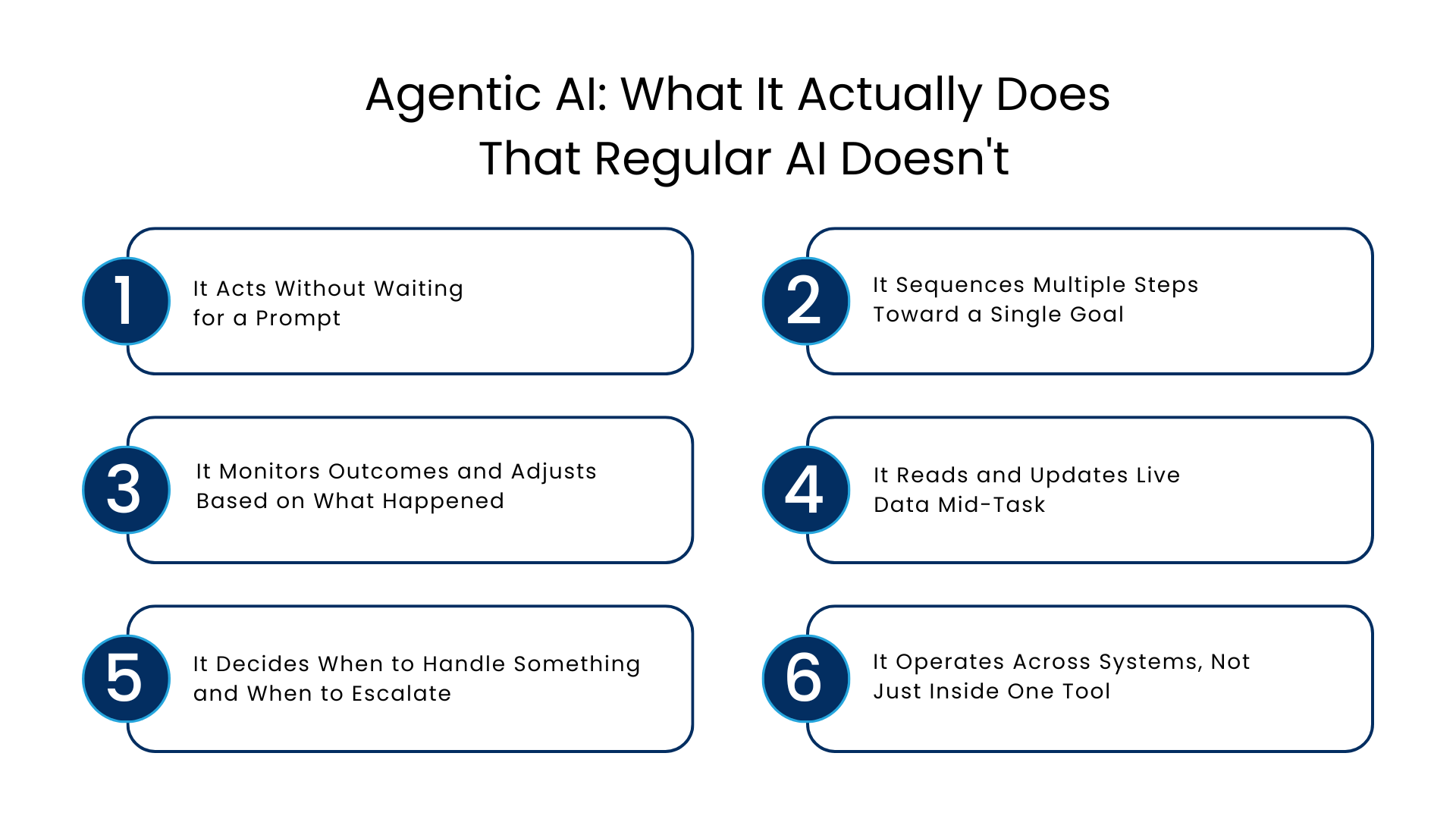
It Acts Without Waiting for a Prompt
Traditional AI sits idle until a human asks it something whereas an agentic AI platform monitors the environment it’s connected to and acts when conditions call for it, no trigger required from a person.
A deal goes quiet for ten days and the agent reaches out. A service ticket stays unresolved past its SLA and the agent escalates it. The work happens because the situation warranted it, not because someone remembered to ask.
It Sequences Multiple Steps Toward a Single Goal
Give a traditional AI tool one task and it completes one task.
Salesforce Agentic AI understands that most real business goals involve a chain of actions and it manages that chain. Qualify the lead, assign it, send the first message, log the response, update the pipeline stage, schedule the follow-up. Each step informs the next, and the agent handles all of it as part of pursuing a single objective.
It Monitors Outcomes and Adjusts Based on What Happened
Regular AI doesn’t know whether its output did anything useful. It produced the result and moved on. Agentic AI closes that loop, it checks what happened after it acted, evaluates whether the outcome moved toward the goal, and changes its approach if it didn’t. That feedback cycle is what makes it capable of operating in real business conditions rather than controlled, predictable ones.
It Reads and Updates Live Data Mid-Task
Most AI tools work with the data they were given at the start of a task. Agentic AI pulls from live systems as it works; checking current CRM records, reading recent activity, updating fields as outcomes change. By the time it completes a task, the data it touched reflects reality, not a snapshot from when the task began.
It Decides When to Handle Something and When to Escalate
One of the most practically important things an Agentic AI system does is known its own limits. It doesn’t try to manage every situation to completion. When a conversation needs real negotiation, a complaint requires genuine empathy, or a decision is outside its defined scope, it hands off. The human who receives that handoff gets full context already prepared, not a half-managed situation to untangle.
It Operates Across Systems, Not Just Inside One Tool
Traditional AI typically works within the boundaries of the platform it lives in. Agentic AI is built to move across systems; pulling data from one, triggering actions in another, updating records in a third. That cross-system capability is what allows it to handle end-to-end workflows rather than isolated tasks inside a single tool.
AI vs Agentic AI: A Clear Comparison
| Parameter | Traditional AI | Agentic AI |
| Working Model | Responds to inputs when prompted | Reasons independently and acts on its own judgment |
| Decision making Process | Follows predefined rules and patterns | Evaluates live context and decides the appropriate action |
| Human Intervention | Required at every step to direct the next action | Human sets the goal and guardrails, agent handles execution |
| Task handling | Completes one task per input | Manages multi-step sequences toward a broader goal |
| Data interaction | Reads data to generate an output | Reads, processes, and updates live data throughout the task |
| Outcome monitoring | Produces output and stops | Monitors what happened and adjusts the next action accordingly |
| Error handling system | Flags errors or produces incorrect output | Detects when something isn’t working and changes approach |
| Escalation | Cannot determine when human input is needed | Identifies when to hand off and prepares the human with full context |
| Best suitable for | High-volume, rule-based, repetitive tasks | Complex, goal-driven workflows requiring sequenced decisions |
What Salesforce Agentforce Actually Is and What It’s Built to Do?
It’s a Framework for Building Agents, Not a Chatbot Layer
SF Agentforce is not an upgraded bot. It’s a platform for deploying AI agents that live inside Salesforce and take real actions across business workflows, each with a defined role, set permissions, and clear boundaries around what it can and cannot do.
Agents Work from the Full CRM Picture
Every agent built on Agentforce has access to the full CRM record; deal history, past conversations, open tickets, purchase data. What makes Salesforce AI agents effective is that their responses are grounded in what’s actually true about that customer, not pulled from a generic script.
Businesses Set the Guardrails and Agents Operate Within Them
Every agent works within boundaries the business defines, what data it can access, what actions it can take, when to hand it off to a human. The Salesforce AI agent platform doesn’t act outside those parameters. Control stays with the business, not the system.
Real Use Cases Across Sales, Service, and Operations
A sales agent monitors pipeline, spots stalled deals, and initiates outreach without a rep involved. A service agent resolves common queries using live account data and hands off complex ones with full context ready. These aren’t demos, they’re running in businesses today.
Why Does This Matter More for Some Businesses Than Others?
Not every business is at the same point in this conversation, and that’s worth being honest about.
A company with clean Salesforce data, well-defined sales and service processes, and a team that’s already working effectively in the CRM is in a strong position to get real value from Salesforce AI agents quickly.
The agents have good data to work from, clear processes to operate within, and a team that understands the system well enough to set appropriate guardrails and evaluate what the agents are doing.
A business with already fragmented data, inconsistent CRM adoption, and undefined processes is in a different position. Deploying Agentic AI on top of a messy foundation doesn’t fix the foundation, it automates the mess. The technology doesn’t create the clarity it needs to operate well. That has to come first.
This is the conversation Manras has with clients before any Agentforce engagement.
Not “here’s what the platform can do” but “here’s what your business needs to have in place for the platform to do it well.”
Sometimes that means addressing the data architecture first. Sometimes it means revisiting how pipeline stages are defined or how leads are categorized. The technology is ready. The question is whether the business is.
For the ones that are or are willing to do the work to get there the gap between what a team can handle manually and what becomes possible with Salesforce Agentforce running across sales, service, and operations is genuinely significant. Not in a product-demo sense. In a day-to-day operational reality sense.
Conclusion
AI and Agentic AI are not the same thing. One responds. The other reasons, acts, evaluates, and keeps going. That difference is not a marketing distinction, it changes what a business can actually do with the technology and how much human attention each outcome requires.
Salesforce AI agents built on the Agentforce framework represent the most practical implementation of Agentic AI available inside an enterprise CRM today.
For businesses that are ready to move beyond AI as a productivity tool and start using it as an operational layer; one that handles execution, not just assistance, this is where that conversation starts.
Manras works with businesses at every stage of Salesforce maturity to build the foundation that makes Salesforce Agentic AI genuinely useful, not just technically deployed. If you’re trying to understand what this means for your specific operation, that’s exactly the conversation worth having. Talk to a Manras Salesforce Expert About Agentforce.
FAQs
What’s the simplest way to explain the difference between AI and Agentic AI?
Regular AI responds to what you ask it. Agentic AI figures out what needs to happen, does it, checks the result, and decides the next step without needing a human to manage each transition. One is a tool you operate. The other operates on your behalf.
Do you need to already be using Salesforce to use Agentforce?
Yes. Salesforce Agentforce is built on the Salesforce platform and works within the existing CRM environment. The agents draw on your CRM data, operate within your pipeline workflows, and take actions inside Salesforce which is also why businesses with clean, well-structured Salesforce data get the most out of it fastest.
Is Agentic AI safe to use in a customer-facing context?
When deployed properly, yes. Agentforce agents operate within defined guardrails , they know what they can access, what actions they’re permitted to take, and when to escalate to a human. The business sets those boundaries during implementation. Agents don’t act outside them.
How does Manras help businesses get started with Salesforce AI agents?
We start with an honest assessment of where the business is; data quality, process definition, current Salesforce adoption. From there, we identify which agent use cases will deliver real value quickly and build from there. The goal is working AI agents that your team trusts, not a technically impressive deployment that nobody’s sure how to use.
For more insights, updates, and expert tips, follow us on LinkedIn.