

Why Accurate Reporting and Data Integrity in Salesforce Matter More Than You Think?
Here’s something most Salesforce admins don’t want to admit out loud: a surprising amount of what lives inside the average Salesforce org is junk, error-prone or unnecessary. .
Duplicate contacts. Leads with missing fields. Accounts that were never properly merged. Opportunity stages that haven’t moved in eight months but nobody’s closed them out. A custom field that three different people use in three completely different ways because nobody documented what it was for.
It happens gradually. In fact, it seems like a common practice. The org starts clean, everyone has good intentions, and after a few weeks or months, real life takes over. Teams get busy, data hygiene slips, and before long you’re running reports that nobody fully trusts.
That’s not a Salesforce problem. That’s a Salesforce Data Integrity problem. And fixing it or better yet, preventing it is one of the highest-leverage things you can do for your business.
What Does Data Integrity Actually Mean in Salesforce?
Data integrity, at its core, means that the information in your Salesforce org is accurate, consistent, complete, and trustworthy.
It’s not just about having clean contacts, it’s about making sure every record across every object reflects reality, and that the relationships between those records actually make sense.
In practice, Salesforce Data Integrity covers several things simultaneously.
You need records to be accurate; what’s in the field should be correct. You need them to be complete with required fields filled, no half-created records floating around.
You need consistency; the same data shouldn’t look different across related objects.
And you need timeliness, information should be updated as things change, not three weeks later when someone finally gets around to it.
When all four of those are working together, your Salesforce org becomes genuinely useful. Reports reflect reality. Forecasts can be trusted. Sales teams spend time selling instead of debating whether a lead is actually qualified.
When even one breaks down, the whole thing starts to feel unreliable and an unreliable CRM is almost worse than no CRM at all, because it gives you false confidence.
Why Data Integrity Breaks Down Fast?
Maintaining data integrity in Salesforce is genuinely difficult, and it’s worth understanding why before jumping to solutions.
Volume
Salesforce orgs accumulate data fast because of leads from multiple sources, contact updates, opportunity modifications, activity logs. When data is coming in from web forms, marketing automation platforms, manual entry, and third-party integrations all at once, inconsistencies creep in at every entry point.
Human behaviour
Sales teams, understandably, are focused on deals, not on filling in the Industry field or making sure the Account Name is formatted consistently. Data hygiene feels like admin work, and admin work loses to closing deals every single time.
Technical debt
Every customization, workflow, and integration added to your org over time creates new potential points of failure. A field that was meaningful two years ago may now be redundant. An integration that was set up in a hurry may be creating duplicate records silently in the background. These things accumulate.
None of this is anyone’s fault in particular. It’s just what happens when a complex platform meets real-world business operations.
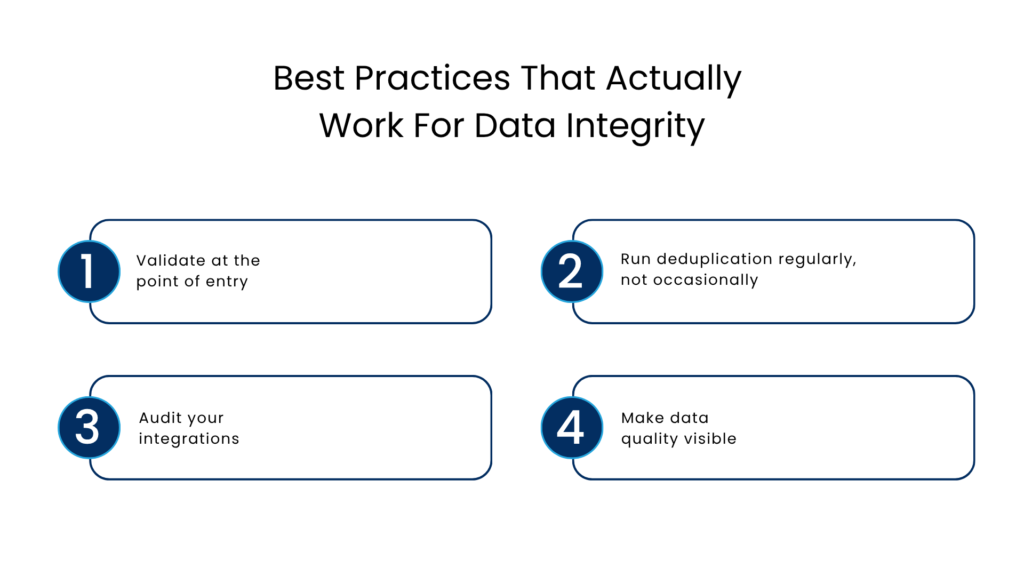
Best Practices That Actually Work For Data Integrity
This is where most articles give you a generic checklist. Instead, here are data integrity best practices that are grounded in how Salesforce orgs actually behave in the real world.
Validate at the point of entry
Salesforce gives you validation rules, required fields, picklist restrictions, and duplicate management rules. Use them proactively, not reactively. The best time to stop bad data from entering your org is before it enters and not three months later when you’re doing a cleanup project.
Run deduplication regularly, not occasionally
Duplicate records are one of the most common and most damaging forms of data corruption in Salesforce. Native duplicate rules help, but most mature orgs will need a third-party deduplication tool for deeper cleanup. Schedule it. Don’t treat it as a one-time project.
Audit your integrations
Every system that pushes data into Salesforce is a potential source of corruption. Review your integration mappings periodically, especially after updates to connected systems to make sure data is arriving in the right fields, in the right format, without creating unintended duplicates.
Make data quality visible
If nobody can see how clean or dirty the data is, there’s no pressure to improve it. Build dashboards that surface data quality metrics; incomplete records, overdue follow-ups, stale opportunities. When the health of the data is visible to leadership, it tends to improve.
How Does Salesforce’s Own Tools Support Data Integrity?
Salesforce has been investing heavily in data infrastructure over the past few years, and it shows.
Salesforce Data 360 is a significant part of that direction bringing together data from across the Customer 360 ecosystem to give businesses a more unified, accurate view of their customers. The idea is straightforward: better connected data means fewer gaps, fewer inconsistencies, and a more reliable foundation for every team using the platform.
Salesforce Headless 360 takes a related but distinct approach enabling businesses to surface Salesforce data across different channels and touchpoints without being locked into a single front-end experience. For companies operating across multiple interfaces, this matters because it reduces the risk of data getting out of sync between systems.
Both are part of Salesforce’s broader push toward making data more trustworthy at the infrastructure level,not just at the admin level.
As a result, Salesforce Data Security and integrity ultimately depend on how your org is configured, governed, and maintained. The best data infrastructure in the world doesn’t compensate for bad entry practices or ungoverned integrations.
Conclusion
Salesforce Data Integrity isn’t a project that is done once and a business can move on from. It’s an ongoing commitment; part governance, part technical configuration, part team culture.
The good news is that the payoff is real and measurable. Cleaner data means more accurate forecasting, faster sales cycles, better customer experiences, and leadership teams that actually trust the reports sitting in front of them.
If your Salesforce org has been running for a while and data quality has never been a formal priority, the gap between where you are and where you could be is probably larger than you’d expect and closer to close than you think.
Start with an audit. Understand what’s broken and why. Then fix the entry points before touching the existing mess. It’s slower than doing a bulk cleanup first, but it’s the only approach that actually sticks.
Manras- A Trusted Salesforce Platinum Partner, can help you with this if you are planning to put an extra check on your data integrity. Book a demo and ask your queries today!
FAQs
What is Salesforce Data Integrity and why does it matter?
It refers to the accuracy, completeness, consistency, and reliability of data stored in your Salesforce org. When it breaks down, reports become untrustworthy, sales teams waste time on bad data, and customer experiences suffer directly.
What are the most common causes of data integrity issues in Salesforce?
Duplicate records, missing required fields, inconsistent data entry standards, poorly governed integrations, and lack of validation rules at the point of entry are the most frequent culprits.
How often should we audit our Salesforce data?
At minimum, a quarterly data quality review is advisable for most orgs. High-volume orgs with multiple integrations benefit from monthly checks and real-time dashboards that surface data quality issues continuously.
Is data integrity the same as data security in Salesforce?
They’re related but distinct. Data security governs who can access and modify records. Data integrity governs whether those records are accurate and consistent. Poor security configuration, however, directly contributes to integrity problems,so the two should be addressed together.
What’s the difference between Salesforce Data 360 and Salesforce Headless 360?
Data 360 focuses on unifying customer data across the Salesforce ecosystem for a more complete and accurate customer view. Headless 360 enables Salesforce data to be surfaced across multiple front-end experiences without being tied to a single interface.
For more insights, updates, and expert tips, follow us on LinkedIn.