

Salesforce Revenue Cloud: Why Your Revenue Operations Need a Single Source of Truth
Most revenue ops teams aren’t failing because they lack effort. They’re failing because the systems underneath them were never built to scale.
Here’s the industry truth that doesn’t get said enough: the average B2B revenue operation runs on at least three disconnected tools, a CRM that owns the pipeline, a billing system that owns the invoices, and a spreadsheet that somehow owns everything in between.
Each one works fine in isolation. Together, they create a version of your revenue that nobody fully trusts, and no single person can see clearly.
That’s the real problem. Not effort, not people, it is infrastructure. Salesforce Revenue Cloud is built specifically to fix it, by bringing quoting, billing, subscriptions, and revenue recognition into one connected system that your entire team can actually rely on.
The Hidden Tax of Fragmented Revenue Operations
Fragmented revenue ops don’t announce themselves with a single crisis. They show up as small, persistent friction that compounds quietly over months and the cost is almost always larger than it looks on the surface.
Sales closes a deal on one set of numbers. Billing goes out with different ones. A renewal lapses because it lived in a calendar reminder that nobody checked. A forecast gets built from exports, manual edits, and educated guesswork. By the time anyone notices the pattern, the damage is already spread across every team that touches revenue.
Here’s what that friction actually looks like, broken down:
- Invoicing errors caught after the customer already received a wrong bill or not caught at all
- Delayed revenue recognition because the data needed to close the books is scattered across systems
- Renewal gaps where subscriptions lapse due to lack of visibility, not lack of intent
- Pricing mismatches between what sales quoted and what billing actually charged
- Forecasting built on guesswork because no single person has a trusted, complete view of the pipeline
Revenue Lifecycle Management systems like Salesforce Revenue Cloud doesn’t patch these problems one by one. It removes the structural conditions that create them.
What Does the Salesforce Revenue Cloud Actually Do?
Think of it as the connective tissue your revenue operation has been missing. Every stage of the journey, starting from the first quote to the final payment, runs through one unified system, with no manual handoffs or data re-entry between steps.
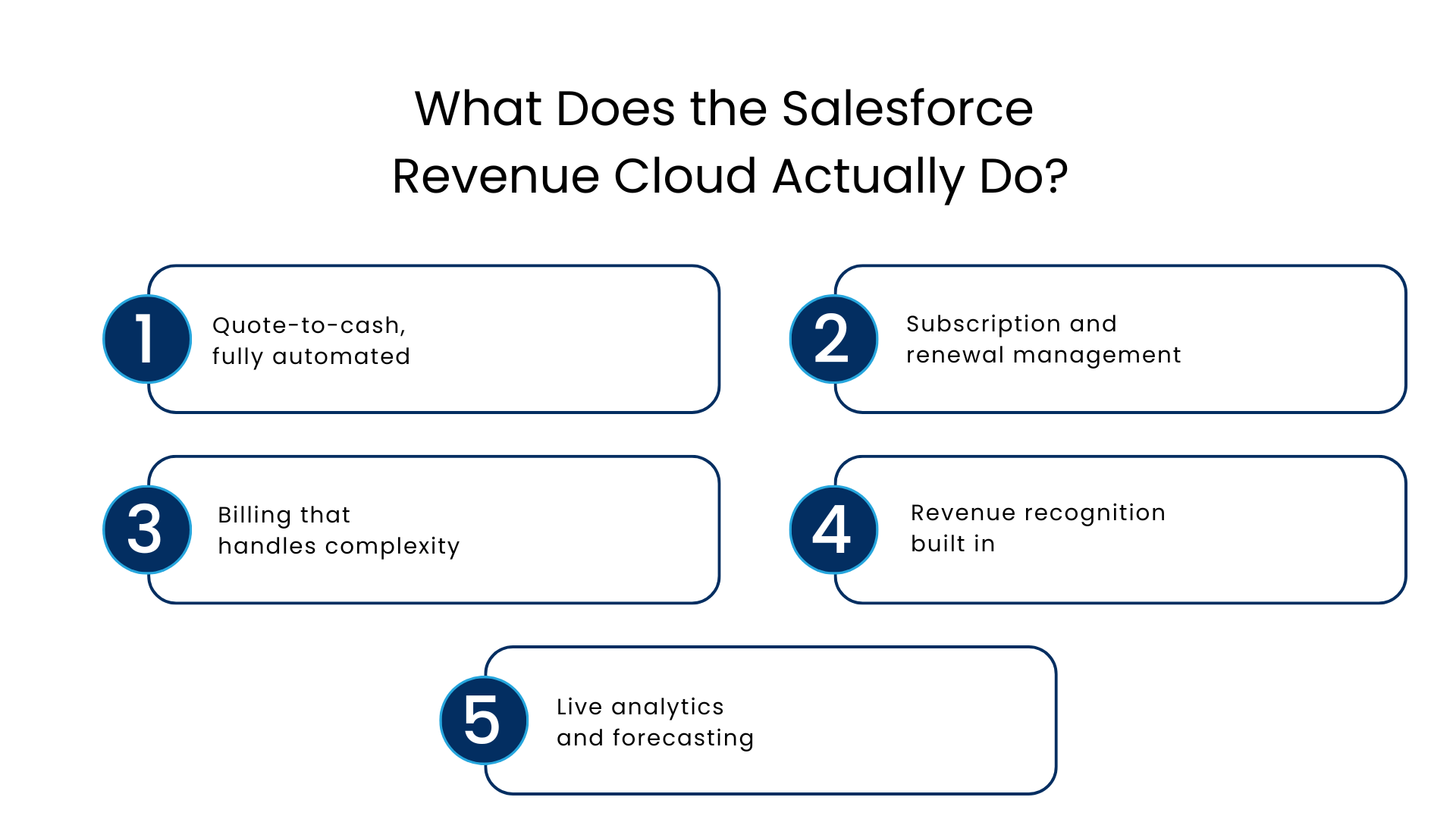
- Quote-to-cash, fully automated: The gap between generating a quote and collecting payment becomes a clean, automated workflow. What used to involve three teams, and two systems now happens in one place.
- Subscription and renewal management: Recurring revenue is notoriously hard to manage manually. The platform handles upgrades, renewals, cancellations, and changes automatically with real-time updates to billing and revenue records as they happen.
- Billing that handles complexity: Usage-based, seat-based, milestone-based, hybrid. Whatever your pricing model looks like, the platform accommodates it without custom workarounds for every edge case.
- Revenue recognition built in: Automated recognition that stays in sync with your transactions, reduces manual overhead for the finance team, and keeps compliance requirements front and center.
- Live analytics and forecasting: Your revenue ops team gets real-time visibility into pipeline health, renewal rates, and revenue trends. No more waiting for a monthly export to understand where things stand.
This is what a mature Revenue Lifecycle Management approach looks like in practice, not reacting to problems, but having the infrastructure to prevent them from forming.
Who Actually Needs the Salesforce Revenue Cloud?
Any team where revenue doesn’t come from simple, one-time transactions will feel the weight of managing it manually at some point.
- SaaS companies juggling subscription tiers and usage billing.
- Professional services firms tracking project milestones and retainers.
- Manufacturers with complex pricing configurations and volume agreements.
- Financial services or healthcare organizations with tight compliance requirements around billing and recognition.
What all of this share is a need for Salesforce Revenue Lifecycle Management that handles complexity without multiplying it.
The moment your revenue model has more than one dimension; recurring charges, multiple products, tiered pricing, multi-currency, the cost of managing it manually starts climbing whether you’re watching it or not.
How Does It Connect to the Rest of Your Salesforce Stack?
One of the most underrated advantages of this platform is how naturally it extends what your team already uses.
Salesforce Agentforce Management capabilities integrate directly into the revenue workflow surfacing AI-driven signals like at-risk renewals, upsell opportunities, and high-priority accounts, all based on live revenue data.
Rather than asking your team to dig through reports to figure out where to focus, the platform puts that context directly in front of them. It’s the difference between a team that reacts to revenue problems and one that sees them coming.
The Workaround Progression and Why It Always Ends the Same Way?
Most businesses don’t invest in proper revenue infrastructure on the first try.
The progression is predictable: start with spreadsheets, hit the limits of spreadsheets, bolt on a billing tool, realize the billing tool doesn’t talk to the CRM, build a custom integration, watch that integration quietly break six months later.
Each step feels like a reasonable fix at the time. The problem is that none of them address the root issue. Revenue Lifecycle Management Software only works when it’s actually connected.
In other words, you will be able to react to revenue challenges before they even occur.
Signs Your Current Setup Has Hit Its Ceiling
Revenue ops teams are often the last to call it because they’re the ones holding things together with workarounds. But a few signals are hard to ignore:
- Sales and finance are regularly working from different numbers with no clear reason why
- Subscription renewals are managed reactively;caught when they lapse, not before
- Building a revenue report means pulling from multiple systems and reconciling manually
- New pricing models take weeks to operationalize because the billing system can’t accommodate them
- The finance team spends more time correcting errors than analyzing performance
Two or more of these means the infrastructure is the problem, not the team.
What to do next?
Implementing Salesforce Revenue Cloud is not just a configuration project. The decisions made in the early stages of implementation shape how the platform performs for years.
Get them right, and the system becomes a genuine competitive advantage. Get them wrong, and you’re rebuilding within eighteen months.
Manras Technologies works as a true implementation partner not just technically, but operationally. As Salesforce Revenue Lifecycle Management Experts, the team takes time to understand how your revenue actually flows before touching a single configuration setting. That means mapping your real-world billing models, pricing structures, approval processes, and edge cases, then building an implementation that reflects them, rather than working around generic defaults.
The ongoing relationship matters too. Manras doesn’t disappear after go-live. As your business evolves with new products, new markets, new pricing models, they’re there to make sure the platform evolves with it.
If you’re looking for a partner who treats your revenue operations with the same care you do, that’s exactly what Manras brings to the table.
Conclusion
The businesses winning at revenue ops right now aren’t doing anything dramatically different from their competitors in terms of effort or talent. They’ve just built infrastructure that compounds in their favor: clean data, automated processes, real-time visibility while everyone else is still manually reconciling last quarter’s numbers.
Salesforce Revenue Cloud is that infrastructure. And the right implementation partner is what determines how quickly and how fully you actually capture its value.
Manras is ready to have that conversation whenever you are. Book a Consultation with Manras
FAQs
What is Salesforce Revenue Cloud?
A connected platform built natively on Salesforce that manages the full revenue lifecycle quoting, billing, subscriptions, and revenue recognition in one place. It keeps your CRM, sales pipeline, and finance data in sync automatically, eliminating the gaps that come from running disconnected tools.
Which businesses benefit most from Revenue Lifecycle Management?
Any business with recurring revenue, complex pricing, or multi-product billing. SaaS, professional services, manufacturing, and financial services are the most common, essentially anywhere the process between quote and cash involves more than one team or system.
How does Salesforce Revenue Lifecycle Management Software handle subscriptions and renewals?
Upgrades, downgrades, renewals, and cancellations are automated based on rules your team defines. Renewal dates are tracked proactively, billing adjustments happen in real time, and revenue records update automatically, no manual intervention needed at each step.
Why work with Manras rather than handling implementation internally?
The platform’s long-term performance is shaped by early configuration decisions that aren’t always obvious without experience. Manras brings cross-industry implementation expertise that reduces costly mistakes, shortens time-to-value, and ensures the system is built to last — not just built to launch.
For more insights, updates, and expert tips, follow us on LinkedIn.