


Importance of Creating a Utility Framework in Salesforce
The Salesforce CRM is a complex logic based environment that uses several codes and logics to run smoothly. However, as the implementations and integrations grow in size and complexity, it becomes critical and equally challenging to maintain clean scalable and efficient codes.
As the CRM setup starts evolving to a complex and customized ecosystem with triggers, lightning components, batch jobs, validation rules, and automation layers working together, the importance of creating a utility framework in Salesforce rises.
Without a utility framework in place, the complexity of the CRM leads to duplicated logic, inconsistent coding patterns and structures, inefficient integrations, and rising technical debt. A utility framework solves this problem by creating a centralized repository of the codes.
In simple terms, utility frameworks in Salesforce CRM are reusable code architectures that save the developers’ time to rewrite logic in multiple cases and also avoids duplicacy in codes. When developers use these frameworks they improve consistency and maintainability of codes.
What are the Core Provisions of a Utility Framework in Salesforce?
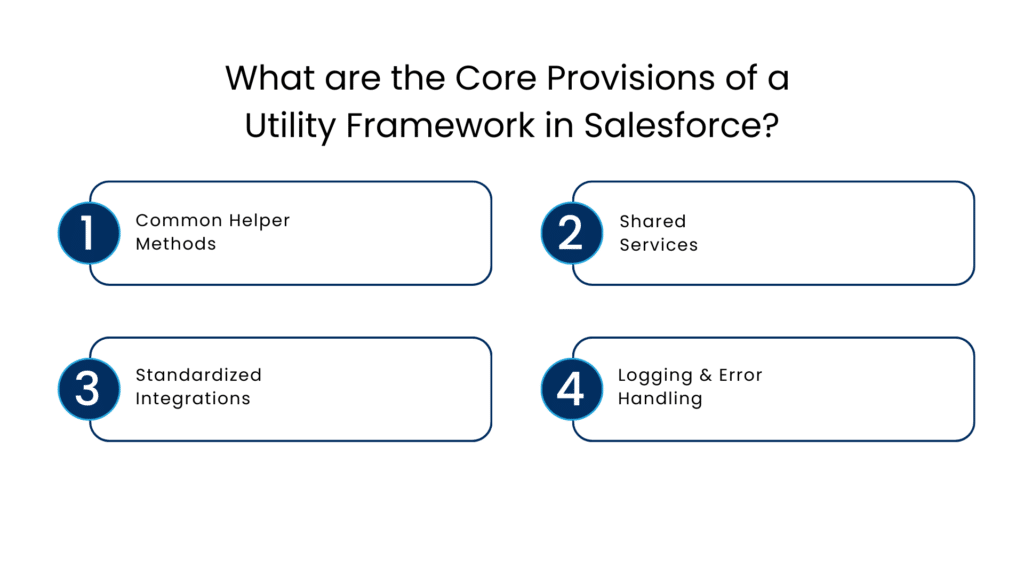
Having understood that these CRM frameworks are a centralized repository of the codes, they hold great value and bring certain important provisions to the table. These reusable code architectures provide –
- Common Helper Methods: Reusable utility functions handle frequently used tasks like data validation, string manipulation, date formatting, and SOQL query execution to avoid duplicacy in codes.
- Shared Services: Centralised service classes that manage core business logic and operations like calculations and record processing so that multiple modules can use the standardised functionality.
- Standardized Integrations: A unified integration layer managing API callouts, authentications, and response handling in a consistent manner across all external systems.
- Logging & Error Handling: he centralised mechanism to capture errors, system logs, and exceptions uniformly, making debugging easier and ensuring predictable system behaviour.
Why Do Utility Frameworks in Salesforce CRM Matter?
In a complex Salesforce environment where changes happen with the speed of light and with Salesforce introducing new upgrades thrice a year, duplicity of codes becomes a concern and repeated logics hamper the performance. This makes the usage of utility frameworks in Salesforce critical.
Stated below are the core reasons as to why these frameworks matter and how the centralised code repository affects the systems and its performance.
Reusability and Reduced Development Time
When developers do not use any utility frameworks it more often than not leads to duplicated codes and multiple error handling styles making the whole environment more complex than it already is. Without the utility frameworks in Salesforce, the most common issues faced include:
- Same business rules being written in multiple classes or triggers which increases maintenance efforts and risk of inconsistencies.
- Integration codes or API callout logics are being recreated in different modules which leads to code redundancy. This makes it harder to manage upgrades and fix bugs.
- Various developers end up implementing exceptions in their own way leading to inconsistent logging and making debugging more complex.
On the other hand when developers tactfully use the utility frameworks they enable smooth deliveries and less complexities. The above said issues are then auto resolved.
- The developers write the code just once in a single utility which is leveraged across multiple modules, ensuring consistency and reduced duplicacies.
- Developers can easily and quickly build new features by reusing the same utility codes rather than developing a fundamental code from scratch.
- Since the shared utilities are tested and reused consistently, the changes of errors and new defects reduce significantly.
Standardization and Governance

The enterprise Salesforce organizations are required to remain compliant with strict governance to maintain scalability. They require consistent logging, uniform exception handling, secure integration patterns, and of course controlled data access. Predictable system behaviour across modules is only possible with a utility framework in place, which enforces –
- Coding Standards – Defined guidelines for development ensuring consistent naming conventions, modular design, and clean + maintainable coding structures across the Salesforce organizations.
- Security Checks – Validation mechanisms enforcing field level security, object permissions, and safe data access to prevent unauthorized activities are in-built.
- Structured Response Handling – The standardised way to process and return responses ensuring consistent formatting, error mapping, and predictable system behaviour.
Scalability and Future Enhancements
As the business grows, the salesforce systems get robust and more complex. With increasing business new integrations are added, automation level and standards increase and improve, and data volume expands.
With a standardised and proper utility framework in Salesforce the companies ensure that the systems are smooth, and developers work with a sense of ease. A strong framework is critical for long-term architectural scalability and lays the foundation for:
- Plug & Play Feature Addition – New features can be easily added without disrupting the current workflows by using existing utilities and service layers.
- Minimal Refactoring – Enhancements and updates require changes in centralised components instead of scattered classes which eventually reduces rework.
- Easier Testing & Deployment – Modular and reusable code simplifies unit testing, improves the test coverage reliability, and makes the deployments effortless and more predictable.
Real-World Enterprise Benefits of Utility Frameworks in Salesforce CRM
Organisations and enterprises using these centralised code repositories have experienced positive changes in their system, and developers work without any duplicacies. Organisations who have used these frameworks consistently report –
- Faster releases with reusable components that accelerate sprint velocity and reduce time-to-market.
- Lower maintenance costs with centralised updates that eliminate repetitive fixes across varied modules.
- Better system scalability through standardised logging error handling that reduces production defects.
- Easier developer onboarding as they understand structured architecture faster than scattered logic.
- Reduced technical debt with clean modular code that prevents long-term system decay.
Conclusion
The Salesforce environment often operates with complex logic systems and multiple codes. With multiple developers in place, the risk of duplicate codes and errors is high, and with no standardized codes it becomes difficult to deal with such increasing complexities. Therefore, as the business grows, utility frameworks in Salesforce play a critical role and become one of the most important architectural investments in Salesforce.
The utility frameworks which is a centralised repository of codes, the businesses get access to reusable codes saving time to develop one from scratch every time a new Salesforce integration or Salesforce implementation happens, they enable standardisation in processes leading to fully compliant systems, and ensure scalability which ultimately ensures sustainable growth and enterprise grade development.
FAQs
What are utilities in Salesforce?
A utility is broadly defined as a single-column Lightning page. Salesforce provides you with several ready-to-use utilities, such as Recent Items, History, and Notes. You can also make your own, and customize the utility bar in Setup.
How to create a reusable Apex utility class example?
To create a reusable Apex utility class, start with static methods for common, stateless operations like validation or data manipulation, ensuring bulkification for lists to respect governor limits.
What are the essential elements of a utility framework in Salesforce?
A utility framework is a set of common helper methods, shared services, standardized integrations, and logging and error handling. These elements ensure that there is reusable code, standardized integrations, and predictable system behavior in the Salesforce org.
How does a utility framework enhance the efficiency of development?
A utility framework enables developers to code once and reuse the code in multiple modules. This eliminates code duplication, accelerates the development of features, and minimizes the risk of introducing new bugs. It also makes maintenance and upgrades easier.
What are the practical advantages of implementing a utility framework in an enterprise environment?
Enterprises that implement utility frameworks experience faster releases, reduced maintenance costs, improved system stability, simplified developer onboarding, and decreased technical debt. The utility framework enables Salesforce to function as an enterprise-level system.
dates, and expert tips, follow us on LinkedIn.