


How OTP-Based UIDAI Integration in Salesforce Secures Customer Data?
In today’s digital first environment, customer data is the prime asset that an organization holds. From personal identification details to contact information and transaction history the businesses hold all the details, and these must be protected at all costs.
At the same time, the pressure around privacy, security, and compliance continues to rise. This is where the OTP based UIDAI integration in salesforce comes into picture.
This salesforce UIDAI integration ensures secure, compliant, and trustworthy customer data handling. When the three security structures – One-Time Password (OTP), national identity framework of UIDAI, and strict CRM capabilities of salesforce are combined, it starts to serve as a powerful and a highly secure verification and data management ecosystem.
The Aadhaar UIDAI Authentication Integration approach not only helps with a seamless and flawless KYC process but also prevents unauthorized access. Moreover, this ensures that the customer identity verification is done in real time, reducing frauds and improving the data accuracy and security.
Understanding OTP-Based UIDAI Integration – An Identity Verification Solution
In layman terms, OTP based integration refers to the process where customer verification is done using the Aadhaar based authentication. In this process, an OTP is shared on the registered mobile number of the client (the one that is linked to the Aadhaar card).
To successfully complete this verification and ensure data security, the end user must enter the OTP to ensure that only the rightful owner of the identity can proceed.
Now when this Aadhaar UIDAI Consulting is done within the salesforce CRM, the entire KYC process becomes a natural part of the CRM workflow. This eliminates the need for manual KYC checks or any third-party applications for identity verification. The verification happens effortlessly within the ecosystem where the entire customer data is being stored, managed, and accessed by sales, services, and onboarding teams.
How Does the Salesforce Aadhaar OTP Authentication Work?
The Salesforce Aadhaar OTP authentication acts as a digital KYC tool for customer verification and is fully compliant with the UIDAI framework. This handles all risk intelligently and reduces fraud. It enables smart paperless transactions and workflows along with secure data across industries in India.
A typical OTP based workflow is a multi-step process that includes obtaining user consent, entering the Aadhaar number, OTP sharing, verification and match, and the final response and action.
- User Consent: The process lawfully requires obtaining explicit consent from the individual for their Aadhaar information to be used for verification.
- Data Submission: The user will then provide their Aadhaar number and other required information (like a fingerprint, iris scan, or an OTP) through the identity verification solution, IdentryX.
- API Request: The salesforce system will then securely bundle and encrypt this data and send a request to the Aadhaar Verification API endpoint, which then communicates with the UIDAI’s Central Identities Data Repository (CIDR).
- Verification and Match: The UIDAI system will verify the submitted details (demographic or biometric) against the information stored in its database.
- Response: The Aadhaar verification API receives a “Yes” (match) or “No” (no match) response from the UIDAI. Importantly, the Aadhaar verification API does not return personal identity information itself, only the status of the match, to protect user privacy.
- Action: IdentryX then takes appropriate action based on the response (e.g., completes customer onboarding, grants access to a service, or flags the transaction for manual review).
What are the Different Types of Authentication Methods Under OTP and Aadhaar Based Verification?
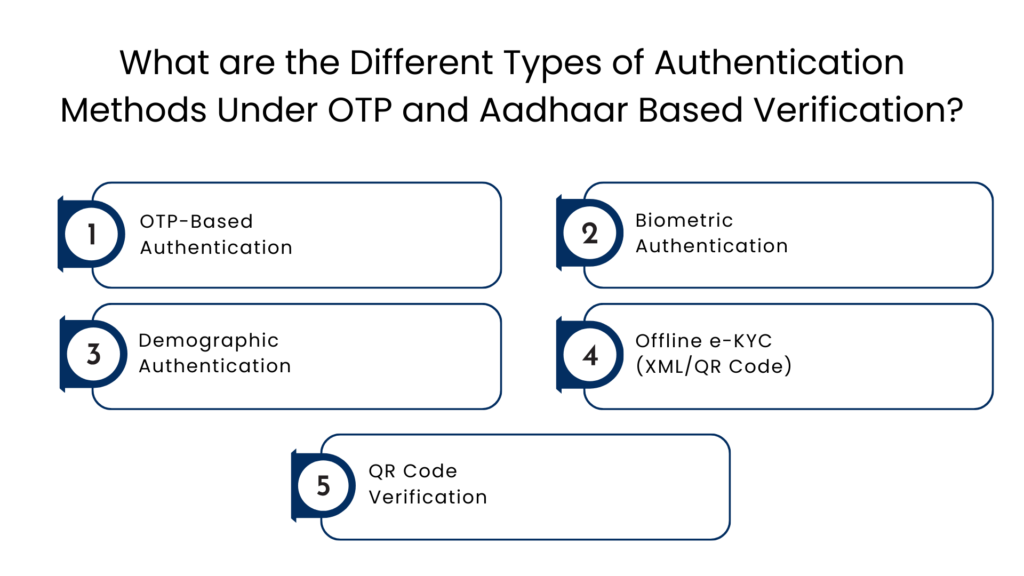
The Aadhaar verification can be done using multiple methods including OTP based identity verification, bio-metric, retina and facial scan, demographic authentication, and offline e-kyc.
OTP-Based Authentication
A One-Time Password is sent to the Aadhaar-registered mobile number/email address and entered by the user for verification. This is the quickest way and most user-friendly for remote onboarding.
Biometric Authentication
Biometric authentication uses physical attributes like fingerprints or iris scans for verification. This is highly secure and typically used for in-person verification or high-security applications.
Demographic Authentication
Demographic authentication matches the basic information (name, date of birth, address) provided by the user with the UIDAI database. This is a quicker method for low-risk needs.
Offline e-KYC (XML/QR Code)
Here, the users download an encrypted XML file or allows scanning of a QR code from their mAadhaar app/card, which the Aadhaar verification API uses for verification without needing real-time UIDAI access.
QR Code Verification
In this method, the customer scans the QR code printed on the e-Aadhaar card during an in-person interaction. The scan securely fetches verified identity details, enabling instant validation without manual data entry or document handling.
How OTP Verification Strengthens Identity Authentication?
OTP verification adds an extra layer of security that goes beyond usernames, password, or basic form validations. Now since OTPs are time-bound it becomes also impossible to reuse or intercept the number being sent to the registered mobile number. The OTP verification ensures that the user is legitimate and all fraudulent cases are removed or at least detected immediately.
Legitimacy of the User
OTP-based UIDAI verification ensures that the person accessing the system is genuinely linked to the Aadhaar number being used. Since the OTP is sent only to the mobile number registered with Aadhaar, the verification can be completed only by the rightful owner. This prevents impersonation, misuse of stolen identity details, and unauthorized access to sensitive customer data within Salesforce.
Real-Time Identity Verification
Unlike manual verification methods that rely on document uploads or back-office checks, OTP-based authentication validates identity instantly. As soon as the OTP is entered and confirmed, verification status is updated in Salesforce in real time. This allows businesses to proceed with onboarding, approvals, or transactions immediately, without delays or operational bottlenecks.
Eliminate Fraud Activities
By validating customers against a unique national identity at the very beginning of the process, OTP-based UIDAI integration prevents fake or duplicate profiles from entering the CRM. This early-stage verification stops fraudulent records from being created and reduces data duplication. As a result, Salesforce maintains cleaner data, more accurate reporting, and stronger overall data integrity.
Conclusion
In the digital environment of today, customer data is the most sensitive information held by any organization. In these times, data security and protection becomes a prime concern for the organizations and UIDAI integration with salesforce helps the businesses in India verify the client identities in a single place and one identity is mapped to only 1 person.
OTP based identity verification has become the most secure way to verify ID proofs because the OTP is sent to the Aadhaar registered number and is valid only for a limited time. This helps in eliminating frauds and reducing the risk of data loss or breach.
In an era where data security defines brand credibility, this approach ensures that Salesforce UIDAI integration is not just a system of record, but a secure foundation for growth, compliance, and meaningful customer relationships.
FAQs
What are UIDAI API authentication requirements for Salesforce?
UIDAI API authentication for Salesforce requires organizations to register as an Authentication User Agency (AUA) or KUA, involving UIDAI approval, agreements, and infrastructure like HSM for certificates, before using direct APIs.
What is OTP-based UIDAI integration in Salesforce?
OTP-based UIDAI integration in Salesforce enables businesses to verify customer identities using Aadhaar-based OTP authentication directly within the CRM. The OTP is sent to the mobile number registered with UIDAI, ensuring that only the legitimate Aadhaar holder can complete verification. This integration embeds secure identity validation into Salesforce workflows, reducing manual effort and improving data accuracy.
How does OTP-based Aadhaar verification improve customer data security?
OTP-based verification ensures that customer identity is validated in real time before sensitive data is stored or accessed. Since the OTP is time-bound and delivered only to the Aadhaar-linked mobile number, the risk of impersonation or unauthorized access is significantly reduced. This helps maintain a secure and trusted customer database within Salesforce.
Can OTP-based UIDAI integration be used for digital KYC?
Absolutely. OTP-based UIDAI integration acts as a secure digital KYC solution that eliminates the need for physical documents or manual verification. Customers can complete identity verification remotely in seconds, making onboarding faster, paperless, and more convenient while maintaining compliance and security.
How does OTP-based UIDAI integration help real estate businesses using Salesforce?
OTP-based UIDAI integration helps real estate teams verify buyers and tenants instantly using Aadhaar-linked OTPs within Salesforce. This reduces fake enquiries, prevents duplicate leads, and ensures agents work only with verified prospects, resulting in cleaner pipelines and higher conversion rates.
How does this integration help prevent fraud and duplicate records?
By verifying customers against a unique national identity at the start of the process, OTP-based UIDAI integration blocks fake or duplicate profiles from entering Salesforce. This early validation ensures one identity maps to one individual, improving data integrity, reducing fraud, and enabling more reliable reporting and analytics.
For more insights, updates, and expert tips, follow us on LinkedIn.