


Evolving Role of Salesforce System Integrators in United States Digital Ecosystem
The United States digital ecosystem is evolving rapidly driven by cloud adoptions, rising customer expectations and artificial intelligence. While US businesses are continuously dealing with multiple business leads and large amounts of data, the salesforce CRM is the go to management system adopted by the companies.
Now, the businesses are managing data from a multiple chain of sources and the salesforce system integrators in the United States enable them to manage everything within the CRM.
Be it managing your social media data, marketing campaigns, or e-commerce platforms, the salesforce system consulting and integrators in the United States unify all your customer data into a single CRM helping you streamline the business workflows, improve business performance, show better results, and enhance customer experiences.
Now as the salesforce systems grow complex in the US, so have the system integrators. The salesforce integration systems have gone beyond sales automation and the system integrator firms are now strategic partners enabling the end-to-end digital transformation.
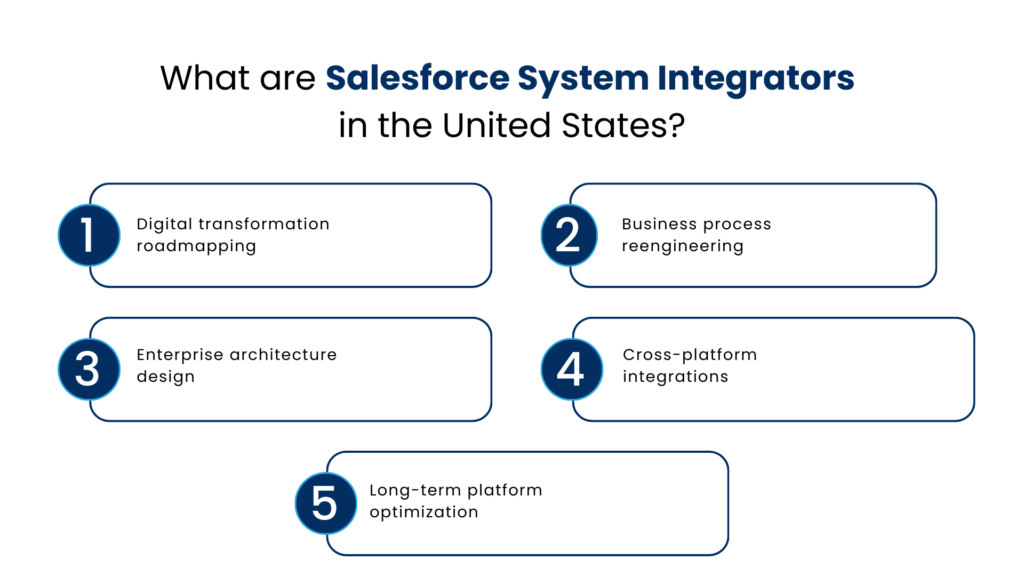
What are Salesforce System Integrators in the United States?
Till a few years ago, the system integrators in salesforce CRM were limited to the implementation of salesforce clouds like marketing clouds, service clouds, and migrating data from older CRMs. The core responsibilities included basic workflow setups, and training end-term users.
Now this scenario has changed and the CRM has expanded its capabilities. Salesforce has now evolved into a deeply interconnected platform with multiple clouds including marketing, sales, services, financial, non-profit, and commerce, and each of these are designed to support complex business processes in each industry.
With that being said, the role of CRM system integrators has also evolved and responsibilities are no longer limited to implementation. Their role is now elaborate and involves creating long-term strategies for sustainable business growth.
Digital transformation roadmapping
Digital transformation roadmapping defines a structured, long-term plan for adopting and scaling digital technologies. It aligns Salesforce initiatives with business objectives, priorities, and timelines. The roadmap helps organizations move from current-state systems to future-state digital capabilities in manageable phases. It also ensures investments deliver measurable business outcomes.
Business process reengineering
Business process reengineering involves analyzing and redesigning core business workflows to improve efficiency and effectiveness. It focuses on eliminating manual steps, reducing redundancies, and leveraging Salesforce automation. The goal is to create streamlined, customer-centric processes that support growth and agility. This approach enables organizations to operate faster and more consistently.
Enterprise architecture design
Enterprise architecture design provides a holistic view of an organization’s IT ecosystem. It defines how Salesforce fits within the broader technology landscape, including data, applications, and infrastructure. This design ensures scalability, security, and compliance across systems. It also supports long-term flexibility as business needs evolve.
Cross-platform integrations
Cross-platform integrations enable Salesforce to seamlessly connect with other enterprise systems such as ERP, marketing automation, and data platforms. These integrations ensure consistent data flow and real-time information sharing. They help eliminate data silos and improve operational efficiency. Well-designed integrations support better decision-making and customer experiences.
Long-term platform optimization
Long-term platform optimization focuses on continuously improving Salesforce after the initial implementation. It includes adopting new features, enhancing performance, and refining configurations. This ongoing effort ensures the platform evolves with changing business requirements. Optimization helps maximize ROI and extend the value of Salesforce over time.
What Does a Salesforce Integrator and Expert Consultant in the United States Have to Offer?
A Salesforce integrator and expert consultant in the United States provides strategic guidance beyond implementation. They help align Salesforce with business goals, enable seamless integrations, and build scalable solutions. Their expertise ensures that Salesforce delivers long-term value and supports ongoing digital transformation.
ERP Integration
Salesforce ERP integration connects CRM with enterprise systems such as SAP, Oracle ERP Cloud, NetSuite, Sage, and Microsoft Dynamics 365. It enables seamless data exchange across finance, operations, and sales teams. This integration improves visibility, operational efficiency, and decision-making.
Accounting Integration
Accounting integration allows financial data to flow directly into Salesforce, giving sales and service teams better visibility into invoices, payments, and transactions. It helps improve customer profiles, forecasting accuracy, and financial insights. Organizations benefit from stronger alignment between finance and revenue teams.
Marketing Automation Integration
Marketing automation integration connects Salesforce with marketing platforms to manage campaigns and track customer interactions. It enables a unified view of customer touchpoints across channels. This results in more consistent messaging and an improved overall customer experience.
eCommerce Integration
eCommerce integration links Salesforce with platforms such as Shopify and WooCommerce to synchronize customer, order, and product data. It provides operational insights and supports personalized customer journeys. Businesses can deliver consistent experiences across digital and sales channels.
Database Integration
Database integration connects Salesforce with external data sources to centralize and enrich customer information. It enables organizations to leverage existing data for reporting and analytics. This approach helps extract actionable insights and improve data-driven decisions.
Social Media Integration
Social media integration brings customer interactions from social platforms into Salesforce. It supports personalized engagement, improved campaign performance, and real-time visibility into brand conversations. Organizations can better manage relationships and respond quickly to customer needs.
CTI Integration
CTI integration connects Salesforce with computer telephony systems to streamline call handling and customer support. It enables features such as screen pops, call logging, and faster case resolution. This improves service efficiency and overall customer experience.
Collaboration Systems Integration
Collaboration systems integration connects Salesforce with tools such as SharePoint and Office 365. It enables secure document sharing and real-time collaboration within Salesforce workflows. Teams gain greater flexibility and productivity while working on shared projects.
Conclusion
It is safe to say that the salesforce system integrators in the United States are no longer limited to the implementation projects and have evolved. The business responsibilities now include building long term strategies for sustainable business growth and enhancing the overall business operations.
By delivering industry-specific solutions, enabling enterprise integrations, unlocking data-driven insights, and supporting long-term platform evolution, Salesforce system integrators play a vital role in shaping the U.S. digital ecosystem.
FAQs
What is a Salesforce system integrator in the United States?
A Salesforce system integrator in the United States helps organizations implement, integrate, and optimize Salesforce CRM within their existing technology ecosystem. Their role goes beyond setup and includes aligning Salesforce with business processes, data sources, and long-term digital strategies.
How has the role of Salesforce system integrators evolved in the U.S.?
Salesforce system integrators have evolved from basic CRM implementers to strategic digital transformation partners. They now support complex multi-cloud environments, enterprise integrations, data management, and long-term platform optimization to drive sustainable business growth.
What services do Salesforce system integrators typically offer?
Salesforce system integrators offer services such as digital transformation roadmapping, business process reengineering, enterprise architecture design, cross-platform integrations, and long-term platform optimization. These services ensure Salesforce delivers ongoing value beyond initial implementation.
What is digital transformation roadmapping in Salesforce projects?
Digital transformation roadmapping is the process of creating a phased plan to adopt and scale Salesforce technologies. It aligns CRM initiatives with business objectives, timelines, and priorities to ensure measurable outcomes and long-term success.
What is long-term platform optimization in Salesforce?
Long-term platform optimization involves continuously improving Salesforce after implementation. It includes performance enhancements, feature adoption, and configuration updates to ensure the platform evolves with changing business needs and maximizes ROI.
For more insights, updates, and expert tips, follow us on LinkedIn.