


Leveraging PMD in Salesforce for Secure & High-Performance Architectures
The full form of PMD is Programming Mistake Detector, and it is a static code analysis tool which is used extensively in the salesforce development community. PMD is essentially valuable to analyze Apex, Visualforce or Lightning code for issues including performance bottlenecks, security vulnerabilities, best practice violations, etc.
Since Salesforce operates in a multi-tenant architecture with many strict governor limits, writing optimized and maintainable code is not optional; it’s critical. PMD assists developers by identifying potential problems before deployment, which improves the quality of the code and contributes to the long-term stability of the overall system.
In an enterprise Salesforce implementation like insurance policy management, marketing integrations, and payment automation, the complexity of the code rises exponentially. PMD is now a tool of governance that ensures all deployments are of technical quality.
Why is PMD in Salesforce Essential?
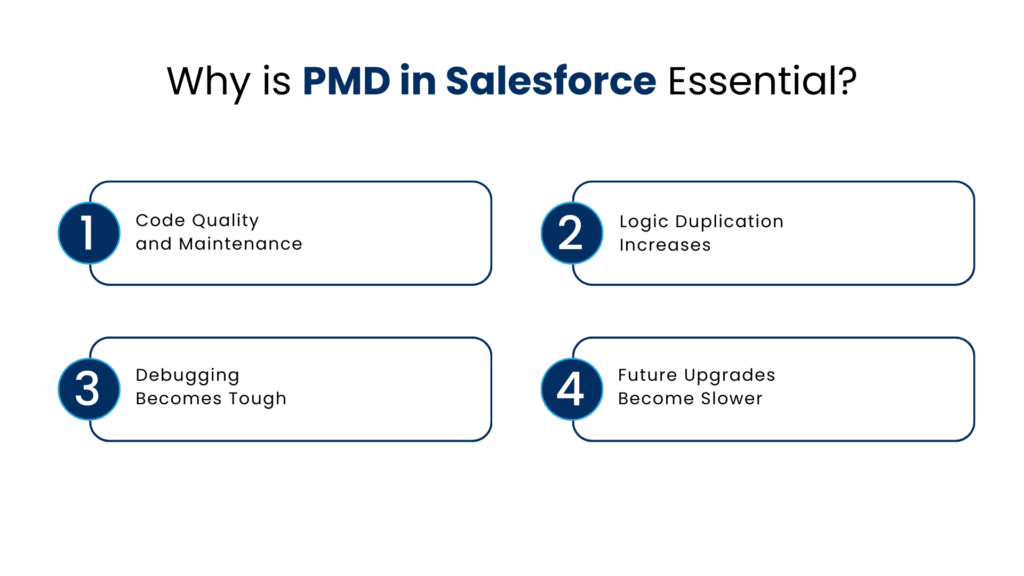
Detection of programming errors at an early stage before deployment is a requirement in the salesforce environment. PMD in salesforce is important because it assists in code quality, security, and performance before the deployment.
Due to the governor limit imposed by the strict governor in Salesforce, inefficient code can cause performance failure and scalability issues. With PMD, developers can identify potential problems early and enforce best practices for a stable system performance.
Code Quality and Maintenance
PMD ensures well-structured, readable, and standardized code. In bigger organizations using Salesforce, more than one developer works on Apex classes, triggers, and integration. The absence of a strict coding standard is the reason for duplicated logic, difficult debugging, and a longer deployment process.
Logic Duplication Increases
If the coding standards are not followed, then the same business logic is being implemented and executed again and again in different classes. This makes the maintenance process tough, and the chances of errors in implementation are high in one place and not others.
Debugging Becomes Tough
If the code is unstructured and lacks standardization, it is a difficult task to point out the cause of the problem. Unstructured code with scattered logic, naming conventions, and repeated code makes it difficult to follow the flow of execution.
Future Upgrades Become Slower
If the code is unorganized or coupled, it will be difficult to implement new features. It will take more time to understand the code and identify the impact area, which may lead to new bugs being introduced during the upgrade process.
What Do the PMD Rules Detect?
The PMD rules are very important to identify any logic blocks or unused variables so that they do not cause problems during the final implementation stage. The PMD rules generally identify the following –
- Unused variables and methods: The unused variables and methods cause clutter in the codebase and make it unreadable. It creates chaos and confusion if a particular logic needs to be implemented, added to technical debt, and makes the entire coding maintenance a heavy duty task.
- Long or complex logic blocks: Often, extremely long logics can make the code less readable and make the logic difficult to understand. This makes the code prone to errors, difficult to debug, and have a negative impact on maintaining the code.
- Hard-coded IDs or values: Hard-coding record IDs, credentials, or configuration values makes the code inflexible and prone to failures across environments.
- Improper naming conventions: Improper or confusing naming conventions for classes, variables, and methods make code unreadable and uncollaborative. Using proper naming conventions makes code readable, easy to onboard new developers, and maintainable in the long run for the Salesforce companies.
Now, when these teams address these problems, they ensure that they have clean architecture, easy onboarding of new developers, and rapid feature development cycles. In the insurance
Governor Limit Protection and Performance Optimization
Salesforce has very strict governor limits on CPU, SOQL queries, DML operations, and heap usage. This is done to ensure that the system is always optimized and running well on the multi-tenant environment.
The governor limits make sure that no single transaction on the platform uses multiple system resources that impact other users of the platform. This means that developers must write code that is optimized and does not go beyond the limits set by the governor.
PMD identifies coding standards that could lead to a violation of the governor limits, such as the use of SOQL or DML queries in a loop, inefficient use of collections, and unnecessary computations. By identifying these issues early on, PMD helps developers refactor their code to ensure that it is always performing better.
PMD identifies the coding patterns that may break the governor rules, such as the use of SOQL or DML queries in loops, inefficient use of collections, and unnecessary computations. By identifying these issues at an early stage, PMD helps developers in refactoring their code to ensure that the performance is optimized. Therefore, PMD directly helps in handling large-volume transactions, which is critical in systems such as policy issuance, WhatsApp automation, or payment reconciliation.
Security and Compliance Enforcement
Security is a significant aspect in Salesforce, particularly when dealing with the personal data of customers, payment details, and insurance information. In this case, PMD looks for any missing checks for CRUD/FLS, dangerous dynamic SOQL, hardcoded credentials, and misuse of the sharing model.
This ensures that the privacy of data is adhered to, that the data is safe from unauthorized access, and that integrations with external APIs are secure. In an enterprise setup, PMD is part of the DevOps governance.
PMD in CI/CD & Deployment Cycle
The modern and new age Salesforce teams have the capability to integrate PMD directly into their development and deployment pipelines to ensure that the code quality is continuously monitored. This is usually done by integrating PMD into their Git pipelines, code review tools, and CI/CD tools such as Jenkins or GitHub Actions to check the code before it moves to the environments.
This ensures that the teams are able to prevent low-quality code from being deployed, that all teams are coding in the same way, and that the production bugs are reduced. This ensures that the quality checks are moved earlier in the development pipeline to minimize the testing costs.
Conclusion
PMD is more than a code scan tool; it is a quality control tool, but it also assists in enhancing the performance, security, and maintainability of the Salesforce CRM system. For an enterprise-level Salesforce implementation, PMD is a must-have tool to ensure scalable and secure architecture.
The companies that adopt PMD in their development life cycle establish a culture of disciplined engineering and risk management. This not only enhances technical governance but also ensures that the Salesforce environment is stable and optimized.
FAQs
What is PMD in Salesforce?
PMD is a source code analyzer that does static analysis on code written in a variety of programming languages. The set of rules that come with PMD can identify problems with code such as empty catch blocks and unused variables.
What is the use of the PMD tool?
PMD is a source code analyzer that enables static code analysis for a variety of languages, including Java, Apex, and Visualforce. The tool comes with predefined rules that identify common errors in source code, such as empty catch blocks and unused variables.
What does PMD software stand for?
PMD stands for Programming Mistake Detector. It is a source code analyzer that identifies common mistakes in your code, such as unused variables, if-else statements without braces, naming conventions of methods, SOQL in loops, and many more.
How to create custom PMD rules for Apex?
Writing custom rules for PMD in Apex requires extending PMD’s Java-based framework to create new checks specific to your organization’s coding standards.
How does PMD assist in governor limits protection?
PMD identifies the patterns in the code that could potentially be dangerous, such as SOQL or DML in loops, inefficient handling of collections, and unnecessary computation. This ensures the developer does not exceed the governor limits of Salesforce.
For more insights, updates, and expert tips, follow us on LinkedIn.