

Avoid CRM Failures by Hiring Expert Salesforce Integration Partners
When businesses deploy a CRM, they aim to look for streamlined processes, smooth conversations, and no lags or delays. Despite Salesforce being the most used platform, businesses tend to fail. The major reason being, even by investing heavily in the relevant licences, they do lack proper integration and the expert guidance of Salesforce integration partners.
The well reputed Salesforce system integrators ensure that your systems are well connected to various tools like marketing, accounts, and others. Additionally, with proper ERP and system integration in Salesforce CRM the businesses also gain a competitive edge.
However, as important it is to fine tune the integrations, it is equally crucial to choose the right Salesforce CRM integration partners that understand your business well, are certified experts, and know how to maintain the system health.
Why do Most CRMs Fail Without the Guidance of Proper Salesforce Integration Partners?
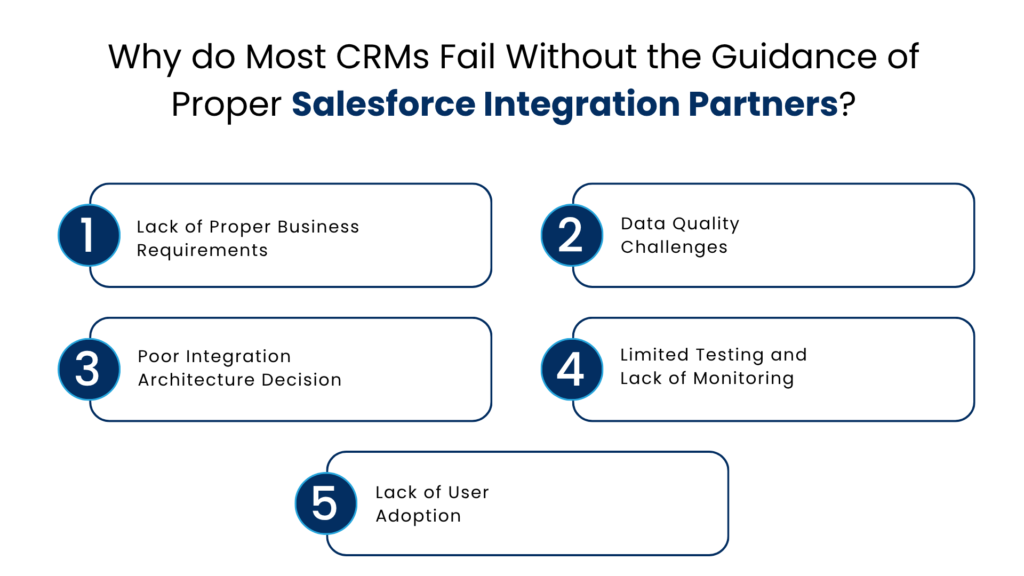
Although the most common reason for a CRM failure is the poor integration and execution of a CRM tool, there are several other reasons for the failure of a CRM without the Salesforce integration services. These reasons include:
Lack of Proper Business Requirements
Many organizations start their integration projects without having a clear picture of what they need to achieve by integrating Salesforce with other applications.
For instance:
- Is real-time pricing from ERP required in Salesforce sales?
- Is there a requirement to import order history in customer support from eCommerce?
- Do we require lead synchronization in marketing?
The absence of well-defined business needs leads to partial integration or integration that is of no practical value.
Data Quality Challenges
The primary reason for CRM failure is data quality issues. If bad data is loaded into Salesforce via integration, the whole system becomes ineffective. Poor quality data usually includes:
- Duplicate records
- Incomplete mandatory fields
- Incorrect customer segmentation
- Non-uniform contact information
- Obsolete customer record data
Lack of proper planning and architecture around the data governance issue may lead to Salesforce being used inefficiently, as well as losing its credibility among the users.
Poor Integration Architecture Decision
Sometimes, organizations tend to implement direct point-to-point integration without thinking of scalability. On other occasions, they make wrong decisions when using middleware. Such decisions often result in:
- Consuming excessive API usage
- Poor system performance
- Frequent sync failures
- Higher maintenance costs
- Security risks
Limited Testing and Lack of Monitoring
Integration works well during testing, but issues arise as the quantity of data increases. Without monitoring solutions, companies would only discover that their data is not synchronized after encountering problems. Examples of such problems include:
- Prospects not landing in Salesforce
- Incomplete order synchronization
- Lack of customer service data
- Lost revenue opportunities
Lack of User Adoption
If users can’t navigate Salesforce properly due to complexity, integration could succeed but still be problematic for businesses. This leads to incomplete CRM usage and data inconsistency.
The Real Cost of CRM Software Implementation Problems
CRM implementation failures are costly to businesses beyond technical malfunctions. Poor executions can result in heavy business losses and poor employee performance as well. See what happens to the CRM in the absence of proper Salesforce integration companies.
Missed Sales
As leads sources, contact information, or reminders to follow-up do not work properly, sales reps fail to close deals because of poor timing and lack of information about clients’ needs.
Poor Customer Relationships
When support representatives do not have complete client history at hand, they cannot provide adequate answers to clients’ inquiries. The latter are forced to repeat themselves again and again.
Operational Inefficiencies
The loss of time occurs due to employee transitions between different software, manual data entry, and error correction.
Faulty Data Analysis
Top management relies on dashboards of CRMs for their sales predictions. If Salesforce fails to be integrated seamlessly into other systems, the results become flawed.
Security Risks
Integrations that are not working properly raise the threat of information leakage, involving confidential customer details. The firm can run into problems with GDPR, HIPAA, and other regulations.
Choosing the Right Salesforce Integration Partner
Not all Salesforce consultants possess integration skills. An incorrect choice might result in delays and subsequent issues within your system. The following criteria must be carefully considered while choosing the desired Salesforce integration partners.
- Experience in Salesforce Integration Projects → Require references from past projects. Your chosen partner should be able to present real-life case studies.
- Knowledge of API and Other Middleware Platforms → Salesforce integration cannot take place without knowledge of APIs, data mapping, authentication mechanisms, and other middleware tools.
- Specific Industry Knowledge → Consultants that know everything about your sphere will be able to predict your needs and design workflows based on them.
- Ongoing System Optimization → Integration is not a once-and-for-all procedure. Systems change and require further optimization. Select your consultant accordingly.
- Documented Solutions → Your partner will offer you detailed documentation of solutions used and comprehensive training so you don’t remain dependent upon them.
Valuable Salesforce Integration Solutions Offered by the Right Partner
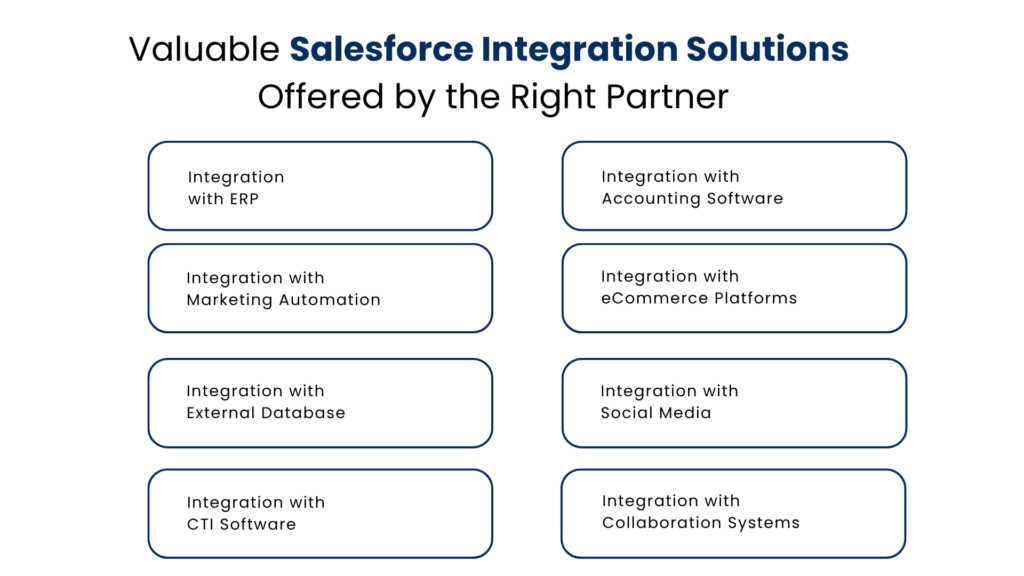
Businesses may want different tools at different stages of the business. These firms have the opportunity to choose from a wide range of solutions including:
Integration with ERP
The integration of Salesforce with other ERP software such as SAP, Oracle ERP Cloud, NetSuite, Sage, and Microsoft Dynamics 365 helps coordinate customer, orders, and inventory information.
Integration with Accounting Software
This integration allows the sales and accounting department to collaborate and exchange financial information for better customer information and financial planning.
Integration with Marketing Automation
Integration with marketing automation software can ensure that marketing efforts are consistent with customer interaction and touchpoint activities.
Integration with eCommerce Platforms
Integration with online platforms, including Shopify and WooCommerce, can facilitate the visibility of order processing, personalized marketing campaigns, and create an integrated customer journey.
Integration with External Database
Integration with external databases ensures better data management, reporting, and analysis across different business functions.
Integration with Social Media
Integration with social media platforms is useful for businesses to track engagement levels and ensure personalized interaction and consistent communication across different campaigns and updates.
Integration with CTI Software
Integration with CTI software helps manage calls effectively, increase response times, and improve customer service processes.
Integration with Collaboration Systems
Integration with collaboration software such as SharePoint and Office 365 helps manage documents, facilitates teamwork, and optimizes internal processes.
Conclusion
Salesforce is an extremely effective CRM platform, but it will not automatically provide you with the necessary results. Your Salesforce implementation will depend on how successfully it integrates into your business environment.
A common mistake made by companies that fail their CRM implementation is considering integration to be merely a technical issue. However, improper integration planning, insufficient infrastructure, and flawed data flow will inevitably lead to loss of confidence and reduced ROI.
Using experienced Salesforce integration partners from the very beginning will help avoid such problems. With their profound technical expertise, business understanding, and strategic vision, they will create a functional CRM system that meets all your requirements and brings you value.
FAQs
Why do CRM implementations fail even after investing heavily in Salesforce licenses?
Despite Salesforce being the most used platform, businesses tend to fail. The major reason being, even by investing heavily in the relevant licences, they do lack proper integration and the expert guidance of Salesforce integration partners.
What is the biggest reason behind CRM failure?
The most common reason is poor integration and execution of the CRM tool, which results in disconnected systems and inefficient workflows.
How does lack of business requirements lead to CRM failure?
Without clear goals, businesses may integrate Salesforce in a way that is incomplete or not useful, such as missing ERP pricing, order history, or lead synchronization needs.
What are some integration solutions available for Salesforce?
Salesforce can be integrated with ERP systems, accounting applications, marketing automation systems, eCommerce websites, other databases, social media channels, CTI applications, and collaboration applications.
Why should companies consider Salesforce integration?
It is because Salesforce works only when it is effectively linked with all the processes of a company.
For more insights, updates, and expert tips, follow us on LinkedIn.