

How Businesses Generate 45% Higher Revenue with AI Powered Salesforce CRM Solutions?
The business dynamics have changed notably in the last few years and the focus has shifted from quantity to quality. Businesses are continuously seeking ways to increase revenue, improve efficiency, and deliver exceptional customer services. Now while traditional CRMs were good enough to manage data, they still fall short.
This is where the AI-backed Salesforce integrated CRM solutions take the lead. By utilising the CRM solutions and combining its capabilities with Artificial Intelligence (AI) opens new doors for revenue generation.
From predictive analysis and automation to personalized customer engagement, these AI Salesforce integrated solutions turn a simple data repository into a powerful growth engine.
Now the question that lingers on is how businesses are able to achieve upto 45% higher revenue by leveraging the integrated solutions for Salesforce.
How Have the Traditional Salesforce Dynamics Shifted to AI Integration Solutions?
The traditional Salesforce integration solutions primarily focused on storing data in a unified database, tracking interactions, and managing pipelines. Although this is useful, this traditional CRM method relies on manual input and reactive decision making.
On the other hand, the AI-powered Salesforce integrated CRM solutions follow a proactive approach. They analyse a vast amount of data in real-time, identify patterns, and suggest actionable recommendations. This eliminates all guesswork and helps businesses make the shift towards a data-driven approach.
With the help of AI, Salesforce can:
- Anticipate the actions of customers
- Automate routine operations
- Provide real-time analytics
- Personalize interactions with the customer
How Businesses Evolve and Generate Revenue with the Salesforce Integrated CRM Solutions?
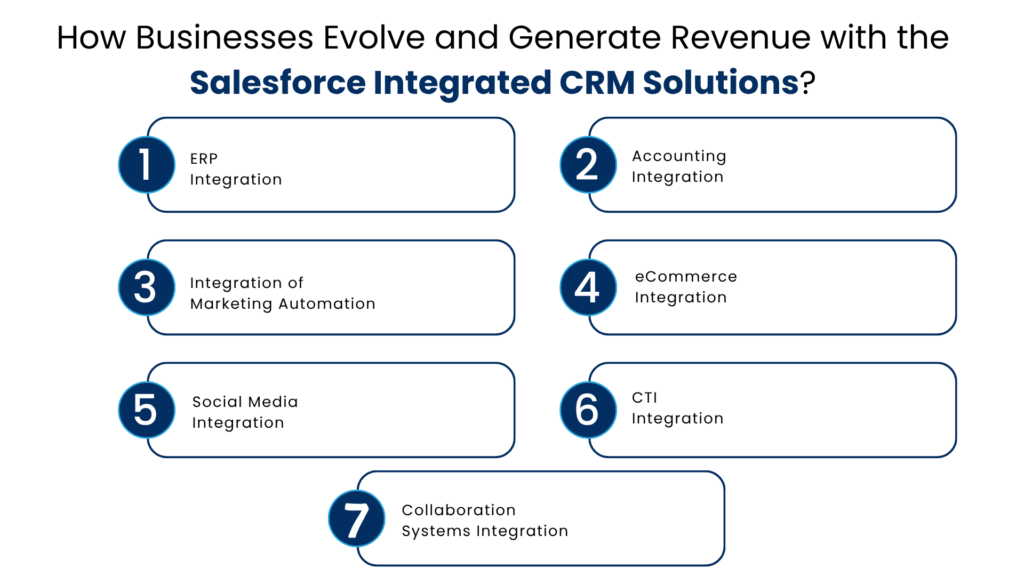
Salesforce has various solutions to offer and each one of them has a unique property. Take a look at how these solutions can aid businesses grow and generate a healthy amount of revenue.
ERP Integration
ERP integration with Salesforce helps companies integrate their sales, accounting, and inventory operations by providing an integrated process for managing the flow of information between front-end and back-end processes. This is useful in ensuring effective forecasting and order management, which help drive business revenue.
Accounting Integration
Accounting integration gives companies the ability to integrate financial data in real-time with their sales functions to enhance financial transparency. This ensures that accurate financial forecasting and financial decision-making that drives revenue growth take place through improved visibility of payment history, invoices, and transactions.
Integration of Marketing Automation
The integration of marketing automation in Salesforce helps firms in managing their campaigns, as well as ensuring that they maintain consistency of message while touching on various touch points with their customers. This helps firms market their products efficiently to their customers.
eCommerce Integration
Integration between Salesforce and other e-commerce services such as Shopify and WooCommerce is beneficial for businesses that want to connect customer data from both online and offline channels. The insights gained will be useful in implementing personalized marketing campaigns and ensuring seamless shopping experiences for customers.
Database Integration
The integration between Salesforce and databases will provide businesses with greater insights and data intelligence to help them make smarter decisions, explore new opportunities, and come up with strategic business plans that will result in revenue gains.
Social Media Integration
By integrating Salesforce and social media services, businesses will have an effective way of monitoring social engagements, personalizing their campaigns, and staying connected with their social audiences. Companies will benefit by increasing their brand visibility, engaging with the right customers, and generating more leads.
CTI Integration
Computer telephony integration will enable businesses to communicate seamlessly through the use of click-to-call functionalities and live call tracking capabilities, resulting in improved customer services.
Collaboration Systems Integration
The integration of sales force applications with collaboration systems like SharePoint and Office 365 will make processes more efficient and effective since communication within the company will be improved. It will become easier for employees to share information and collaborate with each other.
What Advantages Does a Business Get From These Salesforce End-to-end CRM Solutions?
If executed nicely and with proper precision, the Salesforce integrated CRM solutions can offer various advantages to the business. Some of these advantages include:
- Quick response ensures that any query, lead generation, and requests made by the customer are answered immediately. Because of the use of artificial intelligence in automation, firms can respond to questions through bots, email automation, or intelligent route systems within seconds, thus making conversion more likely because customers are keen on doing business with firms that react quickly.
- Customer experience is personalized and consistent thanks to insights generated through data analytics enabled by AI. In this way, companies can learn about their customer behavior and preferences to give them relevant recommendations, timely communication, and follow-up whenever necessary.
- With the help of data-driven decision-making, companies are no longer limited to making assumptions when running the business. By analyzing the big volume of data, AI finds useful patterns and trends to highlight opportunities and threats in time.
What is The Future of AI-Based Salesforce CRM?
There is great potential in the future of the AI-based Salesforce CRM solution, which includes continual innovations in the following areas:
- Improved machine learning algorithms
- Personalization improvements
- Compatibility with new technology trends
- Increased levels of automation and analytics
With continued development in artificial intelligence, there is a likelihood that its revenue-generating ability will increase.
What Challenges Must Be Considered While SF Integration?
Even with all its benefits, deploying AI-driven Salesforce CRM applications poses issues including:
- Quality of Data: Artificial intelligence needs good data
- Costs of Implementation: Some costs will be involved
- Training Issues: The team needs to know how to use the AI software
Conclusion
Artificial intelligence-based Salesforce integrated CRM solutions have revolutionized the operation of many companies by optimizing their processes of lead management, personalizing customers’ experience, automating tasks, and offering insights from analytical tools. This solution enables businesses to generate 45% more revenue than those without the aid of AI.
AI-based Salesforce CRM solutions are critical in enhancing productivity and efficiency while ensuring optimal customer satisfaction. These components are essential for achieving business success and generating profits in a highly competitive landscape.
FAQs
What is meant by Salesforce CRM integration?
CRM integration from Salesforce unifies all your business applications into one cohesive application that provides all teams with the one and only source of information on your clients.
How does AI-enabled Salesforce CRM facilitate the generation of revenues?
The AI-powered Salesforce integrated CRM solutions follow a proactive approach. They analyse a vast amount of data in real-time, identify patterns, and suggest actionable recommendations. This eliminates all guesswork and helps businesses make the shift towards a data-driven approach. This becomes the reason for higher revenue generation.
What distinguishes an AI-powered CRM system from a conventional CRM system?
Unlike conventional CRM systems, which prioritize data storage, interaction tracking, and pipeline management, AI-powered CRM systems adopt a proactive strategy that entails processing massive amounts of data instantaneously and providing valuable insights for informed decision-making.
What issues should firms take into account when deploying AI-enabled Salesforce CRM?
The quality of data is an issue because AI depends on high-quality data. Cost implications and training requirements are also significant, as employees need to learn how to utilize AI effectively.
Why are AI-enabled Salesforce CRM systems necessary for contemporary businesses?
They are necessary since they increase efficiency, provide better customer experiences, and facilitate intelligent decision-making. In such a dynamic marketplace, these features are necessary for ensuring that businesses can grow and maximize their income.
For more insights, updates, and expert tips, follow us on LinkedIn.