

The Business Value of a Well-Executed Salesforce Implementation
Salesforce is one of the most powerful CRM platforms worldwide and is being used by almost 90% of the businesses. Organizations across the industries invest in this CRM to manage and build customer relationships, streamline all business operations, and grow the business. However, simply buying a salesforce license is not enough, and the real key to success lies in the Salesforce Implementation.
A salesforce CRM implementation goes beyond simple integration and implementation. It transforms and changes the way businesses function and how they collaborate to drive growth. Moreover, they offer 24*7 support irrespective of your time and location so that your teams are always working in sync and your CRM runs without any disruptions.
When a salesforce CRM is implemented correctly and with precision it becomes a strategic asset that delivers measurable results and outcomes. In addition to this, it is equally important to find a good Salesforce implementation partner who knows and understands your business and can provide effective solutions at a reasonable price without interrupting your current workflows.
Aligning Your Salesforce Implementation Strategy With Your Business Goals
The foundation of a good and effective CRM does not just lie in the implementation but its alignment with the business goals and objectives. A business truly reaps the benefits of a complex CRM like salesforce when it is well executed, implemented, and most importantly aligned with your business goals.
To understand this process more, it is important to know what your business aims to achieve with a CRM implementation. Therefore, the first step is to identify your business objectives. These goals can cover anything from improved sales team productivity, enhanced customer experiences, increasing visibility across business or strengthening compliance and reporting. Once this is understood, then the most appropriate salesforce cloud(s) is implemented to support these requirements and not the other way around.
Most businesses who fail to thrive despite using a powerful CRM is due to poor implementation and adoption, and undefined business goals. This then leads to poor RoI and productivity in the teams.
Step-by-Step Process for a Perfectly Executed Salesforce CRM Implementation Strategy
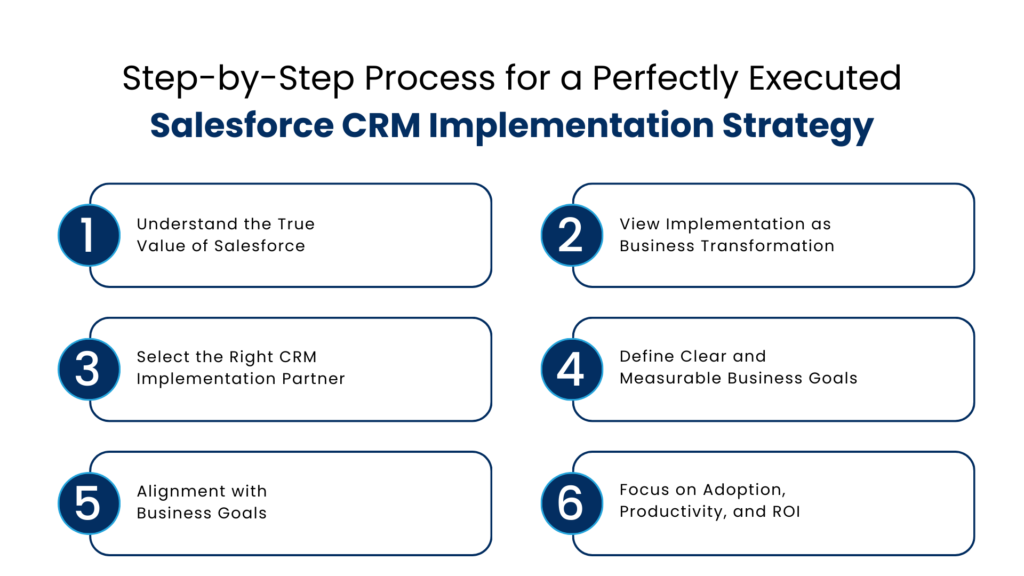
When businesses understand their need for a salesforce CRM integration and implementation, they are often in the right direction. This understanding is followed by choosing a salesforce implementation company that will guide you through the process and help you with a deeper understanding of your needs so that your organization is tied with the correct implementation plan.
Given below is a step-by-step procedure for a near perfect salesforce CRM implementation that delivers not only quality service but is also scalable as the business grows and expands to new horizons.
Step 1: Understand the True Value of Salesforce
Salesforce is one of the most powerful CRM platforms used by businesses across industries. However, simply purchasing a Salesforce license does not deliver results on its own.
The true value of Salesforce comes from how effectively it is implemented and aligned with daily business operations. A strong implementation ensures Salesforce becomes a system teams rely on, not just a tool they log into.
Step 2: View Implementation as Business Transformation
Salesforce implementation is more than system setup or basic integration. It transforms how teams collaborate, manage customer data, and make decisions. A well-implemented CRM ensures all departments work in sync, with real-time visibility and uninterrupted operations. Continuous support further ensures the system runs smoothly regardless of time or location.
Step 3: Select the Right CRM Implementation Partner
Choosing the right implementation partner plays a critical role in success. An experienced partner understands your business processes and offers solutions that fit your needs and budget. They ensure Salesforce is implemented without disrupting existing workflows, enabling faster adoption and long-term efficiency.
Step 4: Define Clear and Measurable Business Goals
A successful Salesforce implementation begins with identifying clear business objectives. These goals may include improving sales productivity, enhancing customer experience, increasing business visibility, or strengthening compliance and reporting. Without defined goals, even the best CRM can fail to deliver value.
Step 5: Alignment with Business Goals
Once goals are defined, Salesforce is configured to support those specific requirements. The appropriate Salesforce clouds and features are selected based on business needs, not convenience. This alignment ensures Salesforce works as a strategic platform that supports growth and decision-making.
Step 6: Focus on Adoption, Productivity, and ROI
Poor implementation and unclear goals often result in low user adoption and weak returns on investment. A well-executed implementation focuses on usability, training, and team buy-in. This leads to improved productivity, consistent usage, and measurable business outcomes over time.
How Does a Well-Executed Salesforce Implementation Strategy Drive Business Value?
Salesforce adoption is becoming a common norm now more and more companies are now diving into this salesforce pool. But with this increasing adoption, the real question is WHY? What is salesforce doing differently and why are businesses opting for its implementation despite its complex nature.
The answer is simple here. Customer expectations have evolved and businesses are now mostly digital. To survive in this competitive business environment and achieve higher RoI and customer satisfaction levels,it becomes crucial to adopt a CRM that dominates the industry, Salesforce.
Due to its complexity it is often considered best by the organizations to go with a Salesforce CRM implementation consulting partner and service to avoid blunders and chaos at early or later stages. They offer high quality, enhanced experiences, and a strong unified dashboard for all your needs.
Improved Data Quality
A well-executed CRM implementation centralizes customer, sales, and operational data into one reliable platform. By consolidating spreadsheets and disconnected systems, it ensures consistent, accurate data through standardized fields and validation rules. This enables trusted reporting, better forecasting, and faster decision-making without data conflicts.
Enhanced Customer Experiences
Customer experience is a key competitive differentiator, and Salesforce enables personalized, consistent, and timely interactions when implemented with the customer journey in mind. By unifying sales, marketing, and service data into a single customer view, teams gain full visibility into interaction history and preferences. This leads to faster responses, more relevant communication, proactive service, and ultimately stronger trust, loyalty, retention, and brand advocacy.
Better Cross-Team Collaboration
Disconnected systems create silos, but a well-implemented Salesforce platform enables seamless cross-department collaboration. Sales, marketing, service, and leadership share real-time data, workflows, and insights in one system. This improves visibility, reduces miscommunication, enables smoother handoffs, faster issue resolution, and more coordinated execution across the organization.
Smarter Decision Making
Salesforce’s analytics power delivers value only when implemented around meaningful metrics. Custom dashboards and KPI-focused reports provide real-time visibility into sales, customers, operations, and performance. Live data replaces intuition, enabling leaders to spot trends, manage risks, seize opportunities, and build a culture of confident, data-driven decision-making.
Cost Effective Solutions
Although Salesforce requires upfront investment, a well-executed implementation drives long-term cost efficiency. Automation reduces manual work and errors, centralized systems cut tool maintenance costs, and improved visibility enables better resource allocation. Over time, Salesforce delivers greater value than its initial cost.
Scalability for Future
Salesforce’s scalability is maximized through a well-executed, flexible implementation. By following best practices and avoiding rigid customization, the platform can easily support growth adding users, integrations, products, and markets. This future-ready approach protects the investment and enables long-term business expansion.
Conclusion
Salesforce has dominated the CRM industry single handedly and to get the most out of the business, the adoption for the CRM has increased rapidly. However, due to the complex CRM nature, it becomes essential for companies to opt for a salesforce implementation service to attain higher RoI and productivity results.
Choosing the right salesforce consulting partner can transform how businesses function and think and are aimed at providing you with the best support services and the most useful packages. In the tech savvy world we are in today, salesforce adoption and implementation are a necessity for business growth and not a choice.
FAQs
What is Salesforce CRM implementation?
Salesforce CRM implementation is the process of setting up, customizing, and integrating Salesforce to match a company’s business processes and goals. It includes data migration, automation, reporting, user training, and system optimization to ensure long-term success and adoption.
Why is a well-executed Salesforce implementation important?
A well-executed implementation ensures Salesforce delivers real business value rather than functioning as a basic data repository. It improves user adoption, data accuracy, collaboration, customer experience, and overall return on investment.
How to choose a Salesforce implementation partner?
Choosing a Salesforce implementation partner requires evaluating expertise, track record, and alignment with your business needs and goals. Focus on partners with proven Salesforce certifications, industry experience, and success in projects matching your scale such as custom integrations like Aadhaar OTP or LINE marketing.
What are the common challenges during Salesforce implementation?
Common challenges include unclear business goals, poor data quality, low user adoption, over-customization, and lack of change management. These issues can be avoided with proper planning and the right implementation partner.
How do I choose the right Salesforce implementation partner?
The right partner should have certified Salesforce experts, relevant industry experience, and a strong understanding of your business needs. They should provide scalable solutions, transparent pricing, and ongoing support without disrupting existing workflows.
For more insights, updates, and expert tips, follow us on LinkedIn.