

Hire Salesforce Developers in India For Business Growth, ROI & Cloud Success
If you are trying to hire Salesforce developer in India, you already know the platform is not optional anymore. Salesforce has been holding on to the highest market share of all CRMs for twelve straight years, claiming a 20.7% share across the globe in 2024 before Microsoft, Oracle, Adobe, and SAP (IDC, 2025). But the real question is not whether Salesforce is important; it is who should be leading the company.
This guide walks through how to make that decision well, not just quickly.
The Hiring Decision Most Businesses Get Backwards
Most companies start their search by asking, “How many certifications does this developer have?” That’s the wrong first question.
The right first question is, “What business outcome am I hiring for?”
Just because a Salesforce Developer is able to write clean code in Apex doesn’t make him or her an ideal candidate for a company which requires an Experience Cloud portal for its dealers or a Data Cloud pipeline to feed an AI model. The certification will only assure you of the fact that he/she has passed the examination.
A Quick Scenario
A mid-size logistics company opted to hire Salesforce developer in India to build custom Service Cloud automation. The developer was technically excellent but had never worked with field service scheduling logic. Three months in, the project stalled, not from lack of skill, but from a mismatch between certification and real-world context.
The lesson: certifications filter out unqualified candidates. They don’t identify the best-fit candidate for your project.
When Hiring a Salesforce Developer Actually Makes Sense
It is not necessary that all the Salesforce requirements require hiring. Before you even consider Salesforce developer in India, take a look at these possibilities:
- Your in-house admin is flooded with configuration needs and does not have any time left for development
- You are shifting from Classic to Lightning or consolidating multiple orgs
- You require custom Apex code, Lightning Web Component, or integration through API
- Agentforce, Data Cloud, or AI-based automation is in your future, which has never been done by your in-house people
- You have a project deadline and the current team cannot handle the increased work volume
If none of the above mentioned fit your situation, you might require consulting alone.
Choosing the Right Engagement Model
This is the part most hiring guides skip entirely, and it’s often the most consequential decision in the entire process.
| Engagement Model | Best For | Watch Out For |
| Full-time in-house hire | Long-term, ongoing Salesforce roadmap | Slower hiring cycle, fixed cost regardless of workload |
| Staff augmentation | Filling a specific skill gap inside an existing project team | Requires your own project management oversight |
| Managed services | Ongoing support, monitoring, and incremental improvements | Less suited to large net-new builds |
| Project-based/contract | Defined scope with a clear start and end date | Scope creep can affect cost and timeline |
Staff augmentation, in particular, is often misunderstood. It’s not about outsourcing your entire Salesforce function. It’s about placing a certified specialist inside your team, working your sprints, your priorities, and your systems, without the multi-month hiring cycle a full-time role usually requires.
What Separates a Good Developer From a Great One
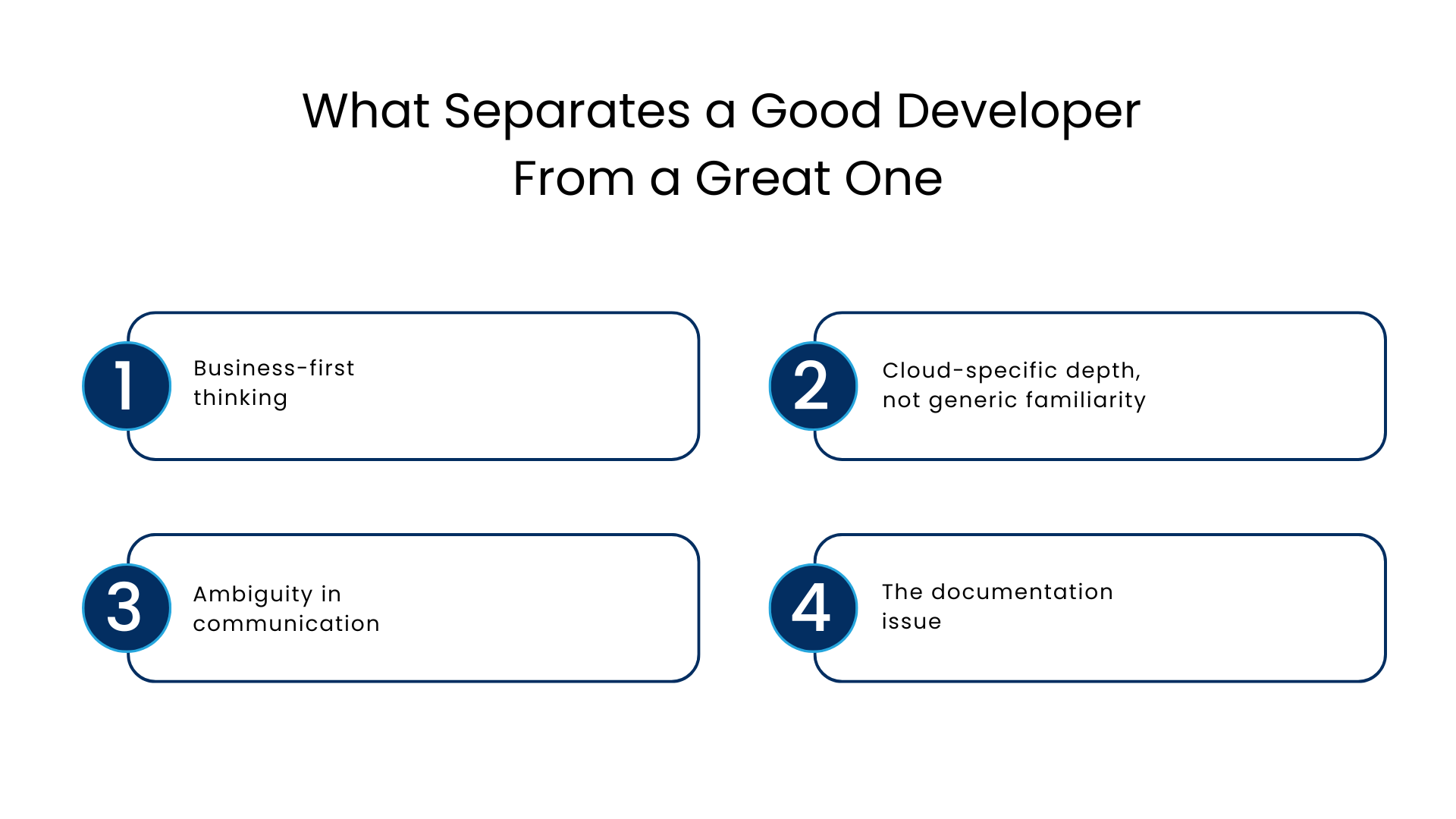
Technical skill is the entry price. It is not the differentiator. When you evaluate candidates, look past the resume for these signals:
Business-first thinking: A great developer asks why a feature is needed before writing a line of code. A good developer just builds what’s asked.
Cloud-specific depth, not generic familiarity: Sales Cloud, Service Cloud, Experience Cloud, Marketing Cloud, and Data Cloud each have different data models and design patterns. Someone who has only worked in Sales Cloud will need ramp-up time on a Service Cloud-heavy project.
Ambiguity in communication: Projects using Salesforce rarely come with precise requirements. The most experienced programmers pose queries for clarification right at the start rather than building something wrong.
The documentation issue: Any piece of undocumented code written by a developer automatically turns into technical debt the second that developer is off the project. Find out how candidates document their code.
A Practical Evaluation Checklist
- Has the candidate worked on a Salesforce Cloud that matches your primary use case?
- Can they describe a project where their initial technical approach changed after understanding the business need?
- Do they ask about your existing data model before proposing a solution?
- Can they explain a past project’s ROI in business terms, not just technical terms?
- Is their certification current, and does it match the complexity of your project (Platform Developer I vs. II, Application Architect, etc.)?
Why India Has Become a Deep Talent Pool for This Work
The demand behind this hiring decision is not small. IDC projects that Salesforce and its partner ecosystem, accelerated by AI adoption, will generate a net gain of over 11.6 million jobs and more than $2 trillion in new business revenue globally between 2022 and 2028 (Salesforce/IDC, 2024).
Much of this capacity rests with the certified experts working from India, with Salesforce Partner organizations leveraging their expertise along with time zone advantages and cheaper delivery as compared to many onshore organizations.
That’s why looking for the top Salesforce developers in India has also become common practice along with the development of Salesforce itself. This is not just a story of cost savings. It is a story of maturity. Indian Salesforce consulting firms have been building up certified benches over the last decade in every cloud.
Measuring ROI, Not Just Delivery
A developer who ships on time isn’t automatically delivering ROI. Before a project starts, define what “success” looks like in business terms:
- Baseline the current state. How long does your current sales cycle take? What’s your case resolution time? Get numbers before development starts.
- Set a measurable target. Not “improve efficiency,” but “reduce average case resolution time by 20%.”
- Track adoption, not just deployment. A perfectly built feature that sales reps ignore delivers zero ROI.
- Review three months post-launch. Initial excitement fades. Real ROI shows up (or doesn’t) once the new system is part of daily routine.
Callout: If your engagement model doesn’t include a post-launch review, add one. Most missed ROI isn’t a development failure. It’s a measurement failure.
Common Mistakes Businesses Make When Hiring
- Hiring for the cheapest hourly rate: Cheap developers who require extensive rework aren’t actually cheap.
- Skipping a technical interview because certifications look strong: Certifications confirm baseline knowledge, not judgment.
- Treating remote Salesforce developers for hire as interchangeable: Time zone overlap, communication style, and domain experience all affect delivery quality.
- No clear handover plan: If a contract developer leaves without documentation, you inherit a black box.
- Ignoring long-term capability building: Hiring solely to fill a short-term gap, without building internal Salesforce literacy, means you’ll face the same hiring cycle again next year.
Building Capability, Not Just Filling a Seat
Those companies that extract maximum benefits from the Salesforce platform do not view the recruitment of developers as a simple transactional process. They establish relations with a consultant who has a good understanding of their org through different projects, and therefore, each time they use the Salesforce consulting services, they have some information already available to them.
This is where the cooperation with a Salesforce consulting partner, and not an individual developer, pays off. A consulting partner can be used either for staff augmentation when needed for one project sprint or for managed services in case you need them on a regular basis.
Questions to Ask Before You Sign
Before finalizing any engagement, whether you’re bringing on one of the certified salesforce developers in India or a full augmented team, ask:
- What happens if the assigned developer is unavailable mid-project?
- How is knowledge transferred if we later bring development in-house?
- What’s the escalation path if delivery quality slips?
- Can the engagement model scale up or down as our roadmap changes?
If a provider can’t answer these clearly, treat that as a signal, not an inconvenience.
Concluding Remarks
Hiring the right Salesforce talent is less about finding someone who knows the platform and more about finding someone who understands your business well enough to make the platform work for it. Whether you need Expert Salesforce Developers For Hire on a single project or an ongoing team, take the time to match the engagement model, cloud expertise, and communication style to your actual roadmap, not just your immediate task list.
If you’re evaluating your Salesforce needs right now, it’s worth having a conversation with an experienced consulting partner who can help you map the right approach before you commit to a hire.
FAQs
What determines if I need full-time hire or staff augmentation?
Full-time hire or staff augmentation works well if your Salesforce needs are consistent and critical to your roadmap. For a project-based need with an end date, project or contract engagements make sense and are more cost-effective.
Are certifications the only thing that will tell me how qualified a Salesforce developer is?
No, certifications ensure a base level of knowledge about the tools, but experience working in projects with your Cloud (Sales, Service, Experience, or Data Cloud) matters most when it comes to delivering high-quality project execution.
Why are companies choosing to engage and hire Salesforce developer in India, rather than in the local market?
The cost-efficiency aspect is one reason, but the main point is access to certified cloud-focused resources that can engage on different levels and with different engagement models developed during years of Salesforce experience.
How long does it take to hire a Salesforce developer through a consulting partner?
It depends on the specifics of the project, but an experienced consulting partner with a pre-vetted, certified talent pool will be able to hire a developer much faster than with a regular hiring process.
What is the most common mistake companies commit while looking for Salesforce developers to hire?
Try to choose the candidate with the cheapest hourly rate. Hiring unqualified or a mismatched specialist can become very expensive and can delay the projects by significant timelines.
For more insights, updates, and expert tips, follow us on LinkedIn.