

The Hidden Cost of Skipping Aadhaar OTP Verification in Your Salesforce Pipeline
Customer identity verification is a prevalent and mandatory practice in India to onboard customers securely. However, most businesses still complain about the leads not converting or not responding. While everything is completed within Salesforce, the real reason for this leakage lies in the disintegrated Salesforce Aadhaar OTP verification systems.
This hidden cost of disintegrated systems creates unnecessary friction that causes delays, increases operational costs, and exposes the businesses to unnecessary risks. Skipping the Aadhaar verification may seem to save time at first, but is not at all feasible in the long run.
This disintegration makes it tough for the agents and sales reps to keep track of any leads and it becomes difficult to find out which leads were genuine, and which ones are just sitting in the database occupying a potential space.
Why is Aadhaar OTP Verification a Compulsory Norm for Indian Businesses?
Aadhaar is one of the most commonly used identity verification proofs, especially in India, and serves as the most authentic proof. With important details like name, aadhaar number, and date of birth, it becomes easier for businesses to fetch details and validate the customers.
Additionally, with the rapid growth of digital onboarding, Salesforce Aadhaar OTP verification has become a critical compliance and the easiest way to verify customer identities in minutes.
Since this Salesforce Biometric Aadhaar Verification via online system is more feasible, more and more industries including banking, finance, insurance, telecom, and e-commerce are increasingly relying on this method.
Why Are Businesses Skeptical About the UIDAI Aadhaar API in Salesforce?
While many businesses agree that the online UIDAI aadhaar verification is no longer optional, they are still skeptical about its Salesforce implementation. A few key reasons for this include:
- Concerns about the implementation cost
- Desire for faster onboarding
- Lack of technical expertise
- Fear of customer drop-offs
- High dependence on manual verification methods
- Limited awareness about compliance risk
The Hidden Costs of Skipping Salesforce Aadhaar OTP Verification
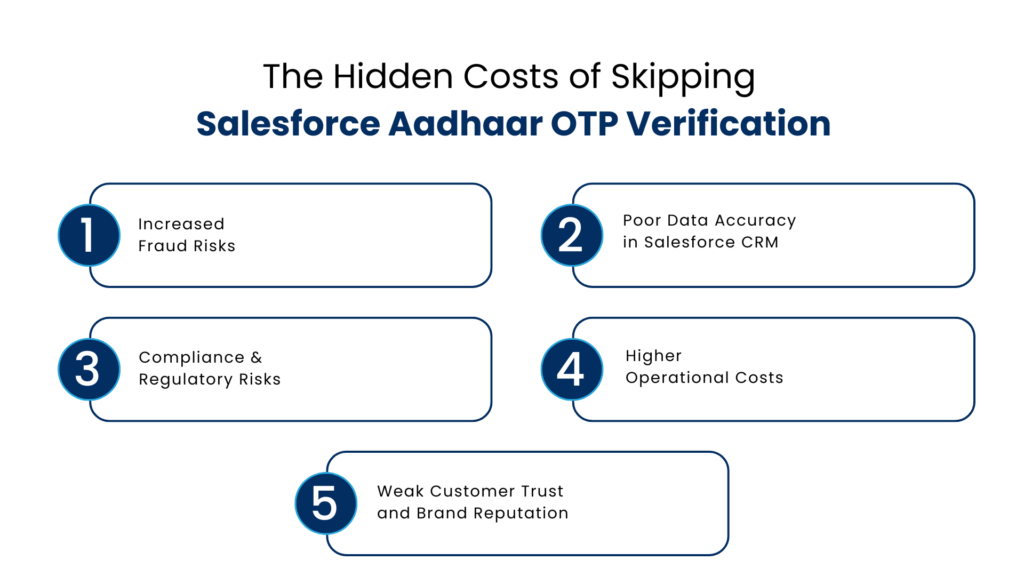
Increased Fraud Risks
The biggest threat to skip the Salesforce automated aadhaar verification comes in the form of identity verification. Businesses can inadvertently bring on board fraudulent customers, duplicate users, or users utilizing stolen identities without proper authentication and verification.
Fraudulent activities can include anything from creating fake accounts, loan frauds, insurance fraud, unauthorized transactions, money laundering, or synthetic ID fraud. Now since Salesforce acts as a centralised repository and unverified IDs can compromise the safety of the entire system.
Poor Data Accuracy in Salesforce CRM
Salesforce pipelines are only as reliable as the data stored within them. When the Aadhaar OTP verification within Salesforce is skipped, the likelihood of incorrect customer details, duplicate accounts, fake mobile numbers, invalid IDs, and incomplete records increases.
Poor quality data often creates a ripple effect across the organisation and the sales teams struggle to get leads because more often than not they are dealing with fake leads, marketing teams may target incorrect users, and customer support teams may be struggling with legitimacy.
That being said, this inaccuracy in data leads to poor forecasting and even a well-defined CRM like Salesforce becomes inefficient.
Compliance & Regulatory Risks
Many industries in India are subject to strict KYC and identity verification regulations. Organisations dealing in banking, NBFC, or fintech sectors must ensure proper customer verification during onboarding.
Skipping the aadhaar OTP verification can result in serious business consequences like regulatory penalties, compliance violations, audit compilations, and even legal disputes with reputation damage.
Higher Operational Costs
Many businesses work under the assumption that avoiding Aadhaar OTP integration with Salesforce reduces costs, but in reality the truth is opposite. Without automation, organisations rely on manual ways leading to work overload, and creates additional costs like document reviews, customer follow-ups, error correction, fraud investigations, and duplicate record cleanups.
Manual verification slows down onboarding time and reduces the overall operational efficiency. This way businesses will end up spending more on fixing the issues than the implementation itself.
Weak Customer Trust and Brand Reputation
Trust is usually the most essential factor when it comes to running a successful business. Now when organisations fail to implement secure verification systems, customers start to question the platform’s integrity.
Data breaches, identity fraud incidents, or unauthorized activities can significantly damage the brand reputation. In high repute industries even a single controversy can take the business down.
Aadhaar OTP Verification and its Benefits for Salesforce Processes
Aadhaar OTP verification when properly incorporated into Salesforce CRM process flow provides the following benefits.
- Automation of Customer Identification Verification: This happens automatically when onboarding customers.
- Accuracy of CRM Data Base: By verifying identity, one can be sure about the accuracy of data on CRM databases.
- Fast KYC Verification: It provides an easy method of verification for KYC verification using the digital medium.
- Customer Onboarding: Customers have fast and quick customer onboarding processes with less documentation needed.
- Measures to Prevent Fraud: Using OTP from Aadhar helps prevent frauds by stopping any fake identity.
- Operational Efficiency: Automation reduces the need for manual interventions, making the process easier.
Industries Benefiting from Integration of Aadhaar OTP
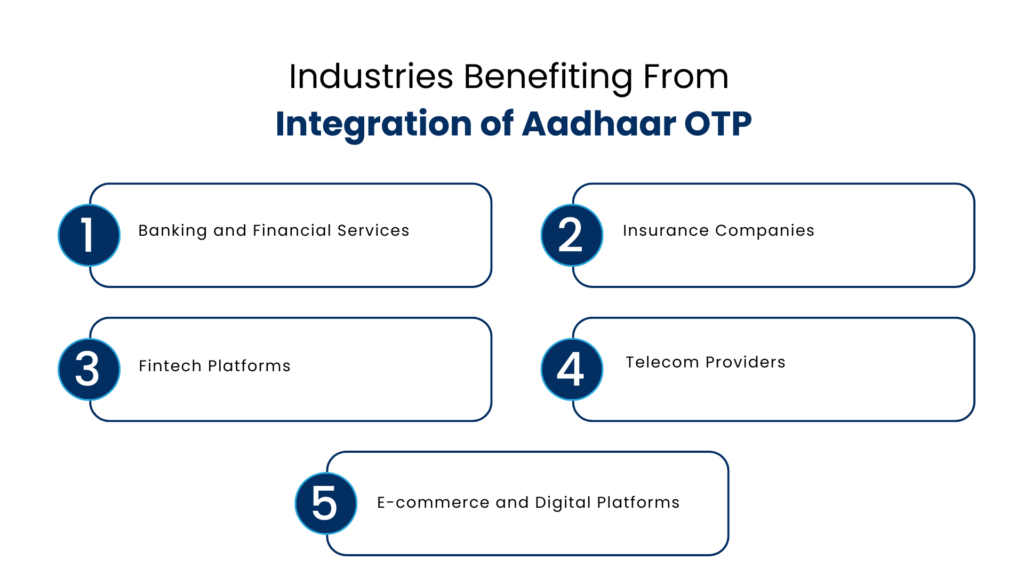
Several industries will find the process of Aadhaar OTP verification via Salesforce to be useful to increase efficiency and maintain compliance.
Banking and Financial Services
Banks and NBFCs use OTP verification for:
- Opening online bank accounts
- Loan processing
- Customer onboarding
- KYC compliance
Insurance Companies
Insurance companies need this method for:
- Validating policyholders
- Fraud prevention
- Fast customer onboarding
Fintech Platforms
The fintech platform should have efficient ways to onboard their customers online. The Aadhaar OTP makes this process more secure and quick.
Telecom Providers
Some of the use cases of Aadhaar OTP by telecom providers include:
- SIM Card Activation
- ID Verification
- Onboarding
E-commerce and Digital Platforms
These sectors need better security and fraud protection for high-value transactions.
How to Incorporate Aadhaar OTP Authentication with Salesforce?
There are some best practices that organizations must implement for getting the best out of this solution.
- Using Reputable APIs: It is important to select APIs that can integrate Aadhaar authentication with ease.
- Workflow Automation: With integration of this solution, the entire verification process can be automated in the CRM system.
- Privacy Considerations: The information provided through Aadhaar needs to be safeguarded at all times.
- Training of Employees: The employees must be made aware about workflow and exceptions handling.
Conclusion
Opting to skip the Salesforce Aadhaar OTP Verification for your business in your workflow can appear easier to adopt but the disadvantages of this approach cannot be neglected.
From cases involving fraud, compliance issues, CRM data inaccuracy, and inefficient processes, the results of going through the onboarding process without verification would have major effects on all aspects of your business operation.
With the increasing rate of customer acquisition, it is important that you have efficient and safe ways of verifying identity, which would enable you to increase your business efficiencies and build customer trust.
Verifying Aadhaar OTP in Salesforce does not only make the workflow more efficient, but adopting this system also helps ensure quality, safety, compliance, and sustainability in your business operations.
Automation of the identity verification process would allow companies to create credible and trusted business relationships in the digital market space.
FAQs
What is Salesforce Aadhaar OTP verification?
Salesforce Aadhaar OTP verification integration refers to managing and conducting the KYC process inside the CRM. This allows the users for faster verification and ensures that the data presented and added in the CRM is authentic and fraud free.
Why is Aadhaar OTP verification necessary for Indian companies?
Through Aadhaar OTP verification, Indian companies would be able to confirm the identity of their customers in an efficient and secure manner. It helps with digital onboarding, compliance, reduces fraud risks, and assists with keeping the correct records of customers.
Does Aadhaar OTP verification help improve CRM data accuracy?
Yes. Salesforce being the most useful and most widely used platforms works with strict regulations and automations. It automatically removes any duplicate data, detects fraud instantly, and can enhance the data productivity. This means that the data accuracy in CRM is legitimate and safe.
Is Aadhaar OTP verification beneficial for small enterprises?
Yes. It also assists in improving onboarding of customers, keeping correct information about them, and ensuring that no fraud happens in the CRM of Salesforce.
For more insights, updates, and expert tips, follow us on LinkedIn.