


What Role Does Salesforce Implementation Play in the Real Estate Businesses?
The real estate industry is evolving and as time passes by, the customer expectations also change and evolve. Customers expect faster service, quick responses, and personalised messaging. With these business changes happening so fast, it becomes essential for the real estate agencies to keep up with multiple leads at once, and this is where the Salesforce Implementation in Real Estate comes into play.
Salesforce is a powerful CRM tool that enables the real estate agencies to automate the lead management system, never miss a follow-up, get real-time data insights to create better marketing strategies, manage payments and invoices, and seamlessly integrate the solution within the salesforce CRM.
However, as easy as this looks, there are certain things that must be taken into account. Salesforce CRM for real estate is a complex CRM and requires proper implementation and support. Only a well defined and well executed CRM can deliver a performance that scales your business and optimizes the team efficiency. To achieve this level of perfection, it is essential to partner with the right salesforce implementation partner in real estate.
Understanding Salesforce in Context of Real Estate
Put in simple terms, the salesforce CRM is a cloud-based real estate management software that is designed to meet the specific needs of the business. This system is aimed at simplifying and organising your leads, prioritise urgencies, property tracking, broker coordination, and post sales engagement.
In terms of real estate, a salesforce implementation service will install the end-to-end system and provide initial training. The salesforce CRM can be easily aligned with your real estate business needs be it residential sales, commercial leasing, property development, or brokerage services. The salesforce real estate CRM implementation providers will tailor the system as per your requirements, and will match the automation to your unique business needs.
What is the Role of Salesforce Implementation in Real Estate?
As observed previously, the purpose of a salesforce real estate CRM is to streamline workflows, automate follow-ups, get real time insights for tailored marketing campaigns, and improve communication workflows within the team and outside of the team.
Streamlining Sales Processes and Workflows
Salesforce enables real estate businesses to design and manage structured sales pipelines that reflect their actual sales journey. From initial inquiry to site visit, negotiation, booking, and closure, every stage of the deal can be clearly defined.
Sales teams benefit from real-time visibility into deal progress, while managers gain insights into pipeline health and potential revenue. Automated stage updates, alerts, and task assignments ensure that deals move forward efficiently and do not stall due to missed follow-ups.
This structured approach improves accountability and helps teams focus their efforts on high-priority opportunities.
Data Driven by Real Time Analytics
Salesforce provides powerful analytics and reporting capabilities that help real estate businesses make informed decisions. With customizable dashboards and reports, management can track key metrics such as lead sources, conversion rates, agent performance, sales velocity, and revenue forecasts.
These insights allow leaders to identify trends, spot bottlenecks, and optimize strategies. For example, businesses can determine which marketing channels generate the highest-quality leads or which sales stages require improvement. Data-driven decision-making reduces guesswork and supports sustainable growth.
Better Customer Experience and Relationship Management
In real estate, trust and relationships play a major role in long-term success. Salesforce helps businesses deliver a more personalized and consistent customer experience by maintaining detailed client profiles and interaction histories.
Sales teams can tailor their communication based on client preferences, past conversations, and property interests. Post-sales engagement, such as documentation tracking, service requests, and follow-ups, can also be managed within Salesforce. This continuity strengthens relationships and increases the likelihood of repeat business and referrals.
What are Businesses Aiming to Achieve with the Salesforce Real Estate CRM?
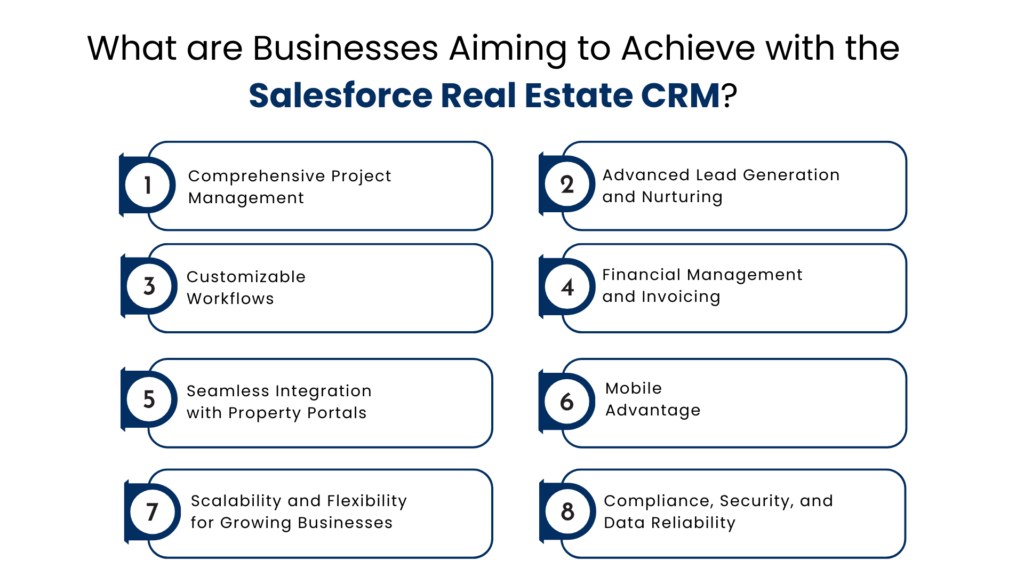
Most real estate businesses struggle with scattered lead data, missed follow-ups, and inconsistent communication. The business aims to remove these data silos with the salesforce implementation of a real estate CRM and experience an effortless workflow with enhanced customer experiences.
Comprehensive Project Management
A robust system allows real estate teams to track project progress at every stage. Clear visibility into timelines, milestones, and responsibilities helps ensure projects stay on schedule. This structured approach supports better planning and more informed decision-making.
Advanced Lead Generation and Nurturing
Efficient lead capture ensures no inquiry is missed, regardless of the source. Personalized communication and timely follow-ups help build stronger connections with prospects. This focused nurturing process increases the chances of converting leads into successful deals.
Customizable Workflows
Customizable workflows allow businesses to adapt the system to their unique processes. Teams can define stages, assign responsibilities, and automate routine actions. This flexibility improves efficiency while maintaining consistency across operations.
Financial Management and Invoicing
Integrated financial tools simplify contract handling, billing, and payment tracking. Clear records improve financial visibility and reduce errors. Better control over finances supports smoother operations and improved accountability.
Seamless Integration with Property Portals
Integration with property portals ensures listings are shared quickly and accurately. Centralized updates reduce manual effort and keep property information consistent. This improves visibility while saving valuable time for agents and teams.
Mobile Advantage
Mobile access allows professionals to manage leads, updates, and tasks from anywhere. Real-time information supports faster responses and better coordination. This flexibility ensures timely action even while working on the move.
Scalability and Flexibility for Growing Businesses
As real estate businesses grow, their operational complexity increases. Salesforce is designed to scale with the business, supporting higher lead volumes, expanding teams, and new service lines without requiring a complete system overhaul.
Its flexible architecture allows businesses to add new features, customize workflows, and adapt to changing market needs. This scalability ensures that Salesforce remains a long-term solution rather than a short-term fix.
Compliance, Security, and Data Reliability
Handling sensitive customer and transaction data requires robust security measures. Salesforce offers enterprise-grade security, data access controls, and compliance features that help real estate businesses protect their information.
Centralized data storage with controlled access reduces the risk of data loss or misuse. Reliable data management builds confidence among clients and supports regulatory compliance requirements.
Conclusion
In the face of it, the salesforce real estate CRM is no longer optional but a necessity for the businesses. Salesforce implementation plays a transformative role in real estate businesses by centralizing operations, improving lead management, automating workflows, and enabling data-driven decisions.
It empowers teams to work more efficiently, respond faster to prospects, and build stronger client relationships. For real estate companies navigating increasing competition and digital expectations, Salesforce serves as a powerful foundation for operational excellence and scalable growth.
FAQs
How is Salesforce used in real estate?
Salesforce serves as a centralized data repository to consolidate information on customers, leads, properties, and business processes, helping agents effectively manage leads and customers, make accurate real estate valuations, and collaborate with colleagues and partners.
Can Salesforce be used for property management?
That’s where Salesforce steps in. As a cloud-based CRM platform, it transforms property management by providing a centralized hub for data, automating repetitive tasks, and enabling real-time communication.
Do real estate agents use a CRM?
A real estate CRM can significantly benefit your agency by centralizing client data, automating follow-ups, tracking property interests, and streamlining communication. This leads to improved client relationships, higher conversion rates, and better overall productivity.
Is Salesforce scalable for growing real estate businesses?
Salesforce is highly scalable and can support growing lead volumes, expanding teams, and new business lines. Its modular structure allows businesses to add features and integrations as their needs evolve.
How secure is Salesforce for managing real estate data?
Salesforce provides enterprise-grade security, including data encryption, role-based access controls, and compliance features. This ensures sensitive customer and transaction data is protected and managed reliably.
For more insights, updates, and expert tips, follow us on LinkedIn.